Sailors are used to it by now and are not surprised that much: from Olympic to Olympic, the boat under their feet and with which they race to contend for a medal is not always the same. To decide the fate of this or that boat is theISAF (International Sailing Federation), a sort of world federvela which imposes, after careful analyzes in concert with the national bodies, the rules and constraints for the construction and outfitting of sailing vessels destined to compete during the Olympics.
In the past, class changes have involved the drifts, the keel boats, multihulls and also the same windsurf, but each time, it was, at most, small tricks that modified the models, but without ever radically changing the discipline. Thus glorious classes such as the Flying Dutchman, the Europa, the Soling, the Dragon or the Tornado were archived and no longer admitted to the Olympics. Then there are classes that have participated in the Games for a very few years, such as the Tempest, the 5,5 meter or the unpronounceable Yngling. In its short history at the Olympics, which began in 1984 in Los Angeles, windsurfing has already changed five classes (windglider, II division IYRU, Lechner A-390, Mistral and the current RS:X).
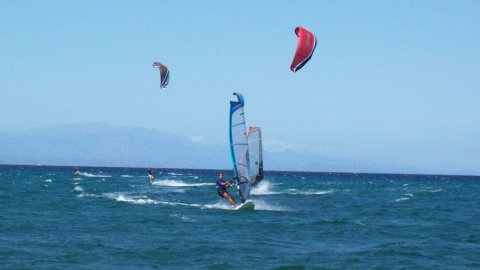
On May 5th of this year the ISAF, gathered in Stresa for the Mid year meeting, took a historic decision in the windsurfing class. A truly radical change that no one expected: kitesurfing instead of windsurfing starting from Rio de Janeiro 2016. To understand what it means to pass from a discipline like windsurfing to what, until a few years ago, was a sport for a few crazy people to practice away from crowded beaches, just compare the equipment: a kite instead of a sail , fins instead of the centreboard, a bar instead of the boom, no mast, but an inflatable structure that must never fall into the water.
Until now, the Olympic class had never reflected true windsurfing, the one of the moment, the one practiced by everyone and indeed, the public had always complained of not being able to see living myths in the water like Robby Naish o Bjorn Dunkerback amaze everyone with their evolutions on the waves and in the air. Light winds and regatta fields too often inadequate to the characteristics of windsurfing had given birth to an Olympic discipline that never found points of contact with what could be found on the beaches of the whole planet on weekends.
Perhaps precisely to recover this gap between the real world and the five-circle world, ISAF overdid it and followed the fashion. Yes, because there is no other sport in the world with a rate of new practitioners that it grows so fast. Every summer, more and more young people enroll in a kite course, while windsurfing is slowly losing its charm.
Alessandra Sensini, Olympic gold medalist in Sydney and silver in windsurfing in Beijing, will take part in his sixth Olympics in London. His opinion on the ISAF decision is clear: "It is a decision that saddens me deeply and leaves me perplexed - reports Federvela - also because Windsurfing and Kitesurfing are completely different disciplines and I don't find it right for one to replace the 'other. Since its debut in 1984, the sector has had the opportunity to develop and strong investments have been made both financially and from the point of view of human resources. The correct route would have been to go from International Olympic Committee (CIO) to propose the establishment of an additional medal. It's like having to decide between skiing and snowboarding. It does not make sense".
To tell the truth, it's not only the Italian champion who turned up her nose at this decision, so much so that a petition has started on Change.org asking ISAF to rethink. On Facebook, however, there is the group "ISAF selects kiteboarding and not windsurfing for Rio 2016", created precisely to open a constructive debate on the issue. Yet not everyone is sorry for the change. Furthermore, the numbers are all on the side of kitesurfing: 180 kites sold a year, even if almost all of them are intended for recreational activities, 50 manufacturing companies, about 12 practitioners and an excellent international level of our athletes.
Perhaps not the veterans of windsurfing, but young people will certainly be able to try to reconvert as "kite handlers" and he is ready to bet on this hypothesis Luca DePedrini (Technical Director of the Italian Olympic team), which sees one of the athletes who came close to qualifying for London, Laura Linares, ready to do very well even with the kite. Then there is to consider the versatility of other athletes protagonists of windsurfing who maybe have kitesurfing as a hobby, like Frederick Esposito (qualified for London), or those who have recently approached the discipline finding themselves at ease after all, such as Flavia Tartaglini (current holder of the women's RS:X world title).
The writer practices both windsurfing and kitesurfing, but perhaps it is more the regret of losing the former than the joy of finding the latter at the Olympics.