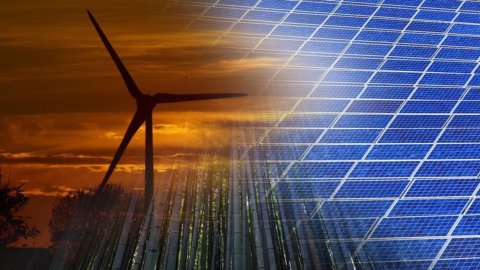
La growth of renewables brings with it a new need: make the energy produced when needed truly available even when the sun isn't shining or the wind slows down. With photovoltaic and wind power on the rise, the ability to accumulate and moving energy over time therefore becomes an increasingly important component of the electrical system.
This is the theme at the centre of the Agici study "Renewables, Flexibility, and Innovation: New Business Models for Manufacturers and Industries," presented on September 23 in Vicenza at the first SSEC – Storage & Solar Expo Conference. The report analyzes storage technologies, regulations, and business models, comparing the risks and returns of different configurations.
More renewables, more need for storage
The starting point is the strong growth of the renewable capacitya. Between 2022 and 2025, photovoltaic power increased by approximately 75% and, to achieve the 2030 NECP targets, it would need to continue growing at an average rate of 12,7% per year. Wind power, on the other hand, would require an average annual increase of 15,7%. In a linear growth scenario, in 2030 Italy could reach around 131 GW of renewable capacity, with 79 GW of photovoltaic, 28 GW of wind, 19 GW of hydroelectric and approximately 5 GW from other sources.
However, more renewables also mean more energy to manage during peak production hours. This is where the flexibility: i accumulate They can absorb excess electricity and release it when needed, helping reduce waste and the use of thermoelectric plants. According to the Agici scenario, approximately 122 GWh of storage capacity will be needed in 2030: 50 GWh will be provided by existing pumped hydroelectric power, while approximately 72 GWh will come from new electrochemical capacity. The South, Sicily, and Sardinia will collectively absorb approximately two-thirds of the demand.
Batteries, performance changes with the configuration
The study highlights that greater risk does not automatically translate into higher returns. Stand-alone plants supported by mechanisms that guarantee more stable revenues, such as the Macse, have a lower risk profile but also limited returns; the configurations full merchant, completely exposed to market prices, instead take on greater risks without obtaining proportionally higher returns.
The picture changes when the battery is integrated with an industrial or commercial site, because it can perform multiple functions and access different sources of revenue. According to the Agici model, participation in the interruptibility service brings the return on investment at around 6%, while also considering the withdrawal modulation service the ROI exceeds 9%. Supporting this result is the revenue stacking, that is, the possibility of combining multiple services on the same battery. However, there remains an element of uncertainty: some services are assigned through auctions annual, making revenues less predictable in the medium to long term.
Also 'The combination of photovoltaic and storage improves profitability Compared to photovoltaic alone, though less so than a battery integrated with consumption: in the Agici model, sharing land, connection, and infrastructure reduces the battery's investment cost by 15% compared to a stand-alone system. Storage also allows energy to be shifted to higher-priced hours, with benefits that increase with battery power and arbitrage opportunities.
Storage, a growing market in search of new rules
The market confirms the growing centrality of the storage: 90% of the operators analyzed by Agici include electrochemical storage in their portfolio and 50% have BESS capacity, for approximately 13 GW in 2025. Nearly 20% are located in Italy, while the rest are concentrated mainly in North America and Australia. Pumped hydroelectric capacity exceeds 19 GW in various European markets. The first auction for new storage capacity also signals theacceleration of the Italian marketApproximately 1,5 GW and 10 GWh have been assigned to 14 plants and seven successful bidders, for an estimated investment of one billion euros. Over half of the capacity is in Puglia, followed by Basilicata and the islands.
To transform the need for flexibility into investments, however, we also need new rules. Agici indicates the completion of the regulation of local markets for network services, a greater coordination between distribution and transmission, and easier market access for aggregators, industrial consumers, and energy communities. Shorter service periods are also needed, tailored to resources available only at certain times or times of the year, and a review of the mechanisms for systems essential to system security.
Completing the picture are strengthening local price signals and investments in network digitization, from smart meters to real-time market platforms and tools for forecasting production and demand. In this scenario, according to Agici, integration car's battery performance, consumption e production renewable It can become central to developing new business models and supporting storage growth.
Comments
"Today, operators and customers operate within a highly complex landscape of technologies, markets, and remuneration mechanisms. The study shows that the risk-return relationship is not a given, and that the integration of storage, consumption, and renewable generation can open up the most interesting prospects," commented Marco Carta, CEO of Agici -. To transform this potential into investments, however, a more comprehensive and stable regulatory framework is needed, one that encourages the participation of new players and makes revenue flows more predictable. This must be accompanied by greater digitalization of networks and price signals capable of directing resources where they can make the greatest contribution to the system."