This afternoon in Europe, the long-awaited meeting between Presidents Donald Trump and Xi Jinping will take place at the White House. Numerous issues are on the table, from Taiwan to Iran, from rare earths to artificial intelligence. Hopes for a new Chinese commitment to purchase Boeing aircraft have faded, but at least, according to Treasury Secretary Scott Bessent, Washington and Beijing could reach an agreement to extend the trade truce, which expires on November 10, until January, allowing more time to reach a more comprehensive agreement. Meanwhile, at the UN, the diplomatic impasse between Washington and Tehran persists, with US and Iranian officials remaining distant from a peace agreement and the opening of the Strait of Hormuz.
Treasury yields hit new multi-decade highs after positive economic data. Here's what happened.
But the movement that has been shaking the markets the most since yesterday has been that of massive sale of government bonds, bringing back the returns at multi-decade highs. It all started from economic data which in truth were positive for the economy and therefore usually of support for stock markets, but it didn't go that way. Here's why.
The index pmi preliminary production composite US, which tracks the manufacturing and service sectors, rose to 58,4 this month, the highest level since July 2021Orders have increased, the backlog Production saw the fastest increase since May 2022, and businesses accelerated assumptions to increase production capacity. Also theEurozone surprised the consensus, with an index at 53,1 points, exceeding expectations (51,7) and marking the highest level since April 2023. Furthermore, the Ifo business climate index reached 89,9 points, the highest level since May 2023. If anything, the input costs (those that normally increase the cost of production) increased at the fastest pace in nearly four years, but ultimately the economy is proving who succeeds in absorb shocks without slowing down.
Too bad that all this represents the perfect cocktail for the central banks, who therefore feel freer than raise rates again to calm theinflation without fear of damaging a resilient economy.
Government bond yields are rising around the world. Oil prices are above $105.
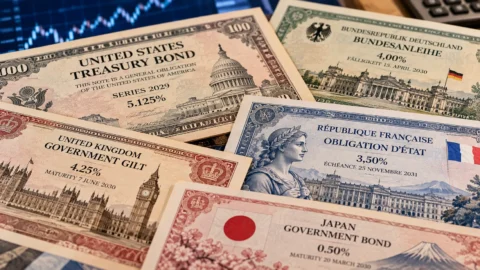
But rising rates and rising inflation are in turn poisonous meatballs for bond markets around the world, flooded by the strongest selling since the earthquake caused by the so-called "Liberation Day" over Trump's tariffs last year. The signal benchmark is represented by the US 10-year bond, rose well above that key 5% threshold, hitting a new post-financial crisis high of 5,145%, with some analysts not ruling out a move as high as 6%. The yield on U.S. Treasuries 30 years rose more than 3 basis points to 5,444%, its highest level since 2004. The situation was further compounded yesterday by a weak result at a US auction of five-year bonds, which sold at the highest yield since 2007.
Bond yields have started to rise again in Europe. The difference between the financing costs of France and Germany has reached its all-time high since Mario Draghi's 2012 “Whatever it Takes” speech, with the'French Oat at 4,69%, the highest since 2007. The German bund 10-year rises 2 basis points to 3,57%, the highest since 2007. Italian BTP is at 4,54%. The BTP-Bund spread rises to 96 points, the highest since June 2025. The yield on ten-year bonds from Japan suddenly jumped to a 30-year high in Asia.
Meanwhile the prices of the Petroleum have once again exceeded 105 dollars a barrel with a new leap of over 2%. Also worrying are the prices of gas in Europe which have more than doubled this year, as the war in the Middle East has effectively cut off about a fifth of the world's liquefied natural gas flows. Asian buyers are increasingly grabbing flexible spot cargo, setting the stage for even fiercer competition between regions this winter, notes BloombergToday, the gas price in Amsterdam is 75 euros per megawatt hour, up 4,15%.
European stock markets fall, while energy stocks hold firm
European stock markets extend their losses with the Euro Stoxx 50 Index at -0,5% and the Stoxx 600 at -0,4%, while energy stocks hold up thanks to the rise in oil prices, with Vallourec to +4,5%, Equinor +3% and Repsol +2,5%. The sectors of also rise consumption, typically more defensive: Food & Beverage +1% and large-scale distribution +0,9%.
Down the technological sectorSoitec is down 4,5%, Logitech is down 4%, Infineon is down 3,7%; while the sector continues to decline. automotive, the worst of the year so far (-18%). The most penalised are German producers, down by more than 2%. Widespread sales also in the sectors of banks and financial services (-1%). BNP Paribas -4,5%, Société Générale -3%.
A Business Square The Ftse Mib falls by 0,6%. The CAC 40 Paris and DAX of Frankfurt they lose 0,7%.
A MilanStm lost 3%, reflecting the decline in the technology sector, while Fincantieri and Leonardo lost 2,7%. Meanwhile, gains involved Eni and Tenaris, up 1,1%, in the wake of oil, and DiaSorin, up 0,6%.