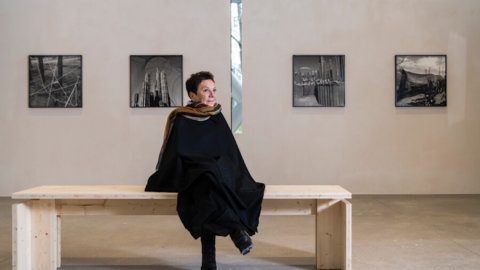
Grace Iturbide is an important figure in the Latin American photography. For over fifty years she has created images that oscillate between a documentary approach and a poetic gaze: “I looked for surprise in the ordinary, an ordinary that I could find anywhere in the world.If today she is famous for her portraits of Seri Indians in the Sonoran Desert and the women of Juchitán, as well as her photographic work on Mexican ancestral communities and traditions, Graciela Iturbide also brings almost spiritual attention to landscapes and objects. This unique exhibition presents two sides of Graciela Iturbide, thus providing us with an perspective on her work.
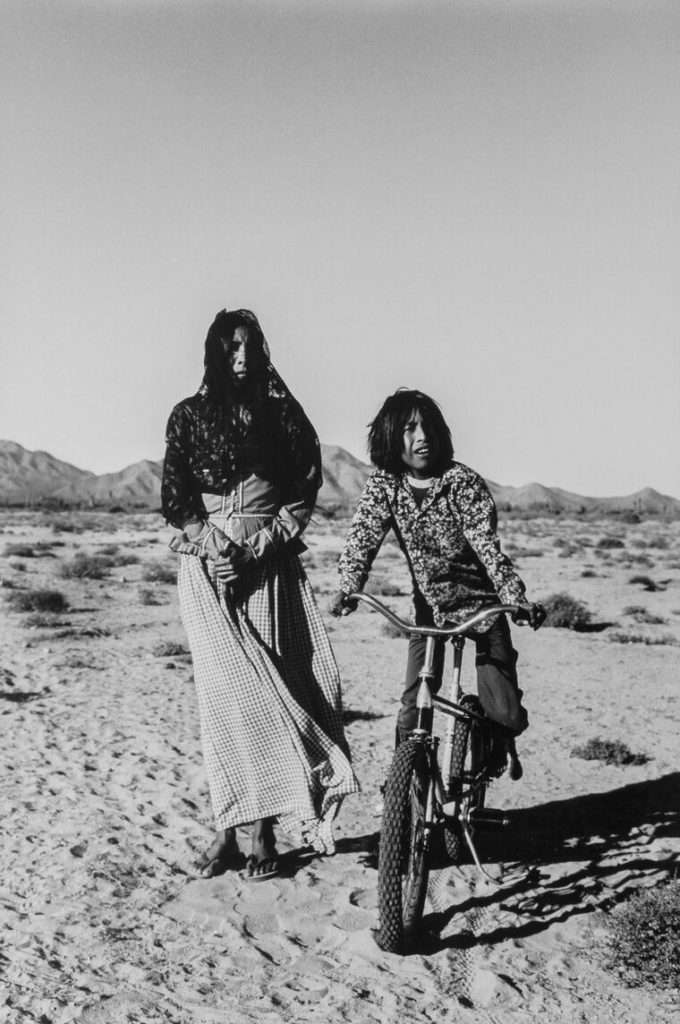
Graciela Iturbide was introduced to photography in the 70s alongside Manuel Alvarez Bravo (1902-2002). She followed the first in his travels in the villages and popular Mexican festivals, where she watched him as he searched for the right place, waiting for something to happen, practically invisible, that does not disturb anyone, and then photography everything that interested him. The exhibition features a large number of photographs of people he met and objects to which he has drawn his attention in the course of his various travels through the Mexico, ma anche in Germany, Spain, Ecuador, Japan, United States, India, Madagascar, Argentina, Peru and Panama, between the 70s and 90s. Among the emblematic series of this period are Los que viven en la arena [Those who live in the sand, 1978] with which Graciela Iturbide lived for a long time the Seri community in the Sonoran desert in the north-west of the country; Juchitán de las mujeres (1979-1989), devoted to women and Zapotec culture, in southeastern Mexico's Oaxaca Valley and the series White Fence Gang (1986- 1989) focused on cholos, gangs of Mexican origin in Los Angeles and Tijuana
Rather than the magical realism that has often been associated with her, Graciela Iturbide prefers the idea of a "touch of poetry and fantasy" that pushes thedocumentary interpretation further and find the opportunity to learn and be amazed through his various travels around the world: “Knowledge is twofold: when you travel, you discover things both outside and inside yourself, through your solitude".
In addition to the photographs that made the artist famous, the exhibition Heliotropo 37 reveals his recent production photography, hitherto little presented. Over the years, Graciela Iturbide's images have become devoid of human presence and her attention has turned to materials and textures, revealing the metaphysical bond that unites the artist to objects, nature and animals. In the late 90s, Graciela Iturbide traveled through Louisiana and studied the desolate landscapes of the southern United States. In 2000 and 2010 she continued her research of objects and symbols in India and Italy, photographic advertising signs, piles of shoes and knives in shop windows, mast relays swaying in the wind and abandoned houses overgrown with vegetation.
In 2021, on the initiative of the Fondation Cartier, Graciela Iturbide traveled to Tecali, a village near Puebla Mexico where alabaster and onyx are mined and cut. A rare event in her career, she abandoned black and white in favor of color photography to capture pink and white stones being polished. The alabaster blocks on which writings and engravings are occasionally visible stand out against the crystalline sky, like totems.
Cover image: Graciela Iturbide – Fondation Cartier. Paris © Julio Piatti