Italian tourism is changing. The destination is no longer just a city of art, a seaside resort, or a major cultural attraction: for a growing number of travelers, it is above all an experience, built around the identity of the place, the quality of the services, and the ability to easily and digitally access what the region has to offer. This is one of the indications that emerged in Venice on the occasion ofevent's audience Shaping the Future of Italian Tourism: Data, Innovation and Priceless Experiences, organized by Mastercard to the Scuola Grande della Misericordia to celebrate ten years of partnership with the Venice International Film Festival of the Venice Biennale. The meeting compared data, digital transformation, and new strategies for enhancing local areas. The emerging picture is of a sector in which experience, technology, and distribution of flows are increasingly becoming key factors in the country's economic competitiveness.
Spending by foreign tourists is growing
The data from the Mastercard Regional Tourism Observatory for the period May-August 2026 indicate an international component equal to 61% of total tourist spending in Italy, up by 9% compared to the same period of 2025Germany remains the main source market, followed by Switzerland, Great Britain, and the United States. But what's changing is the geography of opportunities: Austria and Spain are experiencing double-digit growth, while Australia, Turkey, and the Czech Republic are showing particularly significant increases. This data confirms Italy's ability to maintain strong international appeal, but it also raises an industrial question: how to transform tourism demand into greater value for local communities, preventing growth from being concentrated exclusively in established destinations. This is where villages come into play.
Villages as a new economic infrastructure for tourism
In the summer of 2026 the villages represented the8% of total national tourism spending, with an international component growing by 8% compared to 2025. The average figure, however, hides very significant territorial differences. In Umbria, the villages represent the 27% of regional tourism spending, followed by Abruzzo with 23%, Liguria with 17%, and Marche with 15%. These figures suggest that small towns are no longer just a niche in the tourism offering, but can become a true driver of regional development. Their strength lies precisely in what a growing segment of the market seeks today: authenticity, local dimension, cultural heritage, traditions, craftsmanship, and experiences away from the crowded tourist circuits. Promoting villages can also help distribute tourist flows, with effects that extend beyond tourism itself: increased demand for local businesses, support for local economies, and new opportunities for communities that otherwise risk losing their population and services. Fiorello Primi, president of the Most Beautiful Villages in Italy, emphasized the potential to transform the attractiveness of these areas into a tool for social and economic regeneration.
Technology must become invisible
At the same time, the role of technology is changing. The goal is not to add digital tools to the tourism experience, but to eliminate the friction that still characterizes it. From destination research using artificial intelligence to booking, from access to cultural sites to payments, technology is becoming an increasingly less visible component of travel. This is also a significant shift from an economic perspective: the quality of the digital experience can impact a region's ability to transform visitor interest into actual consumption. In contemporary tourism, ease of purchase and access has become an integral part of the offering. Digitalization, from this perspective, is not a product to be displayed, but an infrastructure that must function without interrupting the experience. This is the principle behind the collaboration between Mastercard and MidaTicket, an Italian ticketing platform for the cultural sector, which announced the integration of Mastercard Click to Pay to make online payments simpler and more secure through tokenization. The economic value is not just about the transaction. The data generated by purchases allows us to better understand the behaviors, origins, and dynamics of demand, creating a useful information base for territorial management strategies.
Veneto as a laboratory
A particularly significant case is that of Veneto, which concentrates a significant portion of international demand. The region represents the 15% of total national international tourism spending, second only to Lombardy. Even more significant is the weight of foreign tourism on the regional tourism economy: 72% of the expenditure It comes from abroad, with an 11% growth compared to 2025. Veneto also demonstrates that there is no single tourism model. The region is a mosaic of destinations: seaside resorts, the lake, Venice, cities of art, mountains, and villages all cater to different markets and behaviors. During the summer, seaside resorts rank first in international tourist spending, followed by the lake and Venice. The first two destinations have a strong presence of German, Austrian, and Dutch visitors, while the lagoon city is dominated by Americans. The challenge, therefore, is not simply to increase arrivals, but to manage an increasingly segmented demand, building tourism products consistent with the characteristics of the different regions.
From destination to experience
This is probably the most significant change. Italian tourism appears to be moving toward a model in which the destination is merely the starting point. Data cited during the meeting indicates that by 2026, 59% of Europeans will place greater value on experiences than in the past, while 60% say they favor offline experiences as a response to the increasing time spent online. For Italy, this represents a potentially significant competitive advantage. Few countries can boast such a broad combination of cultural heritage, landscape, food and wine, craftsmanship, traditions, and small historic towns. But heritage alone is not enough. It must be accessible, narratable, and transformable into an experience. One example comes from Cison di Valmarino, in the Treviso area, where the collaboration between Mastercard and I Borghi più Belli d'Italia (The Most Beautiful Villages of Italy) has led to the creation of an immersive experience dedicated to craftsmanship: a jewelry-making workshop, hosted in a historic residence not normally open to the public, followed by a tasting of local wines and Venetian cicchetti. It is a model that brings together heritage, local economy, culture and digital technology.
A market where data becomes infrastructure
The direction indicated by the Venetian debate is therefore one of tourism increasingly based on the integration of territorial identity and digital infrastructure. On one side are the villages, traditions, cultural heritage, and local economies. On the other are data, artificial intelligence, booking platforms, payment systems, and tools capable of simplifying the interaction between visitors and the territory. The economic game of the coming years will hinge on the ability to connect these two worlds without distorting the former and without making the latter invasive. In this scenario, the scale achieved by the cultural ticketing industry is also of interest. MidaTicket claims to have issued over 30,5 million tickets in 2025, with approximately 200 customers and a total value of tickets issued close to 305 million euro; the company's turnover in the same year was 7,3 million euroTourism, therefore, is no longer simply a matter of arrivals and presences. It is a supply chain in which data, payments, culture, mobility, services, and local businesses contribute to the production of value. And it is precisely the intersection of authenticity and innovation that can determine the next phase of Italian tourism competitiveness.
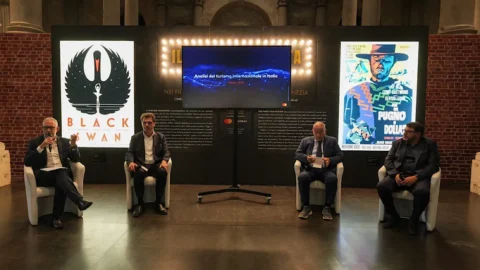
In the photo, Luca Corti, Sergio Bellini, Fiorello Primi, Saverio Mucci: credits ElettraPR