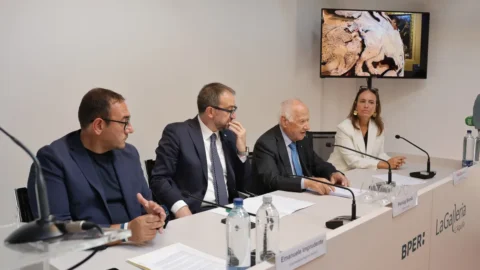
The Brera Art Gallery, Palazzo Citterio, the Braidense National Library, and the Brera Academy of Fine Arts will be the protagonists of a program spanning different eras, languages, and disciplines. Painting, sculpture, literature, research, historical memory, and new forms of contemporary art come together in a program that seeks to be more than a succession of exhibitions, but a concrete representation of the plurality that has always characterized Brera. The project is born in a particularly significant year for the Milanese institution. 2026 marks the 250 years since the founding of the Brera Academy of Fine Arts, while the centenary of the Friends of Brera, two anniversaries that allow us to look at the institution's history from different perspectives: on the one hand, the training of artists and the continuity of its educational tradition, on the other, the relationship between the museum and civil society, through the role of those who have contributed to the growth of its collections over the course of a century. "The new exhibition season of the Grande Brera stems from the desire to fully restore the richness and plurality of an institution that finds its deepest identity in its history, research, and dialogue between eras and languages," explains Angelo Crespi, Director General of the Pinacoteca di Brera and the Biblioteca Nazionale Braidense. The program, he adds, connects the different souls of the Grande Brera, from the Pinacoteca to Palazzo Citterio, from the Braidense Library to the Accademia, spanning the history of art, literature, and culture up to the contemporary era.
The Century of the Friends of Brera
The first appointment is at the Brera Art Gallery. From 6 October 2026 to 10 January 2027, the Napoleonic Rooms will host Brera's One Hundred Years. Purchases and Gifts from Friends, an exhibition dedicated to the first century of the Friends of Brera Association. Paintings, sculptures, and illuminated manuscripts from the collections of the Pinacoteca and the Braidense Library will be displayed alongside documents, photographs, and publications. The exhibition will trace the association's history through the succession of its presidents, recounting a story in which culture, collecting, patronage, and responsibility toward public heritage have all intersected. This is not just an anniversary celebration. It is also a story of how a museum can grow through community participation. Over the course of a hundred years, the Friends of Brera have contributed to enriching the collections through purchases and donations, strengthening the relationship between the institution and Milanese society. "We renew our commitment to be the spokesperson for a history of passion, expertise, and dedication to the growth of the museum's heritage," emphasizes the association's president. Charles Bears.
Hayez and the 250th anniversary of the Academy
The second major anniversary is that of the Brera Academy of Fine Arts, founded 250 years ago. The Pinacoteca will celebrate it starting in November with a major exhibition dedicated to Francesco Hayez, a central figure in 19th-century Italian art and an artist deeply connected to the history of Brera. The exhibition will bring together a core of masterpieces from the Academy and the Pinacoteca in a single exhibition, reconstructing the original dialogue between the place where artists were trained and the place dedicated to the conservation of their works. Hayez thus becomes not only the protagonist of an exhibition, but the point of connection between two institutions that share a long history. The president of the Academy, Marco Galateri of Genola, defines the 250th anniversary as a celebration of "vision, creativity, and excellent training" and emphasizes the synergy between the different realities of the Grande Brera. Alongside the Hayez exhibition, the Academy will also propose Brera Modern and Contemporary, dedicated to the historical continuity of the Academy and the Brera Palace in the Italian and international artistic panorama from the twentieth century to the present day.
Palazzo Citterio, a laboratory of contemporaneity
If the Pinacoteca looks to history, Palazzo Citterio becomes the place where tradition most clearly meets contemporary research. The season will open on October 9, 2026 with the first major posthumous retrospective dedicated to Carlo Maria MarianiSeventy works, including paintings and large-scale cartoons, will accompany the public through the entire span of his production, from his early works to his 2019 works. Mariani is a figure who is difficult to pin down to a single movement. His research has spanned conceptual neoclassicism, hyperrealism, abstraction, and metaphysical painting, maintaining a rigorous intellectual elaboration as a constant element. The exhibition, curated by Eike Schmidt and Clayton Calvert, will therefore offer the opportunity to reinterpret one of the most original figures of twentieth-century Italian painting. At Palazzo Citterio, the theme of education will return with The Masters of Brera. Teaching Art, Scheduled 30 October 2026 to 10 January 2027The exhibition will bring together works by some of the artists who taught at the Academy, from Adolfo Wildt, Carlo Carrà, Arturo Martini and Achille Funi maximum Marino Marini, Gastone Novelli, Alik Cavaliere, Luciano Fabro, Rodolfo Aricò and Grazia VariscoIt is a history of art also told through the history of teaching: masters who not only produced works, but trained generations of artists, accompanying Brera from nineteenth-century tradition to the avant-garde and contemporary art.
Schifano and the season of freedom
Between January and April 2027 Palazzo Citterio will dedicate a major exhibition to Mario Schifano, one of the most innovative protagonists of Italian art in the second half of the twentieth century and a central figure of European Pop Art. The exhibition will be divided into two sections. The first will present works that trace the main phases of his artistic career, from the monochromes of the 1960s to his media experiments, up to the major pictorial cycles of his later decades. The second will recreate the cultural atmosphere of the late 1960s, when the arts tended to merge, and music, poetry, cinema, and visual experimentation shared the same spaces. It was an era of great creative freedom, also explored through the experience of happenings, such as the one organized by Schifano at the Piper in Rome in 1967.
Sean Scully and Italy
From May to September 2027 it will be the turn of Sean Scully, an American artist of Irish descent who has maintained a profound connection with Italy throughout his career. The exhibition, curated by Luca Massimo Barbero, will explore this very relationship. Scully's works resonate with references to the great Italian tradition, from the architecture of Siena Cathedral to the Renaissance masters, from Piero della Francesca to Mantegna, Titian, Bellini, and Raphael, all the way to the modernity of Giorgio Morandi.
Art goes digital
The most radical contemporaneity will also find space on the large LED wall of Palazzo Citterio, through a collaboration with the National Museum of Digital Art. From November 24, 2026 to February 24, 2027 will be the protagonist Marina Abramović with Marina Abramović Element, a series of digital performances in which the artist's body is reinterpreted through an avatar, a sort of digital twin capable of extending the performer's presence beyond physical limits. From February to April 2027, the LED wall will host The Intelligence of Wonder di Davide Maria Coltro, a project conceived specifically for the Palazzo Citterio space. The large screen thus becomes more than a surface on which to project images: it transforms into a space where the work is continually generated.
Umberto Eco at the Braidense
At the Biblioteca Nazionale Braidense the new program takes on a different tone, but perfectly consistent with the vocation of the Grande Brera: to connect art, literature and knowledge. From 2 October 2026 to 10 January 2027, the Braidense will remember Umberto Eco ten years after his death with The Island of the Day Before. Books, Seas, and Machines of KnowledgeThe exhibition will draw inspiration from the novel's original images and the library and scientific heritage of Eco's collection of ancient books, combining them with the Braidense collection, digital reconstructions, and the author's preparatory materials. The result will be a journey through literature, history, science, and navigation, in which Eco's imagined world dialogues with the real documents and objects that fueled it. Between January and March 2027, the Braidense will host: Pathosformel, exhibition dedicated to Michael Ciacciofera, an artist whose research spans archaeology, anthropology, history, and collective memory. Installations, paintings, sculptures, and works on paper will explore the relationship between identity, migration, knowledge, and the transmission of knowledge.
Two hundred years of The Betrothed
The season will close with another great event of Italian culture. In 2027, the 200 years since the first publication of The Betrothed, the so-called Twenty-seven of 1827. From 6 May at 24 July 2027, the Fondazione Centro Nazionale Studi Manzoniani and the Pinacoteca di Brera/Biblioteca Nazionale Braidense will present an exhibition project spanning the Sala Teresiana of the Braidense and Casa Manzoni. At the Braidense, Manzoni's early readings, preparatory materials, and autograph drafts of the novel will be presented, up until the publication of the Ferrario edition of 1827. At Casa Manzoni, pirated editions, early translations, and the major illustrated series created between the first edition and the definitive one of 1840 will be showcased.
A single idea of culture
The common thread that unites such a diverse program is the desire to transcend the traditional boundaries between museum, library, academy, and exhibition space. The Grande Brera presents itself as a space in which the preservation of heritage coexists with cultural production and experimentation. This perspective is summed up in Angelo Crespi's words: Brera aims to be "not just a place of memory, but a living space for cultural production," capable of strengthening its relationship with Milan, Italy, and the international scene. In this sense, the new program doesn't simply showcase what Brera preserves. It showcases what Brera continues to be: a place where memory does not represent a point of arrival, but a material through which to build the futureFrom Hayez's masterpieces to the research of Schifano and Scully, from the masters of the Academy to Abramović's digital experiments, from Eco's books to Manzoni's pages, the Grande Brera proposes a common idea of culture: that of a heritage that remains alive only when it continues to generate questions, encounters, and new interpretations. And this seems to be the true ambition of the new season: to make Brera not just a place to visit, but a place to return to and think.
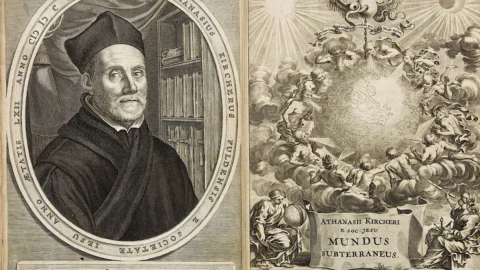
On the cover: Athanasius Kircher, Athanasii Kircheri e Soc. Jesu Mundus subterraneus, in 12 libros digestus; quo divinum subterrestris mundi opificium, mira ergasteriorum naturæ in eo distributio…, Amstelodami, apud Joannem Janssonium & Elizeum Weyerstraten, 1664-1665. Opening of the work: frontispiece and intaglio portrait of the author