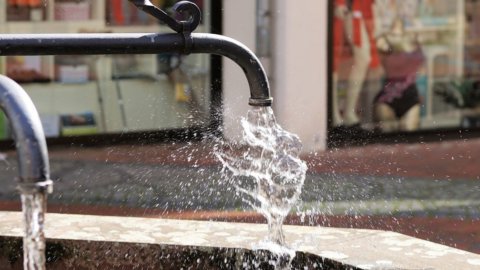
The grain of water also falls on Phase 2. In fact, in the midst of an economic emergency, millions of Italian families are receiving heavier water bills in recent weeks, by virtue of the increases that the local authorities, authorized by the Arera to increase rates from 1 January 2019, they brought down right now with maxi-adjustments. Consumer associations and condominium administrators are on a war footing, to the point of asking for a postponement or installments of this extra expense. A postponement is possible, according to what Arera itself explains: the local authorities could have gradually triggered the increases from 1 January 2019, but even now they are in time to spread them out or postpone them further.
However, there have actually been increases, and how was this possible? The question is very complex and starts from some data: Italy is the European country that consume more water per capita, but also where the service is paid less. This short circuit for many years has brought the operators (which in Italy are hundreds, with different types of governance) not to invest, worsening the quality of the service, not maintaining the network and causing 6,5 million liters per minute (more than 40%) to be dispersed in our country. It is precisely to allow these investments that Arera, which has been responsible for water since 2012, established a new tariff meter in 2017, a sort of menu within which the area body (groupings of Municipalities, metropolitan areas , or even entire Regions) can choose the rate to apply.
To exceed the maximum limit established by the Authority, the utilities operating in the area entities (the so-called ATOs, homogeneous territorial areas) must demonstrate that they have made or planned investments, or in any case that they have improved the service. Furthermore, as Arera recalls, Italy must respond to the EU Directive according to which water is a primary good but those who pollute (that is, those who consume the most) must pay more. Hence the increases, widely expected and due, but whose timing is actually questionable, in the midst of an economic emergency that is overwhelming millions of families. What has actually changed? For domestic users, there is a fixed fee, independent of consumption, to cover the aqueduct and sewage services and a variable fee for which it is applied a rate based on the number of family members, therefore per capita (in compliance with the aforementioned EU Directive).
With the new tariff, the cost per cubic meter of the subsidized tariff goes from 0,23 euro to 0,37 euro, but above all the per capita system foresees that if the number of people in an apartment is not indicated precisely (or, as more often , in an entire condominium), the bill considers a fixed number equal to three members. So if there are actually 3 or less people, the price is protected up to a certain consumption; for large families, on the other hand, the members in excess will pay the higher rate from the first liter of consumption. So far everything is fine. The choice of some companies not to gradually apply the increases by applying a single maxi adjustment - which retroactively counts the increases taken on 1 January 2019 - has instead put groups of consumers in difficulty with increases in the bill that someone has calculated up to + 70%.
“The difficulties that families are experiencing were not enough, between tripled prices, speculation on gloves and disinfectants, in addition to the fear of contagion: the companies that manage the water service contribute to making the situation worse by choosing this delicate moment to apply the new tariff system”, pointed out Federconsumatori. Whose president, Emilio Viafora, has no doubts: “We consider the application, moreover retroactively, of such a tariff system a real madness, in a very delicate and difficult moment for the families affected by the serious crisis caused by the pandemic, instead of facilitating them, citizens are embarrassed. Moreover in relation to a primary good such as water. For this reason we urgently ask for a suspension of the new tariff, at least until January 2021, with the simultaneous suspension of the retroactive calculation".
The condominium administrators join the appeal. The president of Anaci (national association of condominium administrators) Rossana De Angelis, sent a letter to Arera requesting the suspension of the new tariffs until the end of the year, including the calculation of adjustments with retroactive effect. Or at least a moratorium on deadlines e the granting of maximum installments on invoices already issued or to be issued. "The collection of invoices relating to a primary good such as water, increased due to the tariff updates introduced and burdened by the retroactive tariff adjustments until 1 January 2019, appears to be an unjustified countertrend", underlines De Angelis, while Arera itself specified that the adjustments cannot consider the previous consumption of two years.
Finally, it should be remembered that if investments to improve the service initially lead to an increase in costs, over time it is precisely the better quality services that are more convenient for consumers. The example is that of Lombardy, where the service is particularly efficient thanks to correct investments in the past: in 2018 the water bill for a Lombard family it was just over 300 euros a year, compared to the national average of 426 euros.