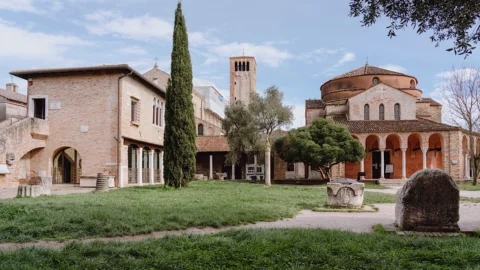
From the earliest evidence of human presence to the full development of medieval civilization and modern art, the Torcello Museum recounts the long history of the Venetian lagoon through a journey that intertwines archaeology, art, and memory. Today the museum becomes part of the network of the Fondazione Musei Civici di Venezia. The inclusion of the museum complex, owned by the Metropolitan City, represents a significant step both from a management perspective, with its inclusion in the network of Island Museums alongside Murano and Burano, and from a cultural perspective. Thanks to the educational activities of MOVE and future enhancement projects, the museum takes on a central role in the island city's museum system, helping to complete the story of the origins of Venetian civilization.
Torcello, an ancient settlement in the lagoon
Torcello was, in fact, a vibrant center in Late Antiquity and the Early Middle Ages: an active commercial hub since Roman times and a key reference point for understanding the birth of Venice. Among the first interventions undertaken to improve the exhibition experience, MUVE has initiated maintenance work and updated the explanatory materials, making the museum more accessible and welcoming. Furthermore, the storage room in the loggia of the Palazzo dell'Archivio has been reopened to the public, now visible, showcasing the important stone heritage preserved there.
Venice before Venice
The complex, which includes the Palazzo del Consiglio and the Palazzo dell'Archivio with their respective collections, was granted to the Municipality of Venice for nine years for free use by decree of the Metropolitan Mayor no. 55/2025 of 30 June 2025. and is now managed by the Foundation under a multi-year concession. The goal is to continue and strengthen the enhancement and research work already undertaken by the Metropolitan City, dedicated to the discovery of "Venice before Venice." In this ancient river and sea emporium, the economic and religious hub of the upper Adriatic in the centuries preceding the rise of Venice, the MUVE Foundation expands its narrative, connecting the civic museums to the deepest roots of the civilizations that inhabited and crossed the lagoon, contributing to the dissemination and understanding of one of its oldest and most significant historical sites.
Torcello Museum, an expression of a refined collecting tradition
Founded in the late nineteenth century thanks to the initiative of Venetian scholars and collectors, It is currently divided into two sections: Archaeological, Medieval and Modern which tell the island's millennial history and its ties to the hinterland and Venice. What emerges is a portrait of a place suspended between water and land, profoundly transformed over time by the combined action of nature and man.
In the Archaeological Section The museum preserves evidence of extraordinary value: from prehistoric materials discovered in the Venetian area to Mycenaean and Cypriot vases, which attest to the existence of maritime trade as early as the late 2nd millennium BC. Of particular interest is the glyptic collection, which includes a carnelian engraved with the walls of Troy and an Islamic agate seal with the invocation "the kingdom of Allah." Directly linked to the area are the Roman cup signed "Clemens," a rare find discovered in Torcello, and the ampoules of Saint Menas, evidence of the spread of African cults in the lagoon during the Byzantine era. Among the most significant works are the Herm of Hermes Propylaios, a Roman copy of Alcamenes, and the veiled head of the god Kronos, examples of high-quality sculpture.
The Medieval and Modern Section, housed in the Palazzo del Consiglio, collects works and documents dating from the 6th to the 19th century, illustrating the period when Torcello was an important urban center. The 12th-century mosaic fragments depicting Christ and angels show clear similarities with the mosaics of St. Mark's Basilica, a sign of a shared artistic culture. The fragments depicting the group of the Righteous and an Angel, originally part of the Last Judgement in the Basilica of Torcello and removed during 19th-century restoration, belong to the same cycle.
Also of great importance are the mosaic heads of the archangels Michael and Gabriel, coming from the Ravenna church of San Michele in Africisco, and an architectural fragment with the inscription “…MPORI…”, perhaps connected to the definition of Torcello as mega emporium cited by the emperor Constantine Porphyrogenitus.
The exhibition also includes the wooden sculpture of Santa Fosca (15th century) and a cycle of canvases and organ doors from the church of Sant'Antonio, attributed to Paolo Veronese (or his brother Benedetto) and their workshop. The narrative is completed by symbols of the Serenissima, such as the marble lion and the "lion's mouths" for secret denunciations, a testament to the civic and institutional role the island maintained over time. With this addition, the Fondazione Musei Civici di Venezia strengthens its museum system, restoring centrality to one of the lagoon's oldest sites and offering the public an even broader and more nuanced interpretation of Venetian history.