After Venice, the exhibition will move to the Guggenheim Museum Bilbao, from 17 October 2025 to 22 February 2026. Through a selection of approximately seventy key works from prestigious international museums, including the Centre Georges Pompidou, Paris, the Guggenheim New York, the Museum of Modern Art, New York, and the Tate Modern, London, as well as important galleries, including Jeanne Bucher Jaeger, Paris, and cultural institutions, such as the Comité Arpad Szenes – Vieira da Silva, Paris and the Fundação Arpad Szenes – Vieira da Silva, Lisbon, the exhibition offers an in-depth and completely new look at the evolution of the visual language of Maria Helena Vieira da Silva (Lisbon, 1908 – Paris, 1992).
Career from the 30s to the 80s
Highlighting the strong relationship between abstraction and figuration, the exhibition retraces the most significant moments of Vieira da Silva's career, from the 1930s to the late 1980s, and emphasizes his interest in architectural spaces, in which the boundary between real and imaginary urban landscapes dissolves, going far beyond the formal references to Portuguese visual culture and avant-garde movements such as Cubism and Futurism. What is new in the exhibition is the reconsideration of his work as independent from the Informal movement, to which he has often been associated in the past, and the recognition as fundamental both his experience in Paris, where he moved as a young man for study reasons, and the period of exile in Rio de Janeiro, where he took refuge with his husband Arpad Szenes, also an artist, during the Second World War and where he created a dense network of contacts.
The artist is also historically linked to the legacy of Peggy Guggenheim and Solomon R. Guggenheim
Not only was Vieira da Silva included among the thirty-one artists featured in the Exhibition by 31 Women organized by Peggy Guggenheim in the New York gallery-museum Art of This Century in 1943, but Hilla Rebay, the first director of the Museum of Non-Objective Painting, the future Solomon R. Guggenheim Museum in New York, is considered one of her first supporters, having purchased Composition (1937) in 1936, still in the collection of the American museum. Born in Lisbon and educated in Paris and Lisbon, Vieira da Silva transformed the idea of space into one of the central themes of her work, combining tradition and modernity. Her compositions, characterized by labyrinthine structures, chromatic rhythms and fragmented perspectives, capture the essence of a world in constant transformation. Works such as The Tiled Room (La Chambre à carreaux, 1935) or Ballet Figure (Figure de ballet, 1948) reflect his interest in architecture and movement, where the distinction between figure and ground dissolves, allowing a deeply personal vision of space to emerge. Vieira da Silva has always experienced art as an extension of his being. As the curator points out in the catalogue essay, the artist was “a creature of the studio”: the atelier was a place that not only represented his workspace but often became the subject of his works. Influenced by her studies of sculpture and anatomy, as well as by the great masters of the past such as Paul Cézanne and the avant-garde movements of the twentieth century, Vieira da Silva develops a unique pictorial language, in which the physicality of space intertwines with the dynamics of memory and time. The exhibition opens with a section dedicated to the bond between the artist and her husband Arpad Szenes, told through a series of mutual portraits that introduce the public to their deeply symbiotic artistic and personal relationship.
The studio-atelier, architectural space
The exhibition then continues with an in-depth look at the theme of the studio-atelier, a place not only for work but also for reflection on architectural space, as demonstrated by the paintings from the 1936s exhibited here, in which the skeletal structure of the spaces takes on an almost anatomical dimension. An emblematic example of this period is Composition (Composition, 1938), from the Guggenheim New York. This is followed by a series of works dedicated to the figures of dancers and chess players, such as Dance (Danse, 1946), from the Museum of Modern Art, New York, and Red Chessboard or The Chess Players (Échiquier rouge ou Joueurs d'échecs, 1942), in which the game becomes a metaphor for existence, made up of action and reaction. A particularly intense moment is represented by the section dedicated to war, a testimony to the difficult period spent in exile in Brazil during the Second World War, during which Vieira da Silva created works imbued with tension and pain, snapshots of the human tragedy of those years. Significant works from this period include The Disaster (Le Désastre, 1946), from the Centre Pompidou, Paris, On the Theme of “Disaster” (Sur le thème du “Désastre”, 1938), from the Musée d'Art Moderne de Paris, and The Drowned (Les Noyés, 1947). His return to Paris in 1951 marked a stylistic turning point, manifested in his search for an abstract language that was increasingly defined and imbued with labyrinthine forms. From here, the artist's gaze subsequently opened up to the urban landscape, both real and imagined, in which the atmosphere of places became more important than their faithful representation, evident in paintings such as Paris, at Night (Paris, la nuit, 1949) or Venetian Feast (Fête vénitienne, XNUMX).
Public architecture
The following works are in which public architecture emerges as a recurring theme, works that depict construction sites, train stations and churches, in a balance between construction and infinity. The reflection on the organization of space continues, with works in which interiors and exteriors merge and continuously transform, such as Black Interior (Intérieur nègre, 1950) or The Arena (L'Arène, 1950). The paintings from the XNUMXs, characterized by an increasingly dark color palette, close the exhibition, while the last room is dedicated to the White Compositions, works from different phases of Vieira da Silva's career, which highlight the special role that the color white has had in her artistic research. Maria Helena Vieira da Silva. Anatomy of a Space will be accompanied by a rich illustrated catalog, published by Marsilio Arte, with texts by the curator Flavia Frigeri, the artist Giulia Andreani, the writer and essayist Lauren Elkin, and the art historian Jennifer Sliwka.
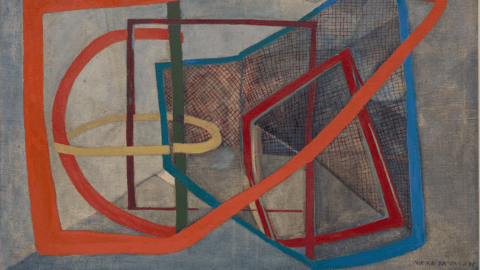
Cover image: Maria Helena Vieira da Silva, Composition (Composition), January 1936, oil on canvas, 105.3 x 161.5 cm. Solomon R. Guggenheim Museum, New York, Solomon R. Guggenheim Founding Collection, By gift © Maria Elena Vieira da Silva, by SIAE 2025