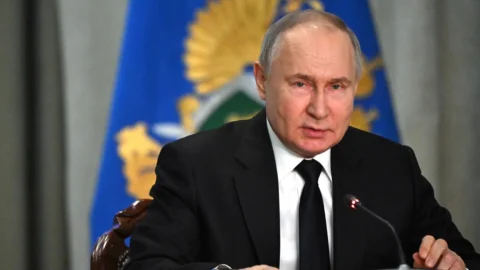
A break from the weapons, at least on paper. From 17pm Italian time on Saturday 19th April until midnight between Sunday and Monday the truce announced by Vladimir Putin: 30 hours of military silence on the occasion of the Easter Orthodox, which this year coincides with the Catholic one. “I order a cessation of all military actions for this period,” the Russian president said live on television during a meeting with the Chief of the General Staff Valery Gerasimov.
Putin justified the decision with "humanitarian considerations", defining the pause as a test to verify whether Kiev is willing to "peacefully resolve the issue". Moscow troops, however, will remain on alert, ready to "repel any violations and provocations by the enemy, as well as any aggressive action by it".
Zelensky: “Russian Drones in the Skies, This Is the Attitude for Easter”
Volodymyr Zelensky did not hesitate to comment on Putin's latest attempt to pass Easter in a truce. "As for Putin's latest attempt to play with people's lives, an air raid alert has been issued across Ukraine," the Ukrainian president wrote on his social media profiles.
In fact, at 17pm they were spotted Russian attack drones in Ukrainian skies. “The Shaheds [Iranian drones] in our skies show Putin’s true attitude to Easter and people’s lives,” Zelensky added, stressing the continuity of air defense and aviation operations by Ukrainian forces.
The president then made it clear how Russia's initiative to proclaim a truce for the Easter holidays is being overshadowed by the ongoing aggression in Ukrainian skies.
Ukraine-Russia: Easter Truce on the Ground, but Uphill Negotiations
If on the ground the truce seems to offer at least a period of calm, on the diplomatic front the road to a real agreement it all remains in words. According to Wall Street Journal, American officials reportedly presented to Paris a peace plan to the European and Ukrainian delegations. No details have been made public, but initially the New York Post had spoken of a “90%” agreement with Kiev — a claim that was later denied by the Ukrainian Defense Ministry.
“We do not make political decisions, so we cannot make percentage assessments,” they clarified from Kiev to Sky News, stressing that he had already supported the American proposal for a ceasefire on March 11. A proposal that, according to Ukraine, had been rejected by Moscow, while "Russian attacks on Ukrainian cities and infrastructure continue every day".
Trump, ultimatum and risk of military aid stop
Meanwhile, political pressure is being felt. According to what was reported by Axios, the threat of the US president Donald Trump to withdraw from the negotiations for the end of the war would have been addressed precisely to Kiev. A prospect that, according to a Ukrainian source, raises fears not only of a stalemate in the talks, but also of the suspension of American military aid.
new meetings they are already on the agenda for next week London, where the delegations will try to unblock the main issue: finding a credible agreement.
Secondo BloombergMeanwhile, a significant detail is circulating: the US is ready to recognize Russian control over Crimea as part of a broader agreement. But for now, Washington has been silent.
The front is moving, truce or not
On the ground, the war continues to redraw maps. Moscow announced this morning that it had reconquered Oleshnya, the penultimate village under Ukrainian control in the Kursk region. “During offensive operations, units of the Northern Group of Troops liberated the village of Oleshnya,” the Russian Defense Ministry said.
Ukraine now has only the town of Gornal left in the area. Russian troops, having regained ground in March, have returned to positions along the border, threatening the Sumy region.
A few hours earlier, the Russian army had also claimed the conquest of the locality of Shevchenko, in the region of Donetsk. The village, located on the outskirts of pokrovsk — one of the strategic Ukrainian strongholds in Donbass and a key target of the current Russian offensive — is considered a crucial point for the control of the area's mineral resources, particularly lithium and coal.