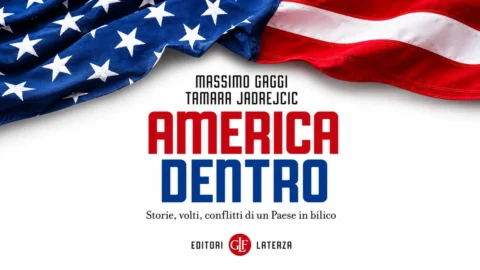
You can say the worst things about Donald Trump, but you can't say he arrived and then returned to the White House by chance. We saw him coming, and no one was able to stop him, because the United States isn't just New York, Washington, or San Francisco. Just read "America Inside," the beautiful book by Massimo Gaggi and Tamara Jadrejcic, two journalists, husband and wife, who have lived in the United States for nearly a quarter of a century and have thoroughly explored America to understand the true origins of Trump and Trumpism. Trump will leave the White House by 2028 at the latest, but many of the changes he has revolutionized America will remain. It will be difficult to eradicate the extreme populism (which has also infected some Democrats), the barbarism, and the unbridled radicalism of political conflict. And it's far from certain that after Trump, America will return to being the guiding light of liberal democracy that the world knew before Donald Trump's arrival in the White House. Reading "America Inside," published by Laterza, helps greatly understand the origins of Trumpism and its future. The prospects for the United States are not encouraging, although it's unlikely things could get worse. But let's hear from Massimo Gaggi, a columnist and longtime correspondent for Corriere della Sera in New York, about the true state of health of America today and what it will likely be tomorrow, in view of the midterm elections in November and beyond.
The long journey across the United States recounted in “America Inside,” the book you co-wrote with Tamara Jadrejcic, sheds very clear light on the profound reasons for Trump's electoral victory and his return to the White House despite the Capital Hill coup. Would you like to summarize, in order of importance, the real causes of Trump's success?
First, his media savvy: during his years on television, those of The Apprentice, he not only gained widespread popularity, but also learned to make the most of television, the press, and then even social media. Two key factors: the ability to make headlines every day, even with harsh statements and a barrage of insults. "Better to always be talked about, even badly, than to be forgotten." And then, his ability to put on a show: his rallies are always packed (unlike Hillary Clinton's and, later, Biden's), entertaining, with catchy soundtracks, rapid-fire jokes, grotesque stories, digressions, and demonizations of his opponents: candidates running against him are demolished with withering definitions (such as "low energy," the name that killed Jeb Bush in 2016).
Second, the understanding that there was a large base of white, conservative-minded, impoverished, and angry Americans (the so-called forgotten men) who no longer recognized themselves in the elitist, pro-global, pro-immigrant Republican establishment, nor in a Democratic Party more interested in the rights of minorities, including sexual minorities, than in improving the living conditions of the most vulnerable.
Third, his chameleon-like ability to become a credible point of reference for the "forgotten" despite being a billionaire: he managed it by playing the card of being extraneous to politics and Washington's games. It worked, despite the fact that in his real estate business he always dealt with local politicians, especially in New York.
But is Trump a flash in the pan or a phenomenon destined to outlast the President? In other words: is Trumpism, understood as an extreme form of populism and contempt for the founding values of American liberal democracy, destined to outlive Trump or will it fade with him?
Trump will wane (I believe a third term can be ruled out, if only because of his increasingly precarious health, as well as constitutional constraints). But he has profoundly changed American politics, shaping it for over a decade. He has given leeway to currents like white supremacism: once underground rivulets, now rivers flowing in plain sight. The spread of hostility toward immigrants (even their criminalization), extreme populism, and the spread of conspiracy theories, starting with the idea of the great ethnic substitution, are phenomena that will remain etched in a significant part of America. As will the barbarization of political struggle. In a country already polarized and disinclined to appreciate the brighter and darker sides, his division of the world between winners and losers has fueled the radicalization of political conflict.

Polls say Trump is in free fall today: what could realistically happen in the midterm elections?
In the past, new presidents have lost dozens of members of Congress in the first midterm elections (Obama as many as forty). With Trump at war, Republicans, in theory, should lose many more. The right, which has a razor-thin majority in the House, could be overwhelmed. In reality, some doubts remain because with the changes already made to the Electoral College at Trump's urging (abnormal but endorsed by the conservative-dominated Supreme Court), the right will regain more than 10 seats in the House. Perhaps as many as 15. Trump will then try to influence the vote. He would like to "nationalize" it to control it. He won't succeed: the Constitution entrusts the management of elections to the individual states of the Union. But he can always interfere by sending ICE agents to polling stations, reporting non-existent fraud, seizing vote-counting machines, and so on.
I believe, however, that given the magnitude of the electorate shift, he won't be able to hide his defeat in the House. In the Senate, where only a third of the assembly, 33 senators, is being renewed, the Democrats (currently holding 47 seats versus the right's 53) have a much tougher time: to regain the majority, they would have to keep all their senators and wrest five from the Republicans. At the beginning of the year, it seemed unthinkable. Now, their victory is considered a real possibility, but I wouldn't bet on a complete victory.
If Democrats win the House and Senate in November, could Trump really be impeached? How much will the unprecedented clash between Trump and the American Pope impact the November vote and the Catholic electorate?
Impeachment can be triggered even with a Democratic takeover of the House alone, but it will never lead to conviction, not even with a progressive-majority Senate. In the American system, the House acts as the prosecutor's office, preparing the charges, while the Senate becomes the judging panel that, to oust a president, requires a two-thirds vote—67 senators. The clash with Pope Prevost is significant because, while under Francis, the American Catholic Church was divided, under Leo, the rift between conservative and progressive bishops appears to have healed. But Catholics have little weight in American politics. I don't think that clash will harm Trump too much, especially since he has put together the most Catholic government in American history, starting with Rubio and Vice President Vance.
“America Inside” highlights how the 2007 subprime mortgage crisis and the systemic financial and economic crisis of 2008 fueled the anger of Americans, who often lost a lot of money, against the lack of punishment for the banking establishment that caused the disaster of those years. But how then can we explain the fact that the majority of the US voted for a President who is precisely the expression of the establishment?
As I said before, Trump has chameleon-like abilities, a true Pied Piper. People believe he made his money in real estate, not finance. He's friends with bankers, but people don't know that, and in any case, these are relationships built when he entered politics. Before that, he was a parvenu detested by Wall Street aristocrats. And also a serial bankrupt, costing the banks no small amount.
The final pages of “America Inside” take a deep dive into the marriage between Trump’s authoritarian populism and the technocracy of Silicon Valley and AI: is it a marriage of convenience or a tangle of interests destined to last?
For him, it's a marriage of convenience: Silicon Valley's support for his election campaign, Elon Musk's hundreds of millions, and the technologists who helped him make billions in cryptocurrency profits. The AI giants, moreover, are the last bastion of American primacy in the world. And with their gigantic investments in data centers, they're growing a US economy that would otherwise stagnate, much like Europe's. The digital giants, on the other hand, believe that the intertwining of interests between politics and a technological world now capable of managing everything with AI—production, information, communications, warfare, and so on—is destined to become increasingly tight. And they hold the upper hand.
When the era of Trump and Trumpism ends, will America return to the country of liberal democracy we knew until a few years ago, or are the changes irreversible?
Afterward, we could have a Democrat who is still populist (see the recent Democratic drift in New York: a left-wing recipe, but the demagoguery and unfulfillable promises are reminiscent of Trump's style) or a successor to Trump: perhaps JD Vance (pushed by Silicon Valley, who is thinking of techno-Caesarism (a sovereign who uses artificial intelligence (AI) and not Parliament for governance) or Marco Rubio, closer to traditionalist conservatives: people who prefer the precepts of Christian nationalism to algorithms. Liberal democracy is also in a bad position in this second perspective, with a glimmer of hope: coming from the Senate, Rubio should have a certain respect for the institutions of the Republic.
The only real light: once Trump's presidency is over, his refusal to acknowledge his 2020 defeat, his pretense of always considering himself the winner, should also disappear. This is a pathology of his, certainly, but a democracy only survives if its citizens have a foundation of shared values and if the loser recognizes the winner's legitimacy. It must never happen again that an incumbent president is considered by half the country to have been elected through fraud.