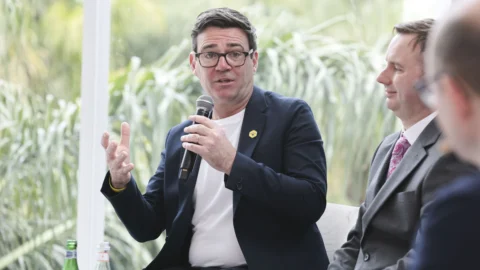
“I am ready for change after 40 years of neoliberalism.” Andy Burnham it has been officially proclaimed leader of the British Labour Party – in government today – thus overcoming the last obstacle before taking on the office of Prime Minister as early as MondayThe center-left political force has announced the outcome of the leadership consultation aimed at replacing the outgoing Prime Minister. Keir StarmerYes, because Burnham, the only candidate in the running and former mayor of Greater Manchester, is considered the premier in pectoris for weeks now.
Burnham: No decision yet on government team
Just in these hours, the first vans of the services of moving house I am in front of the 10 Downing Street, the official residence of the British Prime Ministers: Starmer and his family, in fact, are preparing – together with theentourage – the boxes in sight of the final eviction on Monday. The changing of the guard will take place starting in the late morning, with Starmer's ritual final farewell speech to the nation in front of the government residence; this will be followed by the formalisation of his resignation (announced in June) in the hands of King Charles III, head of state, to Buckingham Palace; then the “suggestion” of the job to Burnham as the new Labour leader; again, the summoning of the latter to the palace for the automatic designation; and finally his transfer to Number 10 with the start of the process of appointing ministers of the new team. In this regard, Burnham stated that she has not yet decided who will be part of her team. top team, denying the rumours circulating in the last few hours about composition of the future shadow cabinetThe statements come after rumours that the current Interior Minister, Shabana Mahmood, could be appointed Chancellor of the Exchequer.
Burnham: Second government seat to be established in Manchester immediately
However, starting from Monday, the Manchester branch of Downing Street long promised: a sort of second seat of the executive branch intended to deal with that decentralization evoked by the incoming Prime Minister to ensure a political, economic and social strategy less focused on London and more attentive to other territories. Starting from those of theDeep North England, his stronghold of origin, which for decades has been suffering from the effects of abandonment and deindustrialization.
In his first speech after the formal victory, Burnham declared that he will be a pro-business Prime Minister. “Make no mistake: I will be a pro-business Labour leader, just as I was a pro-business mayor of Greater Manchester,” he said, speaking of the relaunch of pubs, shops and small local businesses.
Burnham, the program: here's what he said
Unquestionably capable of transmitting more human warmth and more capacity for drag the audience away from Starmer, Burnham tried to express in his speech a prospect of novelty and discontinuity in the political proposal of a party in crisis of consensus, But also unitary ecumenism.
Outlining the priorities of his mandate, Burnham said that the second objective will be “building a new policy”, noting that many citizens are exasperated by politics and end up "not caring about it." "We haven't been good enough," he admitted, adding that the voters of the Makerfield constituency They gave Labour "one last chance" to change. "We must seize it together," he said.
According to Burnham, the party will have to focus on troubleshooting rather than on political opposition, addressing the major issues neglected in recent years, including social care. The Labour leader then relaunched his fifth commitment, promising to transfer powers from Westminster and Whitehall to the territoriesCitizens, he argued, must have greater control over essential services, so that they function better and are more accessible.
Calling himself a “business-friendly” Labour leader, Burnham promised to boost the country's reindustrialisation and improve the education system, with the goal of offering everyone "a path in life." "My plan is to restore the hope that has been missing from all of us for too long. People expect us to keep our promises, and we will," he said.
In the closing passage of her speech, Burnham acknowledged that she hadn't always done everything right. “I'm sorry for the times when I wasn't up to par, but I've always given my all,” he said, adding that he had been able to listen and learn from his mistakes. “I know what I believe in and I know what I want to do: I have a plan,” he said. Concluding his speech, Burnham promised to “bring hope back” to the Labour leadership. “I believe in all of you and I am convinced that we can do it,” he said, receiving a standing ovation and a long round of applause from the audience.