I Italian parties they started a campaign in view of the return of citizens to the polls next year. For now these are tactical skirmishes of a more propagandistic nature than anything else, but little real substance on the policies that will be adopted to address the geopolitical and economic risks that are disrupting our lives. Sooner or later, parties and coalitions will have to put at least some ideas for a concrete program It contains, if not details, some clear indications of the direction in which, in their opinion, we should move. And for now, it must be said that the initial ideas circulating about what to do are far from convincing, because they point to a return of the state to both business management and income support. No one is addressing the underlying problems of our country and Europe as a whole, nor is anyone attempting to address the real issues that are marginalizing us in the new international context.
Draghi and the European recipe for saving competitiveness and democracy
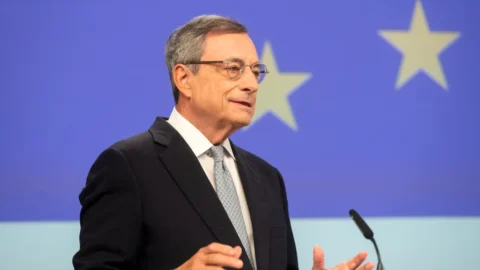
Mario Draghi, former governor of the ECB and former Italian prime minister, has collected in a volume published by Rizzoli (Compete or disappear – For a new European landscape) his most recent interventions Conducted in various European and American locations, these meetings will explain the Draghi Report (i.e., the recommendations submitted to the European Commission on how to safeguard our competitiveness) and monitor its implementation. This is a body of recommendations that could be adopted by Italian political parties to offer voters a concrete perspective on how to safeguard our social model and our political democracy. It also involves courageously addressing the new reality in which we must operate, reflecting the changes that have taken place on the international scene, stemming from China's rise as a major power, not only economically but also politically, the new posture of the United States, and the aggressiveness of powers seeking to restore their imperial power, such as Russia.
But we will have to face radical changes. We already seem to hear politicians, both in Italy and in many other European countries, complaining that these things require the consent of citizens, who instead still seem to demand protection and subsidies from traditional states to eliminate the risks of change. Yet Draghi argues, citing recent surveys, that European citizens have a clear idea of the direction the EU should take: they want the Union to act more unified and more quickly, and they want it to have more shared resources to address future challenges. Therefore, it is often the national ruling classes (not only political ones) who fear losing part of their power if they cede pieces of sovereignty to Brussels.
And Draghi also illustrates with a wealth of arguments that inaction or the very small steps taken in an attempt to conceal changes do not serve to safeguard our model of well-being and our political autonomy. And this seems to be what individual citizens, even though they live in a phase of uncertainty due to the sudden change in the international scenario, we have understood it well and they expect a clear signal from politics and convincing on what should be done and how to do it. In short, citizens seem to ask politicians for more foresightThat is, clear ideas on how to address the new international scenario, while our politicians continue to offer subsidies in the belief that they'll garner a few votes by handing out bonuses or tax breaks. This, of course, fails to account for the impact these policies will have on public finances, private investment, and ultimately, the possibility of returning to growth rates closer to those of the US, let alone emerging economies.
The old pillars of European well-being no longer hold up
Draghi explains that the pillars on which we Europeans have built our well-being over the last fifty years, they do not exist anymoreThe US will no longer provide our defense. international trading The European Union, on which the EU as a whole relied to compensate for weak domestic demand in both consumption and investment, no longer appears so free, but is increasingly subjected to political constraints and becoming an instrument of power politics. We cannot delude ourselves that these are merely passing clouds. New conditions for market functioning will need to be created, and Europe must be united and strong to participate as a leading player in these redefinitions. And yet today, China It doesn't consider us equals, while the US clearly demonstrates its intention to weaken Brussels and negotiate with individual countries deemed so weak they can only be "vassals." And then there's Russia, which wants back its empire, which once reached Warsaw and Belgrade. In this new scenario, it's profoundly wrong to think that our relative decline can be managed painlessly. We have so many resources—some think—that can allow us a peaceful future even if we continue to take a relative position with respect to other countries.
What Draghi illustrates intervention after intervention is one complex scenario Because the problems have been addressed at various levels. It's clear, and we can't deny it, that we will have to revolutionize our system, integrate the state and the market differently, and ask citizens to get back into the game, not to make financial sacrifices (i.e., pay new taxes) but to acquire the skills needed to address the technological and organizational changes already taking place in the world (and on which the EU must make significant progress). All of this is necessary precisely to protect our welfare model, our jobs, and more generally, our values and our freedom.
Draghi's three priorities for relaunching Europe
Wanting to summarise the detailed proposals formulated by the Draghi Report and the book, we can say that we must give ourselves three priorities: focusing on innovation and new technologies, increasing economic security through a good industrial policy and certainty of supplies, and a decarbonisation policy to be reconciled with growth and which aims above all to create a reliable and competitively priced energy market.
Each of these priorities requires profound changes in policies Thus far followed by the EU and individual member states. For example, tools must be implemented to encourage the investment of European savings currently flowing abroad into our continent, thus contributing to a strong revival of investment. Forget about capital taxes! Changes are needed to make Europe attractive for savers. On energy, we must implement a European policy that is completely different from the Green Deal, which is only causing harm. Companies must also be able to reach a size capable of competing with global giants, and therefore appropriate policies are needed to encourage the growth of small businesses. Antitrust authorities must also think in terms of competition with the rest of the world, not just within our domestic markets.
And then there is the staff training with school reforms and efficient lifelong learning systems. Finally, research must be given more resources, but universities must also be able to deploy them efficiently. Ultimately, all of this can be financed by increased growth, which certainly brings more money into the state coffers, but also by a review of current spending where subsidies or tax breaks must be replaced by both public and private investments. In short, at this stage, citizens must be asked to invest in the future, as they did in the post-war period. And this is not only because it is right, but above all because it is convenient: other options lead us to decline, which, as we have seen, cannot be painless but would be destined to jeopardize our social and political structure.
Draghi's is a book to readIt is rich in practical ideas for the ruling class. But it is also educational for ordinary citizens because, as is happening in other European countries, it should push them to demand policies capable of restoring positive prospects for our country, which must be well-integrated into the European context. Of a Europe, Draghi states, that cannot be confederal, but must evolve toward increasingly federal structures, even through a phase of "pragmatic federalism" based on countries willing to do certain things together. Others will follow, if they wish, as indeed happened with the euro.