
La Italian private healthcare continues to grow, supported by the increased demand for services, the aging population, and the difficulties in accessing the public system. After the 5,5% increase recorded in 2024, a further 3,7% increase in aggregate revenues of the main operators in the sector is expected for 2025. This is what emerges from theUpdate of the Mediobanca Research Area Dedicated to the 38 largest Italian private healthcare groups with individual revenues exceeding €100 million. In 2024, their combined revenues reached €13,4 billion, a 22% increase compared to 2019.
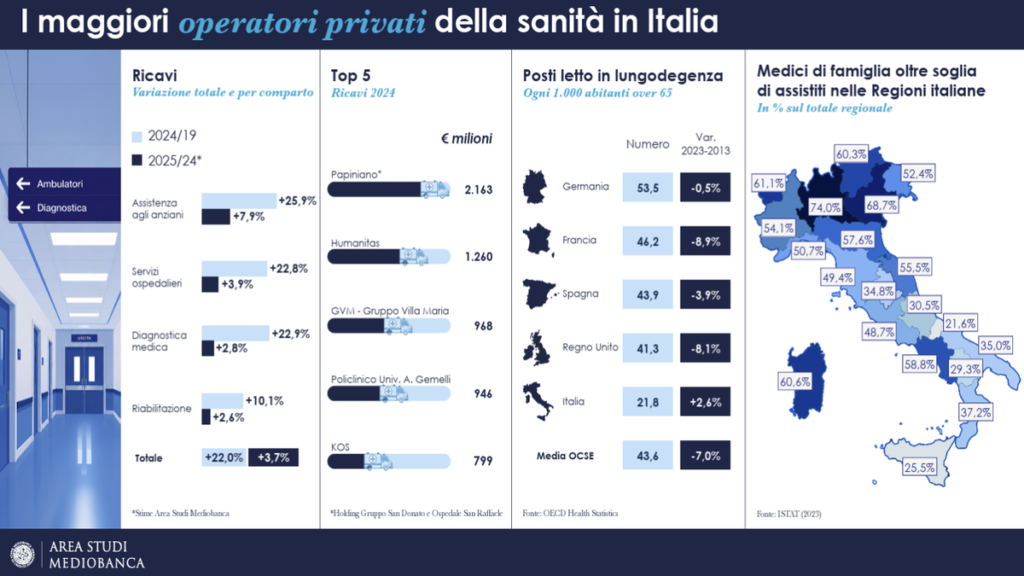
The market is mainly driven by facilities dedicated to the care of the elderlyNursing home operators saw a 25,9% increase in revenue compared to the pre-pandemic period, supported by improved bed occupancy rates and the opening of new facilities.
Revenues are rising, but margins remain below pre-Covid levels.
The first indications for 2025 show positive trends in all the main sectors. revenues of elderly care facilities are expected to increase by 7,9%, those of hospital care by 3,9%, while diagnostics and rehabilitation are expected to grow by 2,8% and 2,6% respectively. The sector has recovered ground after the 6,5% contraction suffered in 2020. The subsequent rebound of 14,1% in 2021 was followed by more moderate growth in 2022, equal to 2,6%, and further increases in 2023 and 2024.
Compared to 2019, after the RSAs, the most significant increases were recorded by diagnoses, with an increase of 22,9%, and hospital operators, which grew by 22,8%. The dynamics of rehabilitation were more moderate, but still showed a progress of 10,1%. profitability shows signs of recovery. In 2024, the aggregate net operating margin increased by 24,9% compared to the previous year, and the EBIT margin rose from 3,1% to 3,6%. However, this figure remains far from the 5,4% recorded in 2019.
Medical diagnostics remained the sector with the highest margins, with an EBIT margin of 9,4%, ahead of elderly care, which remained stable at 5,1%. Hospital care and rehabilitation, however, posted lower margins, despite an improvement compared to 2023. Among individual operators, Affidea recorded an EBIT margin of 14,4%, followed by La Villa with 12%, Pro.Med with 11,5%, and Synlab with 11,2%. Sereni Orizzonti Holding achieved 9,9%, while GHC stood at 9,4%.
It also remains marked the distance Between for-profit and non-profit operators. In 2024, the former reported an average EBIT margin of 4,7%, compared to -1,3% for non-profit groups.
After losses recorded in 2020 and the two-year period 2022-2023, the aggregate profit of the 38 operators returned to positive territory, reaching €34,6 million. ROE thus rose to 0,6%, from -3,1% the previous year, but remains far from the 5,6% of 2019.
ROI increased from 3,9% to 4,7%. This figure remains lower than the 6,3% pre-pandemic. Affidea achieved the highest ROI, at 16,4%, ahead of Humanitas with 13,2%, Pro.Med with 12,9%, Sereni Orizzonti Holding with 12,6%, and Gruppo Gheron with 12,2%.
San Donato first in revenue, with over 102 employees in the sector
The ranking of largest groups by turnover It is led by Papiniano, the holding company of the San Donato Group and the San Raffaele Hospital, with revenues of €2,163 billion. It is followed by Humanitas with €1,260 billion, GVM-Gruppo Villa Maria with €968 million, the Agostino Gemelli University Hospital with €946 million, and Kos with €799 million.
The share of services provided under accreditation varies significantly among providers. At ICS Maugeri, it accounts for 96% of healthcare revenues, while at San Raffaele in Rome, it stands at 87,2%. GVM follows with 78,9%, Papiniano with 78,5%, and Don Gnocchi with 78,4%.
Other groups, however, have a higher share of services paid directly by patients or through funds and insurance companies. At the Centro Diagnostico Italiano, insolvency revenues represent 76,3% of the total, with a 45% share attributable to supplementary funds and insurance companies. This percentage drops to 50% for Lifenet, 41,7% for Istituto Auxologico, 41% for Kos, and 35,3% for IEO.
La territorial presence remains concentrated mainly in the northern regions, although some operators have developed a national network. KOS, Segesta, Sereni Orizzonti Holding, and Don Gnocchi operate in at least nine regions, while among hospital groups, GVM operates in ten regions and GHC in eight. Papiniano and Humanitas maintain their operational centers in Lombardy. Papiniano also has a presence in Emilia-Romagna, which generates 4,1% of its revenue, while Humanitas generates 20% of its revenue between Piedmont and Sicily. Eight operators also have facilities abroad, although most of these are marginal. KOS operates 53 nursing homes in Germany, accounting for 31% of total revenue, while GVM generates 22% of its revenue through 14 foreign facilities.
In parallel with the growth in turnover is employment also increasedIn 2024, the workforce of the groups analyzed exceeded 102, an increase of 5,3% compared to 2023 and 17,5% compared to 2019.
The appeal to external collaborators However, it remains very high in some areas. In the CDI, self-employed workers represent 57% of the total workforce, in the GVM 55,2%, and in the Auxologico Institute 50,5%.
Il average labor cost per employee It amounted to 43 euros, with values ranging from 33,8 euros for long-term care to 47,9 euros for hospital care. According to the study, these levels contribute to making the Italian system less attractive and fueling the migration of healthcare professionals abroad. Furthermore, in Italy, only 1% of licensed doctors have received training abroad, compared to an OECD average of 20%.
Aging and waiting lists push private spending
The growth of private healthcare is part of a demographic picture destined to structurally increase the demand for healthcare. In 2024, those over 65 represented 24,5% of the Italian population, a share lower only than that of Japan and significantly higher than the OECD average of 18,5%.
Within the 2062 the incidence of over 65s in Italy It is expected to reach 34,1%, compared to a projected average of 28,5% in the OECD area. This trend is likely to weigh especially heavily on elderly care and long-term care services.
However, Italy's healthcare provision still appears insufficient. Spending on long-term care is equal to 0,9% of GDP, about half the OECD average of 1,7%. Available beds are approximately 22 per thousand residents over 65, again nearly half the international average. Meanwhile, overall Italian healthcare spending remains lower than that of the major advanced countries. In 2024, it stood at $5.200 per capita, equal to 8,4% of GDP, compared to the OECD average of $5.967 or 9,3%.
The United States Italy leads the ranking with per capita spending of $14.900, equivalent to 17,2% of GDP. Germany follows in terms of economic impact with 12,3%, followed by Austria and Switzerland, both with 11,8%. Italian public healthcare spending alone is projected to reach €138,3 billion in 2024, equal to 6,3% of GDP. This level is lower than that of Spain, the United Kingdom, France, and Germany. 79,2% of public spending is attributable to state-run facilities, while the remaining 20,8% is generated by accredited facilities.
Between 2002 and 2024 the expenditure attributable to accredited operators It grew at an average annual rate of 3%, higher than the 2,5% recorded by public health care. For the period 2026-2029, public health spending is expected to stabilize at around 6,4% of GDP, but the impact of healthcare on primary current expenditure is expected to rise from 15,4% in 2025 to 15,7% in 2027.
The use of private sector is also encouraged by the difficulty accessing benefitsIn 2024, almost one in ten people gave up treatment or tests for economic reasons or because of waiting lists.
In the first half of 2026, some signs emerged signs of improvementAccording to Agenas monitoring, specialist visits and diagnostic tests performed within the expected timeframes increased by over 1,6 million compared to the same period in 2025. However, significant regional differences remain. In this scenario, private healthcare spending reached nearly €78 billion in 2025, considering accreditation, intermediary spending, and direct payments from households. Net of the purchase of drugs and other healthcare products, the value stands at approximately €63 billion.
Demographic trends and the shortcomings of public healthcare provision are making private healthcare a still-expanding sector. Revenue growth and recovering profitability point to a consolidating market, but margins lower than pre-Covid, cost pressures, and staff shortages remain the main obstacles to address.