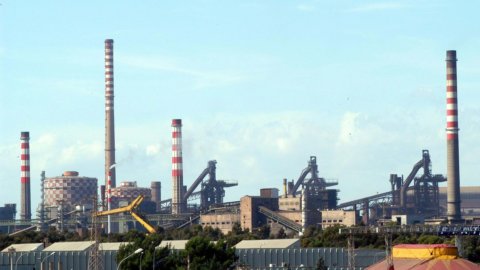
The crisis of the factory ex Ilva of Taranto risks becoming one of the most serious episodes of deindustrialization of our countryBut it also reflects the state of Italian society as a whole: social groups, political forces, and institutional bodies at every level, "ordinary" men and women. In some ways, it brings to mind Piero Gobetti's famous phrase, which defined fascism as "the autobiography of Italians."
The ruling groups of our country have long since given up on what should have been the most important steel mill in Europe? If the Taranto plant were to start production on August 24th shutdown of the last blast furnace (and consequently the steelworks and various plants connected to heat recovery and energy generation), only the rolling mills would remain. Thus, it would be inevitable to reduce the workforce by between 70 and 75%. This would reduce the current workforce from approximately 8.000 direct employees (excluding related workers) to between 2000 and 2400.
Without going into the merits of the real or presumed intentions behind the actions or positions taken by all the subjects involved - be they ministers, local administrators, magistrates, representatives of parties and various groups, trade unions and business associations - it is realistic that the Ilva of Taranto will soon inexorably face a strong structural downsizing, serious and irreparable in terms of employment. Closing the blast furnace, which produces steel of specific qualities that can only be achieved through the integrated process, would only allow the processing of slabs, the raw semi-finished steel products imported (it is said) from plants likely outside the EU. However, this solution would not protect against the risk of further downsizing.
But the most disconcerting thing is that not only has no real "movement" to defend the plant taken hold in Taranto, but also that there are many locals who would welcome the closure of Ilva as a great victory.
The worst would be for companies and their related workers, who have less bargaining power to defend themselves. However, given the average age of Ilva employees, the phenomenon of "Ilva laid-off workers" would diminish within a few years because the guarantee of social safety nets (which in this case could reach 100% of salary) would make the transition to retirement less painful. Nor can we realistically ignore the possibility that a portion of workers would be able to supplement their layoff benefits with paid "off the books" work. A perfect storm which is ultimately a model already widely tested both in the North and in the South, the latest case being that of the former Fiat in Termini ImereseThe closure of the Ilva steelworks in Bagnoli (part of the production ended up in Taranto) was managed with a reconversion agreement between the unions and the government that led to the closure of the rolling mill, which at the time employed around a thousand people, some of whom were relocated to other activities.
Taranto should have been the largest iron and steel center of Europe with all the resulting benefits for employment, growth, exports and so on. It should have been experienced as a identity symbol of the development of the South where job creation has a greater impact on the future of young people but also on public order and security.
Today, institutional actors, including magistrates and local administrators, political forces, and trade unions, seem to be addressing the issue from an essentially local and environmentalist perspective. But is the former Ilva steelworks in Taranto a national strategic issue or not? Once upon a time, a heated debate opened up on important cases, like when George Welcome intervened with an interview given to the unforgettable Beppe Turani on March 31, 1978, to call on the union to guarantee the production efficiency of the Alfa Romeo plant in Arese which, as a publicly owned company, was the heritage of the workers as well as the citizens. And what about the events at Fiat in Turin after the unfortunate intervention of Enrico Berlinguer? And of Bruno Trentin who resigned as head of the CGIL on July 31, 1992, after accepting an agreement he thought impossible to refuse but knew his organization did not share? Not to mention the controversy that opened in 1979 George Amendola with the union and with a part of the PCI, not sharing what he considered harmful extremism. On 22 October 1972, 50.000 people converged in Reggio Calabria on the initiative of the unions to demand the development of the South and oppose the "Boia chi molla!" of Ciccio FrancoIn Taranto today, the conditions for a "march of 40.000" like the one on October 14, 1980 in Turin to defend jobs at Fiat do not seem to exist.
Unfortunately, interlocutors are often lacking. The secretaries of the major parties say little or nothing, and the leaders of the major trade unions are not making the Taranto Ilva issue a priority for national industrial policy. They are not putting forward, in the name of the emergency, concrete proposals for the revitalization of the plant through intense company-level bargaining based on the principle of maximum plant utilization and a significant recovery in productivity as part of an environmental recovery plan. Italian industrialists are also absent, but some observe that it is difficult to put them first in the dock after what happened at the Taranto Ilva plant. Riva familyIn the transition from Fordism to automation and then to information technology, the changes were profound, but the transformation was governed, even though it involved fearsome social conflicts that isolated and even defeated terrorism. Is it still possible, as well as desirable, to build a solution that would restore to our country "the most important steel mill in Europe"? Ferruccio De Bortoli on the Corriere della Sera He launches the slogan: "Defend welfare." And he's right. But to finance welfare, we need to increase productive activities and the number of people in employment.
At certain times it seems to prevail resignation: someone familiar with the problems argues that, under current conditions, the combined effect of the legal action, environmental fundamentalism, and weak local administrators steeped in anti-industrial culture, prevents any hope of recovering the "large" steelworks. And that paradoxically, the former Ilva activities remaining in the North, such as that of Novi LigureResigning oneself to a fate that leaves Taranto with a largely abandoned factory, much like a horror museum, is a bit like receiving an inheritance one should renounce.
...
The author is president of the Anna Kuliscioff Foundation.