Less income = less consumption. Or not?
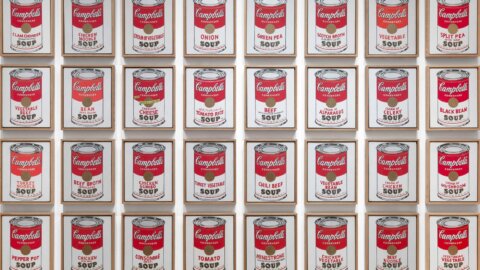
Never bet against the American consumer, Warren Buffet warned, meaning that American citizens are indomitable and incurable spendthrifts. Even when it seems impossible that they can further increase expenses, they do it in defiance of every law of gravity of income, debt, and prudence. Andy Warhol He celebrated American consumerism in many of his works, and the almost dreamlike sequence of Campbell's Soup cans is the most iconic.
Will they continue to spend more this time too? Maybe, but it's worth lining up a few more. reasons to worry of the number one engine (consumption amounts to almost 3/4 of GDP) of the American economy.
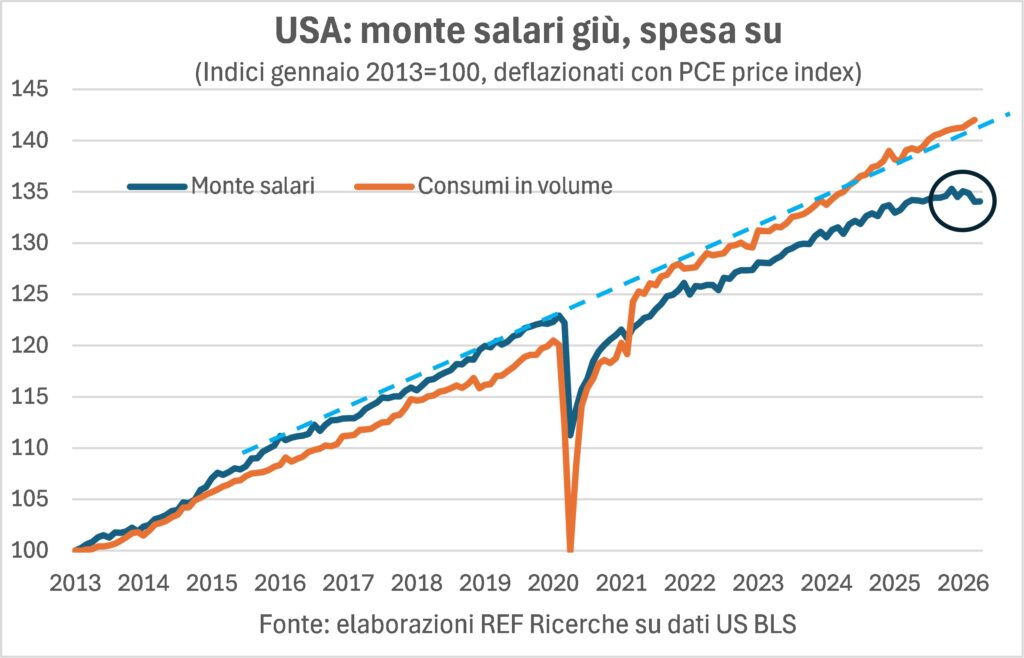
First of all, it is widening the gap between real wages (i.e., the main fuel for spending) and the volume of purchases. It is true that the wage bill does not include the 'fuel' that comes from income other than wages, transfers, and taxes. However, the share of wages in total income is practically constant, so these exclusions do not affect the wage bill's ability to represent the dynamics of disposable income.
This widening has already been highlighted in the past Lancette, which was accentuated in April with the wage, employment and consumer price data. In fact, the nominal wage bill it did increase significantly (+0,5% on March) but it was not enough to compensate for theincrease in the cost of living (+0,6%). Thus, in real terms, income from employment has returned to the level of June 2025, while consumption They are 1,9% higher in volume than they were then. Even using the consumption deflator, the gap only changes by 0,1 percentage points.
Excess savings on the decline
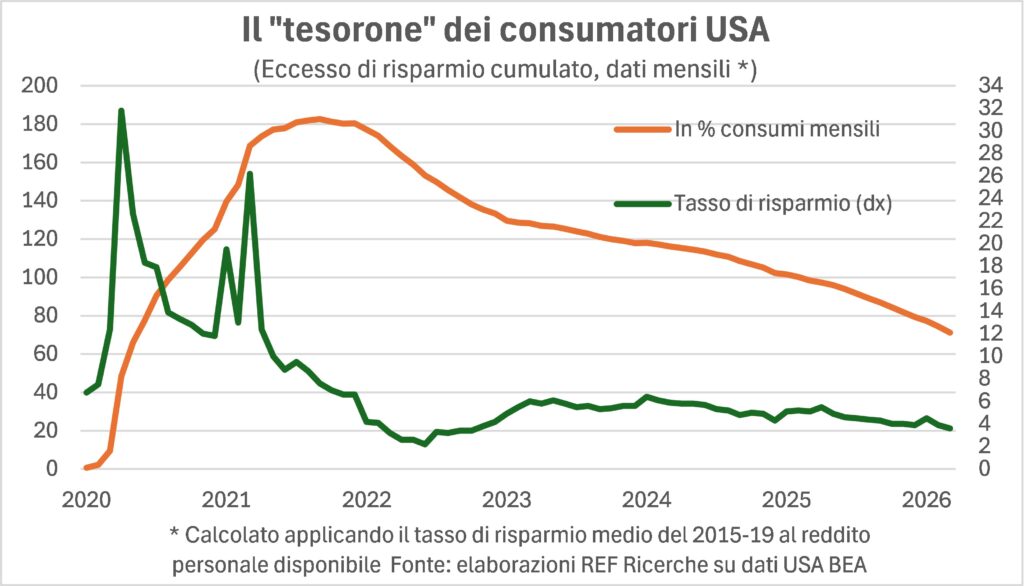
The trend towards a gap between wages and purchases has begun in the post-pandemic. And there had already been, then, an episode of decline in wage purchasing power with theinflationary surge, when in any case the quantity of consumption was not derailed, beyond oscillations often linked to weather factors (it also happened in February 2026). The explanation for this sort of consumerist levitation avoid any recourse to metaphysics: the constraint within the domestic walls has allowed, together with more generous unemployment benefits, to accumulate a “treasure trove”, which reached up to 182% of the monthly expenditure. This excess savings It has been gradually eroded, but it still represents 71% of that expenditure.
Physiological household debt
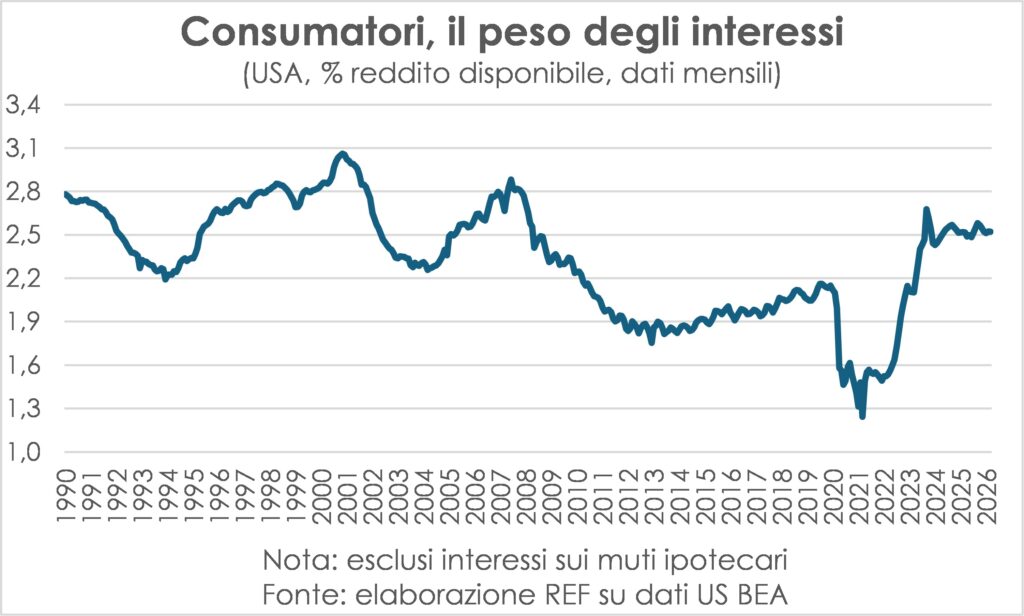
The erosion process has accelerated in recent months just as it had accelerated in 2022, when the price rally peaked. Naturally, this spending reserve It cannot last forever; in fact, many economists, based on other calculations, considered it over a couple of years ago, but evidently this is not the case. Because otherwise, either consumption would have started to decline, or the savings rate would have fallen even further (even below zero, a phenomenon observed a few decades ago), or debts would have skyrocketed (as has also happened on other occasions); or a combination of these variables. In fact, the most reassuring aspect is that the level of interest on debt, in relation to income, rose and then stabilized at non-alarming values, as did the delinquency rate (the % of installments on defaulted bank loans), which is physiologically low.
Many "doubters" about the AI boom...
Un another doubt which worries many (in Tuscany they would be called “cacadubbi”) concerns the duration and sustainability of the AI-related investment boom. In fact, much of the growth in US GDP in recent quarters can be attributed to such investments. This doubt takes various forms: the possibility of financing it, as the cash generation of the firms driving the boom dries up; the availability of electric energy to operate data centers and microchips of various kinds to make them happen;technological obsolescence acceleration of such investments, which reduces their convenience but at the same time makes more of them necessary; and so on.
The December 2025 Clock argued that this boom would not end this year and now we can see that both corporate returns on those investments are starting to materialize thanks to the spread of the AI application, especially by companies, both because the estimates of such investments are constantly upward magazines, so that the end is not in sight even in 2027. Especially since Trump's visit to Xi has strengthened the alliance between China and USA precisely on the technological front which naturally includes the exchange of rare earths for microchips and other sophisticated components.
…but it is spreading among companies and countries…
In fact, the AI boom is branching out into the entire global economy, supporting its growth. The AI supply chain It is very long and internationally complex, and new and greater investments are needed in every segment of it: from copper mines and other raw materials to the generation of more or less sustainable electricity (which also affects this supply chain), from the manufacture of microchips to that of the machinery to make them, from the demand for AI applications to the invention of the latter, and so on.
…and it will last a long time
In every junction of this supply chain There are companies that must decide on further investments, which require confidence that the new capacity that would be created by such investments will then be saturated, and since the doubters surrounding AI are particularly crowded (there are also regulatory issues at stake), this confidence sometimes exists and sometimes does not, so the transmission chain rotates at alternating speeds, depending on who and how much slows it down here and there. The end result, paradoxically, is that this push and pull prolongs life to the boom itself and its push to support global growth.
With the war, manufacturing wins, the Eurozone loses
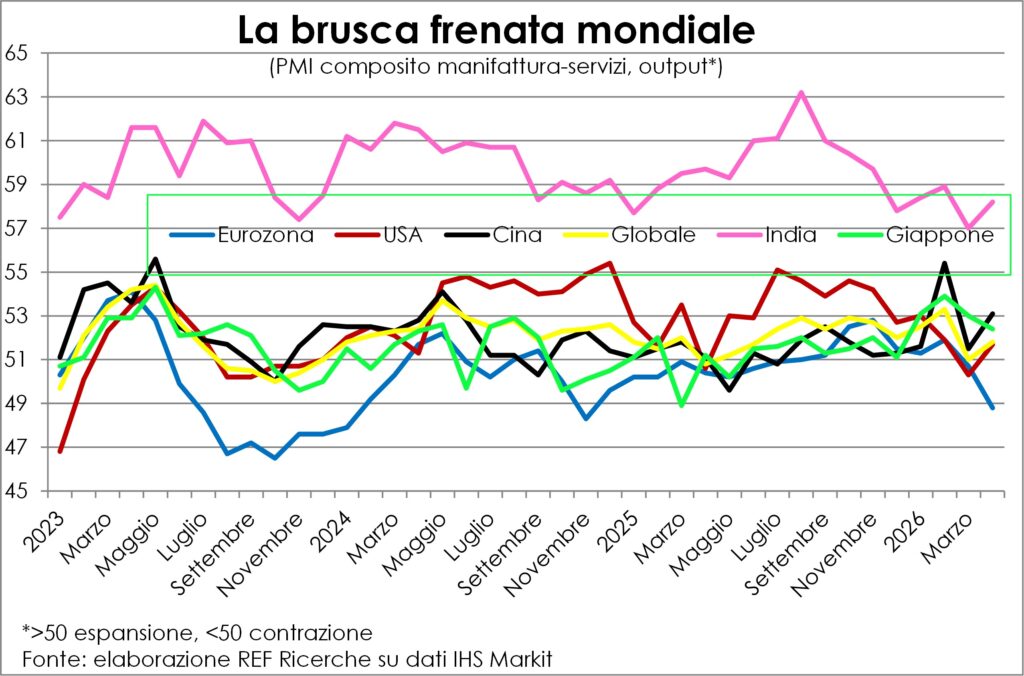
In this regard, it is worth reiterating what has already been observed in the March and April editions of the Lancette: Iran-US war It is not blind in dealing low blows between sectors and countries. Among the sectors continues to benefit the manufacturing, where orders are pouring in to avoid future delivery delays (already evident) and price increases (as well). While it takes a beating the tertiary sector, especially in services purchased by consumers (transport is expensive and slowed down by war and other events; even cruises now seem to be dangerous...). Among the countries, USA they get along with the China (which seems to have regained its verve) and to India, while paying duty on Japan and above all theEuro area.
Is it real inflation?
“Let posterity judge.” We can give the rhetorically evasive answer that Alessandro Manzoni puts in The Fifth of May regarding the glory of Napoleon. A question that the Lancets also asked themselves in the inflationary wave of 2021-22, and that now as then the questions are asked Central bankers. Who, like the generals, risk fighting the new anti-inflation war with the logic learned in the previous one. The fear of making another mistake in the underestimate the risk of inflation as they did last time he induced them to immediately stiffen your posture at least verbally of monetary policy. We remind ourselves and our readers that inflation is a self-perpetuating process of generalized increases in all prices, albeit at different speeds; otherwise, we are dealing with relative price movements (somethings cost more than others).
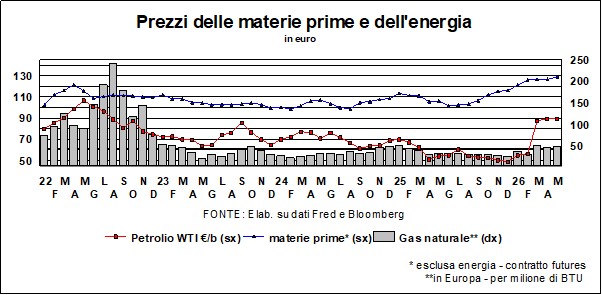
In fact there are similarities between the current inflationary episode and the one from three or four years ago. But there are also differences. The similarities lie in the supply shock: the closure of the Strait of Hormuz has pushed up the cost of oil, natural gas and their derivatives and has caused some shipping routes to be modified, extending delivery times as well as the costs. Instead, the question suffered two shocks in opposite directions in the two macro-sectors of the economy, manufacturing and tertiary (as mentioned above), plus the normal one of loss of purchasing power, which is deflationary.
The differences are more noticeable
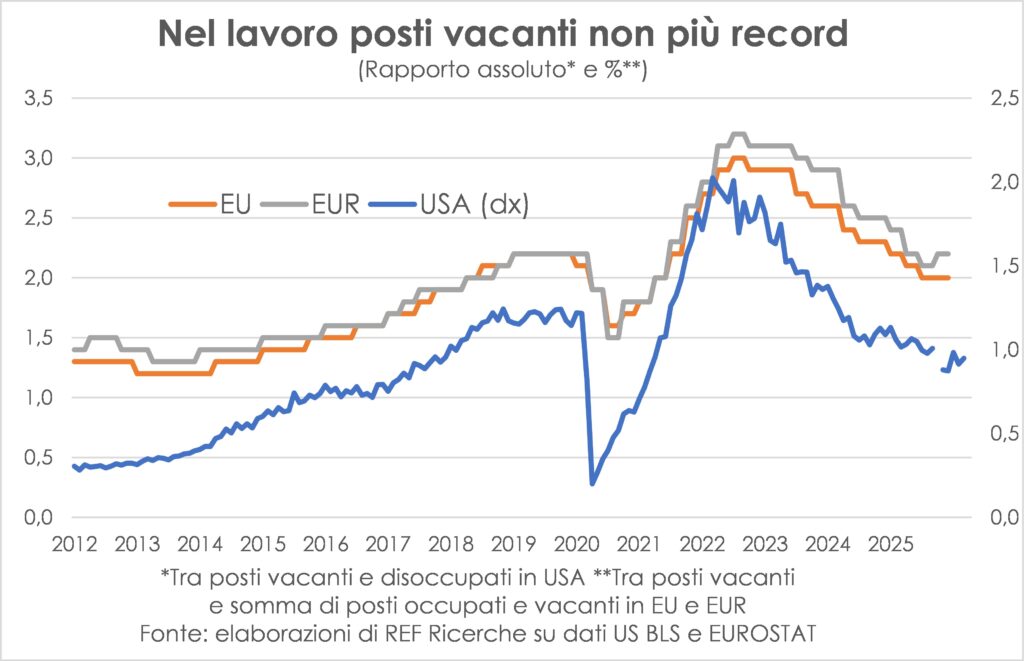
However, the differences appear greater today. First of all, in 2021-22 we were in full swing boom in demand post pandemic, boom supported by the large accumulated savings during lockdowns and from super-expansionary fiscal and monetary policiesToday, however, families still have a little bit of a nest egg (see the US case above), but they have they vent their anger in travel and shopping and appear inclined not to overdo it (the recourse to debt for consumption remains low), the their confidence is in sharp decline, labor income does not keep up with the prices, also because the Staff Application no longer exceeds supply as it did in that recovery phase (the vacancy rate has normalised on both sides of the Atlantic), so that the cost of labor is slowing down. Above all, the monetary policies are now neutral or slightly restrictive (except in Japan) and those of the budget It's true that investments in AI are driving demand, but at most this push offsets the drag of lower purchasing power from higher energy costs.
The truth lies in the duration
The needle on the scale, therefore, at this moment is in the balance and will move towards inflation or towards non-inflation depending on the duration of the closure of the Strait aforementioned. Negotiations continue, despite everything, and if Trump declares that taking enriched uranium from Iran is for reasons of "public relations (=I don't have to lose face?) rather than anything else" and that the Iranian sites are monitored "by nine cameras, 24 hours a day", he signals that this point is not a real obstacle to closing the deal. energy crisis timer, however, is advancing and is ever closer to the trigger.
Rates go up
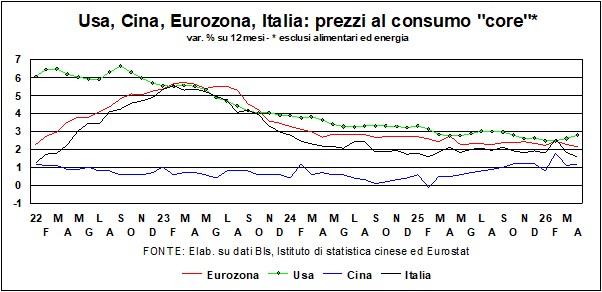
It doesn't take much to understand why rates are rising. Just look at what happens at theinflation, hit by rising energy prices (and not only that: raw materials other than energy are also rising, partly due to local problems, partly out of sympathy). It is true that consumer prices core (excluding energy and food) do not give any particular alarm signals, but it is just a matter of timeIf there is a 'raw material' that is omnipresent in the consumption and production of goods and services (yes, even cutting hair has energy inputs, and not just for the muscles and neurons of the barber), it is energy, and it is inevitable that those higher costs will percolate through the matrices of structural interdependencies. Unless there is a rapid reopening of the Strait of Hormuz that will push the oil price back to where it came from (a bit like the Austro-Hungarian troops described in the Victory Bulletin), and even further, given that the Emiratis have now decided to leave OPEC to extract more black gold (an additional reason for this "desertion" is now being discovered: they asked Saudi Arabia and other countries bordering the Persian Gulf to coordinate militarily in their response to Iran, receiving a resounding "NO"). But don't the interest rates think that, once the war is over, everything will go back to the way it was before?
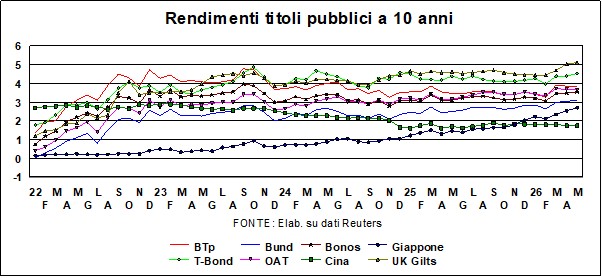
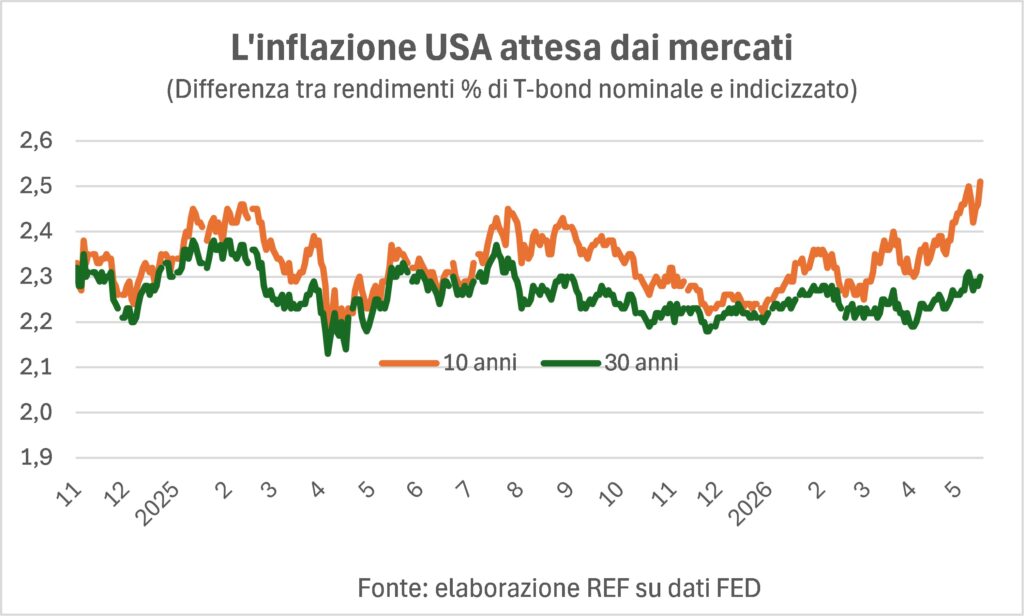
Maybe they'll think about it sooner or later, but for now their inflation expectations speak for themselvesIndeed, both the expectations revealed by consumer surveys and, above all, those revealed by the markets—see the graph of expectations calculated as the difference between the yields (10 and 30 years) on T-Bonds and the yields on similar inflation-linked securities—point to rising expectations. Indeed, the surge in oil prices has been accompanied by a similar rise in fertilizer and transportation prices. Both the 10-year and 30-year rates they are going up: at the head of the platoon there is the Britain, where the political crisis has played its part. The only exception is the China, where inflation is low (but shows signs of increasing) and rates too (but it is a market where the Central Bank exercises much more than moral suasion).
E the BTPsYields have risen close to 4%, a level which, if it were to continue for a long time, would lead to serious public finance problemsthat spread, which, at the outbreak of the war in Iran, had, Pavlovianly, shot up, has dropped somewhat, even if it has not returned to the deserved low levels of before the incident.
In the USA, in May, along with the blooming of roses, a new Chairman of the Federal Reserve also blooms. Kevin Warsh, confirmed by the Senate after the U.S. Department of Justice was forced to withdraw its vindictive impeachment of outgoing President Powell, he won't have an easy life.
It wasn't long ago that markets were divided in their predictions of how many drops in the key rate would be there by 2026. Predictions that were based on the common belief that, if Trump – a President hungry for interest rate cuts more than any other – had appointed Warsh, it was because the latter was in favor of lowering the cost of money. Those predictions were not actually based on ironclad certainties: Warsh, when it came to the count, only had one of the twelve votes of the FMOCHowever, the combination of a President willing to do (almost) anything, and a new Fed Chairman who is listening to the White House, seemed to tip the balance towards monetary easing.
Things have changed, and by a lot. Now, after a tombstone has fallen on the decline in interest rates, one wonders rather when will the first increase arrive?. A bit of all the Central banks they have their finger on the rate triggerIn the usual dilemma that keeps bankers awake at night – raising rates harms growth, not raising them gives free rein to inflation – the risk balance is teetering towards the danger of inflation.
Dollar still fragile, yuan firmer
The US currency has benefited little from thedisplay of military muscles by the United States. (Expensive) missiles and bombings did not force Iran to surrender, and rather reduced the Pentagon's ammunition stockpile. The Nobel Prize winner Paul Krugman He made a funny comparison with what happened in the first “Star Wars” film, where the “Death Star” – an immense spaceship that could disintegrate entire planets – was destroyed by small, agile rebel spacecraft, which had identified the enemy’s weak points.
Il dollar It should also have benefited from the increase in the price of oil, for at least two reasons: first, because it is the billing currency of crude oil; second, because the United States is the oil supplier of last resortThe taps on hydraulic fracturing wells have been opened, the US is exporting oil like never before, confirming its position as the world's leading producer.
If the American currency has benefited relatively little it is because there are well-founded doubts about the future of the economy: the trajectories of public deficits and debts are unsustainable, and America now spends more on debt servicing than on defense (and, incidentally, the weight of interests on GDP is even higher than in Italy).
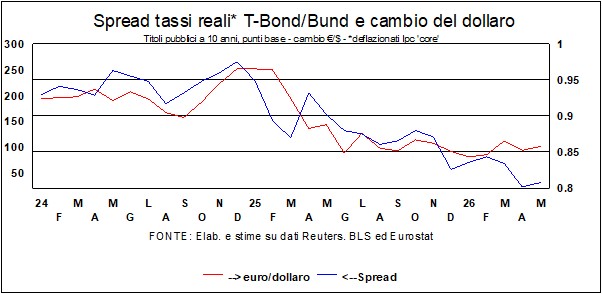
Instead, the exchange rate has moved little more than can be explained by more strictly traditional economic-financial reasons. The graph shows how the explanatory power of the euro/dollar exchange rate persists. long-term real rate differentialWhen the gap between the real T-Bond rate and that of Bunds narrows, the dollar becomes less attractive.
Lo yuanThe US dollar, like President Xi Jinping, increasingly appears to be the "adult currency" in the currency room. The exchange rate is stable and tending toward appreciation, as it should, given the prowess of Chinese exports. Tariffs have made little dent in the flow of goods to the rest of the world, which is driven primarily by AI-related components.
La oil crisis has also generated, in the world, currency crises, in the sense that it has pushed up the currencies of the countries that produce black gold – from Brazil to Nigeria – and put into crisis the currencies of the countries that have to import a lot of oil – from Indonesia to Egypt, from the Philippines to Thailand…–.
In many countries, the question is whether it is necessary to cushion the increase in energy prices for consumers (weighing on the public budget and consequently also on the exchange rates of their respective currencies), and the answers are different. First of all, theIndia had reduced taxes on those prices, now it has decided instead to let them increase to discourage consumption. Even theIndonesia It has a problem: a law, similar to Germany's now-defunct "debt brake," stipulates that the deficit must not exceed 3% of GDP (Maastricht must have been a lesson). And this year, the deficit risks exceeding that limit, also because Indonesia spends 2,7% of GDP on fossil fuel subsidies, mainly on discounts on gasoline and diesel.
Resilient stock markets
La hope She is not only the last goddess, but she also spreads her green wings over the here and now. historical records Stock market speculation has been rife since AI took over production and consumption (see above). For now, suffice it to say that stock markets see the glass half full (or rather, three-quarters full) and are looking at profits just around the corner. Compared to other industrial revolutions, this AI revolution brings with it a major difference: the famous "this time it's different" claim has a justification. For example, the benefits of electrification have unfolded over time, while AI needs huge investments before the benefits emergeAnd the stock markets are capitalizing on both the hopes of those benefits and the boost to GDP that comes from today's investments.
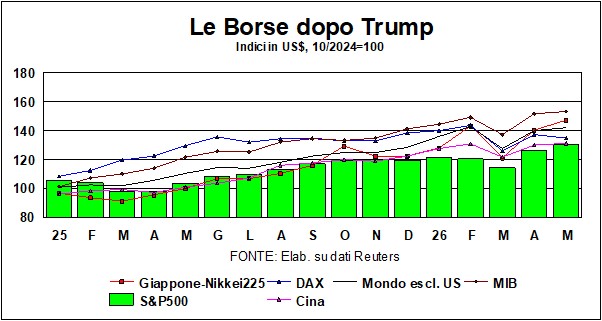
In any case, the anomaly already noted continues: in the epicenter of the AI revolution – the United States – Stock market grows less than in the rest of the world. The graph stands outItaly, where the MIB briefly surpassed 50. Young people are fleeing Italy, but capital is flocking to Piazza Affari.
We would prefer that the young remained and that the Eb were less lively. But the desire in this case is a difficult dream to realize unless the Italian work culture changes (which would also be beneficial for the country's profits and growth, but that's an old story).