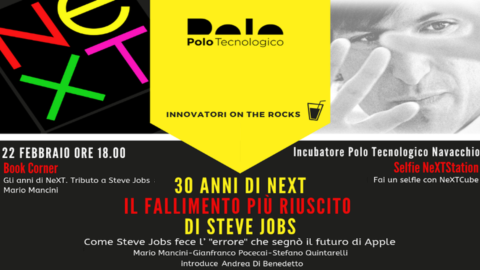
"The NeXT years. Tribute to Steve Jobs“. This is the title of the book edited by Mario Mancini which will be presented at Technological pole of Navacchio (Pisa) the 22 February 18, in the incubator auditorium. The initiative is organized as part of the “Innovators on the Rocks” programme. We will talk about the 30 years of NeXT: iSteve Jobs' most successful failure, a mistake that marked the future of Apple.
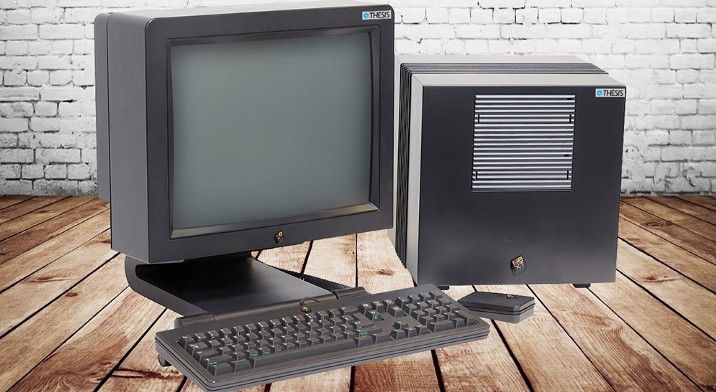
What is it about? In 1988 the marketing of NeXT began, the workstation created by Steve Jobs after his stormy exit from Apple in May 1985. Thirty years ago the first three magnetic-optical disc NeXTCubes arrived in Milan, Florence and Pisa. One of these specimens is in the Museum of Calculation Tools in Pisa. The Pisan museum also has one of the largest collections in the world of materials (hardware, software, peripherals, documentation, advertising) produced by NeXT and donated to the Museum by Thesis, one of the companies hired by Jobs to bring the NeXT to our country. Another large batch of NeXT materials is in the possession of the Science and Technology Museum of Milan, the second institution to which the Thesis donation went.
It can be said that in Italy there is one of the most important deposits of this important chapter in the history of the computer. And rightly so, because Jobs had a very special relationship with Italy and in particular with Florence. One of the people who most contributed to Jobs' education and who passed on his passion for form and harmony, i.e. design, was the Trappist friar of Italian origin Robert Palladino, his calligraphy teacher at Reed College in Portland where Jobs was a few years. One of the reference books of that course was of divine proportion of the Tuscan friar and mathematician Luca Pacioli who worked in Milan alongside Leonardo da Vinci, studying his formal method.
If we were to go to the sources of Jobs' culture we would find, in addition to the Californian counterculture of the sixties and seventies of the twentieth century, a mash-up between East and West, Japan and India (zen and meditation) on one side and Germany and the Italy (Bauhaus and Renaissance) on the other.
A chapter of the book is dedicated to Jobs' relationship with Italy and in particular with Florence 30 years of NeXT. Another chapter is devoted to Jobs' obsession with food with episodes that testify to his food tastes and idiosyncrasies. Jobs often played in public on the "mercurial" language, which was used to define his character. During the 1988 presentation of the NeXT on stage at the San Francisco Symphony Hall, he went to the online dictionary of NeXT to read the meaning given by Merrian Webster (who was online on the computer) and to compare it with its opposite “saturnine” and from the comparison conclude , to the hilarity of the audience: "Well I don't think mercurial is that bad."
NEXT SOFTWARE
But the most interesting part of the book concerns what happened to NeXT after the decision, in 1992, to cease production of hardware to devote itself entirely to software. A real turning point that led to changing the company's name to NeXT Software Inc. and starting the path to be listed on Wall Street. These are a few very intense years (from 1992 to 1996) and perhaps more important than the previous ones, from 1986 to 1992, which have been extensively studied and about which much has already been written. Avie Tevanian recently donated to the Mountain View Computer Museum a very important document which is the listing prospectus of NeXT Software presented to the SEC (Securities and Exchange Commission) in November 1996. A few months later NeXT will be incorporated by Apple.
It is a document of over 100 pages where all the activities of NeXT are reviewed and the financial statements relating to sales, costs and customers are outlined. This source shows how much work the NeXT team had done on all the hot technologies of the time and explains why all this technology then went on to re-found Apple and make it what it is now.
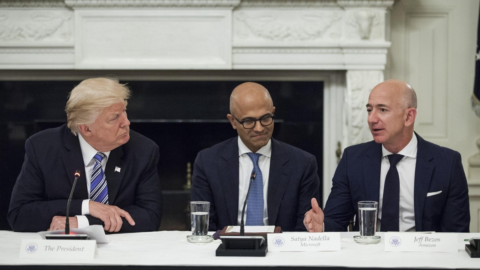
Just a couple of examples. In 1995 Jeff Bezos allegedly used the WebObjects tool developed by NeXT to build the Amazon online bookstore. The following year, Dell would use WebObjects to build its online store within months. Apple itself, almost a decade later, would turn to WebObjects to build iTunes. When it came to building the iPhone development system, the NeXTstep tool for building graphical interfaces was taken as it was, which also kept the same name: Interface Builder.
On the years between 1992 and 1996, covered by this extraordinary document, Mancini will dedicate a special study that will complete the existing one. He'll be out within the year.
NEXT. THE PERFECT SYSTEM
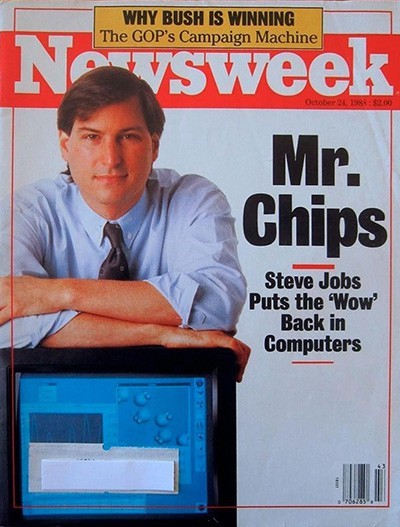
After leaving Apple, Steve Jobs concentrated his energies on two new companies: Pixar and NeXT. If the first was oriented towards developing software and hardware for the world of cinema, the second should have dealt with developing powerful machines like a workstation, but compact and easy to use like a personal computer. They were to be primarily intended for university campua.
The idea had occurred to him in August 1985 while talking to Nobel laureate Paul Berg. The scientist was explaining to him how many difficulties one had to face in conducting laboratory experiments in biochemistry, when Jobs intervened by saying "Why don't you simulate the experiments on the computer?".
It was precisely around this idea that NeXT took shape, a company aimed at satisfying the needs of those who had to process large amounts of data.
Precisely because of this new vision of his, not collected in Apple, Jobs together with a handful of "pirates" left the company he had founded, where, in his opinion, it was no longer possible to innovate.
At NeXT, Jobs wanted to produce a new concept of computer: it would be as beautiful as the Macintosh but as powerful as a workstation. The logo, the shape, the materials, the motherboard, even the screws, everything had to be of superior quality in the NeXT machines.
When the first NeXT product (the NeXTCube with the NeXTSTEP operating system) was presented on October 12, 1988, Jobs entered the scene like a magician telling reporters: “this is the time to present a new architecture destined to change the face of the world of computers". In fact, the machine presented was perfect, cubic in shape, with an excellent operating system and cutting-edge applications.
It was a full multimedia system with a digital signal processor for sound, it had voice mail, the operating system was based on a microkernel (the fundamental core of an operating system, ed) Unix optimized to the max, had a development system with entirely object-oriented, the developers had a tool graphic drag & drop to create system-consistent application user interfaces, used vector graphics, Postscript display, to display objects on the screen, had Render Man, the 3D language used by Pixar to create animated films, with the complete works of Shakespeare had the first ebook in history, he mounted an online dictionary that could be recalled from any application. In short, it was the perfect car… too perfect”
However, the NeXT machines never achieved great commercial success, they cost too much and were not very compatible with the rest of the IT landscape.
NeXT, despite its commercial failure, constitutes a milestone in Steve Jobs' journey since the technologies developed with NeXT and the people of the NeXT team will be the basis for the relaunch of Apple and all subsequent products including iOS, whose libraries begin with the prefix NS (meaning NeXTSTEP). NeXT is therefore the most seminal experience in Jobs' career.
THE BOOK
The NeXT years. Tribute to Steve Jobs
edited by Mario Mancini
creative commons 2019, goware
pp. 160
Ask for a free copy on the website of goWare