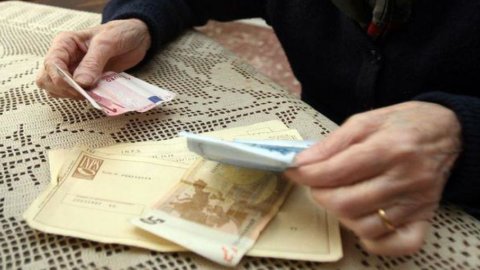
The recent decision of the Constitutional Court on the two-year block on the indexation of pensions exceeding 3 times the minimum has caused much discussion. And it will continue to do so. As could be expected, the sentence was welcomed by pensioners very favorably: "pensions must not be used as an ATM", i.e. to raise cash when the State needs to settle accounts. And, moreover, they shouldn't even act as a social shock absorber for those families who have to support their unemployed children. Above all, in Italy, where, incidentally, one in two young people cannot find a job.
The government's reaction was not long in coming. In just under two weeks, the decision was made for a phased repayment. Not for everyone, though. European constraints do not allow it, starting with the balanced budget that the Monti executive put into the Constitution, despite not being explicitly required by the fiscal rules, in particular by the Fiscal Compact. And, in fact, to date, only three countries have changed the Constitution: Italy, Spain and Slovenia (Germany had already done so in 2009).
For now, therefore, a "problem" that Prime Minister Renzi has defined as "not created by him" seems to have been resolved. In fact, that decision dates back to the winter of 2011, when Mario Monti took office. To bring debt back to a sustainable path and thus reduce the spread – which had exceeded 500 basis points – the freeze on pension indexation was considered inevitable. In hindsight, one may wonder if that cut was really inevitable. A careful analysis of the numbers provided in the Istat Report on the situation of the country published in recent days indicates, in reality, that there were alternatives.
To understand this, it is enough to look at the data on public expenditure in the period 2011-2013, to realize that it has not decreased. In reverse. It increased both in relation to GDP (by 1,8 percent) and in nominal terms (by 0,9 percent). To finance this increase, and at the same time reduce the deficit which had reached 3,5 per cent of GDP, the government increased revenues by 2,6 per cent of GDP and by 1,6 per cent in nominal terms. The tax burden thus increased from 41,6 percent in 2011 to 43,4 percent in 2013.
The high interest rates of the time obviously contributed to the increase in spending (about one and a half billion) but they weren't the only item. Primary current expenditure increased by 1,3 per cent in nominal terms. Among the current components, social benefits in cash (of which pensions account for about eighty per cent) increased by 15 billion euros, going from 304 billion to 319 billion in 2013. Intermediate consumption - one of the main items of expenditure which, for example, also includes the costs incurred for the fleet of vehicles - increased by around 3 billion (from 87 to 90 billion euro). Contributions to production, i.e. transfers from public administrations to businesses, were increased by 4 billion euros, from 23,5 billion to 27,5 billion. The only expenditure item that has recorded a substantial decrease is capital expenditure, which has gone from 62 billion to 58 billion euro.
What do these data say?
First, governments (including technical governments) always tend to cut capital expenditure - perhaps because the (possible) negative effects only occur in the medium/long term, a period in which the probability that the government is still in office is very small - only to announce publicly that it is necessary to increase public investment to give new impetus to the economy.
Secondly, it would have been possible to intervene on other expenditure items, such as that of intermediate consumption and transfers to businesses - as Professor Giavazzi proposed at the time -, considering that it is there that many of the wastes and inefficiencies of the use of public spending. The benefits - in terms of greater efficiency - would have gone to the whole community, while only some companies would have had to do without aid which often does not produce quantifiable positive impacts. It is clear, however, that intervening in these sectors means touching the interests of groups with much greater power of resistance than that of the recipients of a pension exceeding three times the minimum.
In essence, blocking pension indexation was an option. Certainly not the only one, though. Surely, it was the easiest to implement from a political point of view. But, don't technical governments (which in any case represent an anomaly of democracy) really serve to take measures that politics cannot implement?