The film "Painting lesson" directed by the deployed director Pablo Perelman and distributed in Italy by Ahora. Films, already competing for some of the most prestigious awards in Latin America, such as the Festival Internacional de Cine de Guadalajara Mexico, Festival de Cinema de Gramado Brasil, Festival Internacional de Cine de Valdivia Chile, Semana Internacional de Cine de Valladolid España, Festival Internacional de Cine de Punta del Este Uruguay, will hit theaters on October 2.
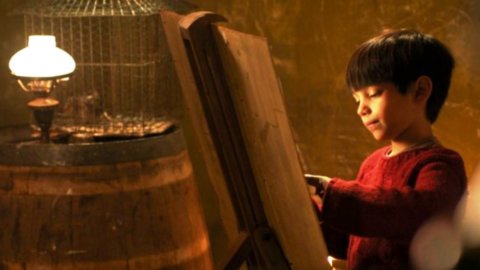
The subject is taken from the novel by the Chilean narrator Adolfo Couve (1940-1998), an incurable and solitary perfectionist by nature, who committed suicide in 1998, whose story so impressed Perelman that it led him to reproduce on the screen the birth of a child's artistic vocation , immersed in the rural countryside of Llaillay, where the story takes place. The boy, the son of a single woman, will find a mentor in the village pharmacist. In the cast the popular actor Daniel Giménez-Cacho, Verónica Sánchez, Catalina Saavedra and the very young Juan José Susacassa in the role of Augusto.
The film, while respecting the guidelines of the novel, deviates from them in a certain political approach: at a certain point it becomes evident that Perelman's work, through latent images, has recreated the painful experience of having lost a brother during the government of Pinochet.
The vicissitudes of Augusto, the child prodigy of Llaillay, are narrated by the voice of Aguiar, the community pharmacist, violinist and amateur painter. He begins to shape the boy's artistic talent. As the story progresses, the plot mixes, between consciousness and unconsciousness, until the protagonist finds the true creative impulse of him. The central conflict that the film deals with is deeply felt in the author's Chile: the sensation of having to face a secret reality, a particular way of conquering the world that can only be expressed through the materials of painting. "Painting lesson" can be read as an abstract aesthetic exercise in antithesis to the social condition of the country's political reality and, precisely as such, is destined to get lost and vanish into thin air like the little protagonist and his works, on the occasion of the coup of state of 11 September 1973.
“Painting lesson” is an expensive production by the local standard and was made thanks to a Chilean-Mexican-Spanish co-production, supported by the Aztec country in the person of Bertha Navarro, one of the most important producers of Latin American cinema (The Labyrinth del fauno) and former partner of Guillermo del Toro for Tequila Gang.
Synopsis: In Chile, during the 60s, a country boy, the son of a poor single teenager, proves to have a prodigious talent for painting. The man who discovers the boy's talent is the owner of a pharmacy on the outskirts of a small rural town. The man is in turn an amateur painter and will try to make the boy a great artist, like all those mentioned in his art books. The story is told from the point of view of the pharmacist who, in his old age, explains the story of this young boy who could have become a great genius of art, if only he hadn't disappeared at the age of 13, together with all of his works, on September 11, 1973, the day of the infamous coup d'état in Chile.