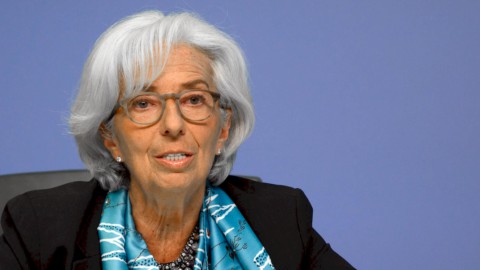
Monetary tightening against inflation continues. There European Central Bank raised rates further 50 points and announced a similar increase in March. Today's increase brings the rate on main refinancing to 3%, that on deposits to 2,50%, and that on marginal loans to 3,25%. The decision - reached with broad consensus, underlined the president of the ECB Christine Lagarde – was widely expected both by analysts and by the markets, so much so that the Stock Exchanges continue on their upward path (Piazza Affari +1%) the Italian 4,04-year yield slips to XNUMX%, on the day's lows, while the spread with the Bund giving up 10 basis points, at 189 points.
“The Governing Council will stay the course in continuing to raise interest rates in significant measure at a steady rate and to keep them at levels restrictive enough to ensure a timely return of inflation to its 2% target over the medium term,” he said Lagarde, during the usual press conference following the rate announcement.
The president of the ECB also reiterated that the ECB's determination to achieve the 2% inflation target in the medium term "it must not be doubted“, explaining that once rates are in restrictive territory there they will stay for some time to decrease inflation over time by curbing demand and to protect against the risk of a persistent increase in inflation expectations.
ECB Lagarde: “Further rate hike in March”
“The discussions in the Governing Council were characterized by a willingness to show continuity in monetary policy, as indicated in December,” Lagarde underlined. And it is in this spirit that the board announced that in March we will proceed with a new increase, again by 50 basis points.
“In light of underlying inflationary pressures”, the Governing Council of the ECB intends to raise interest rates by another 50 basis points at the next monetary policy meeting in March, to then “evaluate the subsequent evolution of its monetary policy", reads the note released by the Eurotower, which underlines: "Keeping interest rates at restrictive levels will cause inflation to decrease over time by curbing demand and will also protect against the risk of a persistent increase of inflation expectations. In any case, the decisions of the Governing Council on key rates will also be in the future data-driven and will reflect an approach whereby such decisions are made on a case-by-case basis at each meeting.”
The data-driven approach was also confirmed by Lagarde during the press conference. The number one of the ECB, speaking precisely of the latest data published, said that the Eurozone economy “slowed down significantly since mid-2022 and we expect it to remain weak in the near term”, while pressure on prices “remains strong”. The glass, however, appears to be half full, considering that “overall the economy has been more resilient than expected and will recover in the coming quarters”.
Not only that, confidence has increased, firms have large order backlogs, wages are rising faster, thanks to robust labor markets. But above all: "The energy price increases could dry up faster than expected". All these factors have made the risks to growth "more balanced", despite the war in Ukraine continuing to cause serious concern. Speaking precisely of the monetary tightening, Lagarde admitted: “There will be consequences, there will be secondary effects, especially on the banks. It is inevitable".
Lagarde: "With falling gas prices, reduce support measures"
“As the energy crisis becomes less acute, it's important to get started right away withdraw support measures in line with falling energy prices and in a concerted manner”. said ECB president Christine Lagarde, highlighting that “Any measures of this type that do not respect these principles will probably increase inflationary pressures in the medium term, which would require a stronger monetary policy response”.
Continuing to address governments, the number one of the ECB said: "In line with the EU's economic governance framework, budgetary policies should be oriented towards making our economy more productive and gradually lowering the high level of debt public".
ECB: reduction of the Paa program by 15 billion per month since March
The Eurotower also decided how to reduce the stocks of securities held by the Eurosystem within the framework of the Asset Purchase Program (APA). As communicated in December, the pace of the reduction will be on average equal to 15 billion euros per month since the beginning of March. The reduction will continue until June when the board will return to evaluate the pace to follow for the following months. “The partial reinvestments will be conducted substantially in line with current practice – the press release explains -. In particular, the remaining reinvestments will be distributed in proportion to the repayment share in the individual components of the APP and, under the public sector purchase program (PSPP), in proportion to the repayment share for each country and for the various national issuers and supranational. In the context of purchases of corporate bonds by the Eurosystem, the remaining reinvestments will be directed more towards issuers with better climate performance. Without prejudice to the ECB's objective of price stability, this approach will support the gradual decarbonisation of the Eurosystem's corporate bond stocks, in line with the objectives of theParis Agreement".
Even the BoE raises rates by 0,5%: “UK in recession
As expected, the Bank of England also announced an interest rate hike of 50 points at the end of the morning, bringing them to 4%. At its previous meeting in December, the BoE raised rates by 50 basis points to 3,50 per cent. For the British central bank, this is the tenth consecutive rise in interest rates. With this new increase, rates in the UK have reached their highest level since 2008.
According to the BoE forecast in January, the UK has entered a recession. According to central bank experts, the recessionary phase will last five quarters but will be shallower than expected. In detail, the British GDP is expected to decrease by 0,5% in 2023 and by 0,25% in 2024, determining a recession “much less deepversus 1,5% and 1% expected last November. The central bank also noted that theinflation overall has started to decline “and is likely to decline sharply over the remainder of the year due to past movements in energy and other commodity prices”. However, the job market “remains tense and domestic price and wage pressures were stronger than expected,” suggesting risks of a more persistence in underlying inflation.
“The Monetary Policy Committee will continue to closely monitor indications of persistent inflationary pressures, including tight labor market conditions and the behavior of wage growth and services inflation,” reads the statement released at the end of the meeting. – Should there be evidence of more persistent pressures, it would be necessary a further tightening of monetary policy".