Argentina could turn to the financial markets in 2012 in search of fresh money to pay off the debt and cover a fiscal surplus that is shrinking in the face of the erosion of the Central Bank's reserves. This would put an end to a decade of absence in the international financial centre.
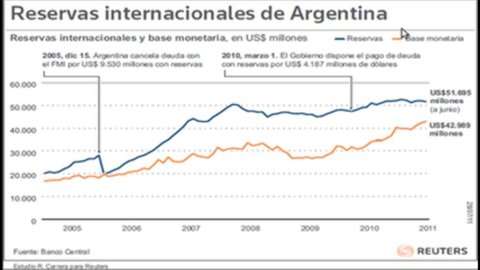
The reserves that the Central Bank can freely use, which are the excess of money on the monetary base, totaled 8.706 million dollars in June, almost half of the 16,9 million in the same month of 2010, according to data from Banco Mariva . Meanwhile, the country's international reserves stood at $52 billion, just $3 billion higher than last year's level, when the government began using them periodically to pay off debt in foreign currency to private creditors.
According to analysts, the country's reserve mattress could be insufficient to cover the financial needs of almost 9 billion dollars in 2012. This could thus boost the first international issue since the default in 2001.
Beyond this sum, additional payments could be added if Argentina manages to make an agreement next year with the Paris Club, with which it is negotiating a normalization of the defaulted debt of between 8,5 and 9 billion dollars. The agreement with these creditors would facilitate the country's return to the global financial markets, from which it has stayed away after the trauma of the non-payment of 100 billion dollars of debt in the 2001 crisis. “Free reserves could end (..) With this basic scenario, the return of the Government to the markets seems the most probable option” reads a report by Banco Meriva.
Less cash on hand. Barclays estimates that Argentina's fiscal deterioration will revolve around half a point of GDP next year, taking the primary fiscal deficit up to 1,4%. This calculation does not consider the revenues of the central bank and the contributions of the state pension company Anses, which the government includes in its report on the performance of the public sector.
Furthermore, the economy is growing at a lower rate than that estimated for 2011: 4,3% against 8%. Added to this is a loss of reserves of about $4 billion due to a larger current account deficit, a large capital outflow and debt payments.
But the government, which last year proposed a $1 billion issuance in a new 2017 global bond along with a revaluation of unpaid debt up to $18,3 billion, doesn't seem keen on the idea of jumping back. immediately in the markets. “It went badly when Argentina resorted to the capital market,” Deputy Economy Minister Roberto Feletti said this month.
There are many politicians who credit President Cristina Kirchner with the skill of having managed not to send Argentina onto global markets. The Government assures that there is room to cover the costs of the debt, which would average 2,8% of GDP each year until 2015, while the debt with private creditors would not exceed 1,5% of GDP.
No hurry. Argentina's gross public debt amounts to 173,14 billion, or 46,3% of GDP. Half is in the hands of public bodies such as the Central Bank and Anses, 36,1% in those of private creditors. According to the National Public Credit Office, the debt whose refinancing is subject to "market risk" is equivalent to 16,7% of the country's GDP.
In 2010, Argentina used central bank reserves to repay its creditors and generally uses state entities, in surplus, to finance itself. “I believe the debt payments will continue to come from reserves. If the current government wins the elections scheduled for the autumn, this scheme will continue and they will be financed with Anses (the national insurance body) and with internal debt issuance”, said Ricardo Delgado, Analytica analyst.
However some banks believe that Argentina will be able to seek up to 3 billion in the markets after December. Economist and consultant Gabriel Rubinstein said the country “will have to struggle with various alternatives. It can take refuge in international and local markets, especially in banks, place bonds in banks. Or devalue for more central bank excess reserves.” A greater devaluation of the peso would make it possible to decrease the monetary base measured in dollars.
Gradual deterioration. In June, Argentina's primary surplus, a key indicator that measures a country's ability to honor its financial compromises, fell 65,5% to $217,6 million.
In turn, the current account, the largest measure of a country's trade with the rest of the world, posted a deficit of $673 million in the first quarter, compared to $486 million a year earlier and despite high for its grain exports.
"Recourse to international markets seems to be the option that the government should consider next year," said Nadin Argañaraz, the president of the Argentine Institute of Fiscal Analysis (Iaaraf).
Source: America economy