How much does a Made in Italy current account cost? And how much if the bank is foreign? The comparison, based on the latest survey carried out from SosTariffe.it, highlights a disparity in costs of Italian banks even if the banks are not all the same. A result largely linked to consumption habits which still reflect a distrust of digital payments and a greater propensity to use cash in Italy. Just think that in almost all countries, payments are made by card or app on the phone (even for a simple coffee), while in Italy many shops still do not have a POS.
The survey examines three different ones consumption profiles: singles, couples and families with children. According to the results, the latter are the most penalized in the choice of the Italian credit institution, arriving at spending on average about 28,12 euros more compared to the annual costs they could incur relying instead on a foreign bank. Furthermore, the survey distinguishes the prices in the case of transactions in branches, ATMs and counters, or telematic use (internet banking). And here too, Italian banks cost more, even for those who opt for mixed use, online and offline.
From the study, banking services through traditional use, on average they cost more in Italian banks than in foreign ones. The same goes for singles, with an annual cost of 78,32 euros, while with a foreign credit institution you would pay 65,70 euros. But couples are the ones most penalized, going to pay 27 euros more by choosing an Italian bank. On the second line families, to access the same services, spend 105,50 euro in a year, against the 79,10 they would spend with foreign banks.
Not better for online banking services. Choosing the internet banking of an Italian credit institution costs around 20 euros more for a single person, 25 for couples and 30 for families. The same applies in the case of mixed use, both traditional and electronic, of the current account, where families are always affected the most, with an annual expenditure of more than 28,29 euros.
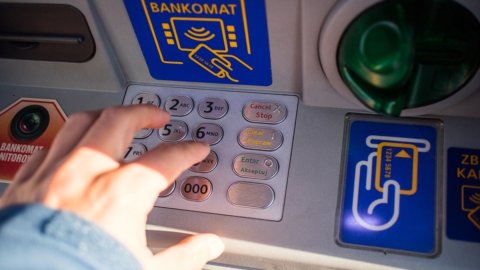
Let's move on to individual banking operations, where there are large price differences. Over the counter transactions, for Italian banks, are generally around 1,74 euro, while foreign ones around 1 euro. The same goes for wire transfers, arranged in the branch, where Italian banks cost us approximately 3,77 euros, and foreign ones 3,33. A few cents of difference, but which are perceived more in case of withdrawals from the ATMs of other credit institutions. In this case, Italian banks impose an average commission of 1,52 euros, compared to only 0,45 euros for foreign banks. Same prices applied for withdrawals from ATMs in other EU countries.
The annual fee is the parameter that most reveals the difference in costs, equal to 23,26 less for foreign credit institutions. Like the annual fees for credit and debit cards, with a cost of 6,85 euros for credit cards, while debit cards are free in foreign banks.
So the comparison is always negative for the Italian bank? No, in fact ATM cash withdrawals are cheaper in Italian banks: the commission is around 1,80 euros, while foreign credit institutions impose a much higher commission of 3,50 euros. On the same wavelength are payments of cash and checks, which cost 0,96 euros, against 1 euro for foreign banks.
It is a new confirmation that Italy is still behind on electronic payment methods. In the digital age, where operations, especially banking ones, are possible with just a few clicks, we remain anchored to an obsolete system, favoring operations that other countries try to penalize instead.