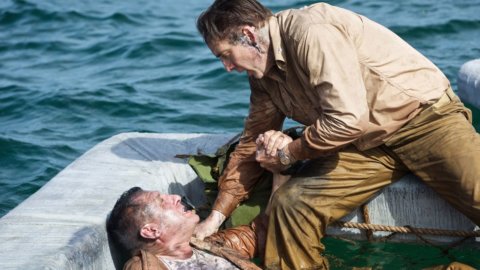
Who knows why the mother of all warriors is always pregnant? Cinematographically speaking, one might ask why war film writers are always in production. He just appeared in USS Indianapolis theaters a few days ago by director Mario Von Peebles with Nicholas Cage in the lead role. We immediately forget: the true story of the American cruiser sunk by a Japanese submarine at the end of the Second World War is not a film destined to enter the annals of cinema. Mediocre screenplay, B-series special effects, various narrative mistakes. Yet, as often happens with this type of product, you can find a reason for it. First of all, perhaps, because the "war film" typology always and in any case finds its loyal audience (a lot of subject for psychologists, anthropologists, sociologists), then the appearance in this period of low turnout in cinemas justifies the ticket to go to the cinema in the cool of the air conditioning.
Unfortunately, there isn't much more to add about the USS Indianapolis, except to report a significant sentence: “Wars are good for business and business is good for America” which speaks volumes about a certain way of seeing war conflicts, about why they are unleashed, about their morality. From this point of view, an important aspect can be seen in this film: it reminds us that behind weapons, more or less sophisticated, there are human beings with their strengths and weaknesses, heroes and cowards, the generous and the greedy. The true story of the American ship sent on a secret mission to contribute to the last, dramatic act of the Second World War, the atomic bombs on Japan, imposes reflection once again on how vast the boundaries of war madness that men are capable are to express. If only as a reminder of all this, USS Indianapolis can be seen. Attention for those who are attentive to detail: in some scenes, the special effects not even in the 70s were of such a low level, almost like a comic book and not to mention the sharks that seem to have been taken from an aquarium and stuffed with chamomile tea.
However, we take the opportunity, given the summer period, to propose an invitation to the cinema for the holidays and let's start from this kind of film. First of all like reviewing old cinematic glories. For those who are lucky and find some arena with a proposal of this type, don't miss the opportunity: seeing a good film, perhaps on uncomfortable oratory chairs, but outdoors and under the stars is always a beautiful emotion. Otherwise, a DVD or VHS is not lacking in any home and this kind of film is usually found quite easily, even on sale at newsstands.
We offer you our short list, not necessarily in order of liking, but respectful of the big names and the most significant images. How not to put The Great War first (Monicelli, 1959) with the unforgettable Alberto Sordi; on an equal footing, albeit for different contexts, Apocalypse Now (Coppola, 1979) and Battleship Potemkin (Ejzenstein, 1925): two absolute masterpieces that still provide food for thought of all kinds, to see or revise without fear of getting bored. In third position a master of war scenes: Akira Kurosawa with at least two proposals: Kagemusha (1980) and Ran (1985), few special effects but great movements of extras. Another great master Stanley Kubrick with at least two proposals: Paths of Glory (1957) and Doctor Strangelove (1958) which, although it does not strictly belong to the "war" genre, is fully in the wake of the subject. To remain on the theme of conflicts at sea and given that we talked about submarines with the USS Indianapolis, it can be included in the U 571 list (Mostow, 2000).
The list could go on and on. We limit ourselves to recalling The Bridge on the River Kway (Lean, 1957), The Great Escape (Sturges, 1963) and Inglourious Basterds (Tarantino, 2009). Fans of the genre are spoiled for choice.