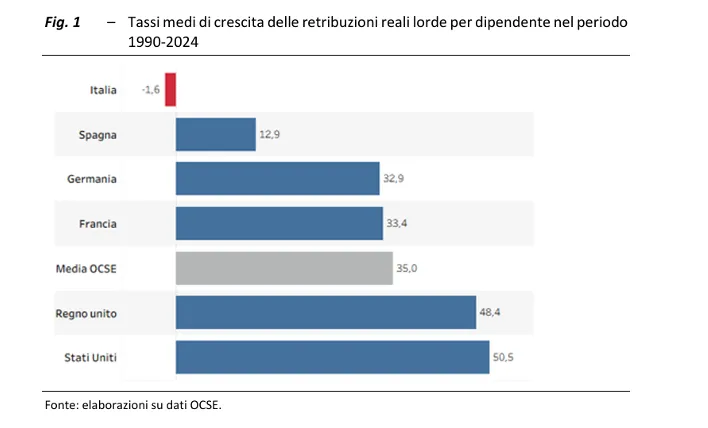
Even the authoritative Parliamentary Budget Office (Upb) deals with the wages Italians, a topic that has long been a source of concern and criticism. Working Note No. 1 of 2026 addresses the issue of wage dynamics and the role of personal income tax (edited by Stefano Boscolo, Corrado Pollastri, and Lorenzo Toffoli) with the aim of observing the wage dynamics of employees in Italy. from the 1990s to today and to analyze the role of Irpef in supporting net wages and mitigating inequality. The Note begins with the act of contrition that political and trade union oppositions recite whenever any topic is addressed (for example: "It's stopped raining, the sun is back," says a government official; "Yes, but wages are low," responds the opposition). "Wage trends in Italy," it is reiterated, "appear unfavorable in international comparison. According to OECD data, gross wages per full-time equivalent (FTE) employee decreased in real terms by 1,6% in the period 1990-2024, compared to significant increases recorded in the main advanced countries. For example, France e Germany have recorded increases of more than 30%, while the Spain A growth of 12,9%. Wage growth was also strong in Anglo-Saxon countries, with the United Kingdom at 48,4% and the United States at 50,5%. He continues relentlessly: "The picture would not undergo substantial changes if we limit the analysis to the period 1990-2018, that is, excluding the effects of the pandemic and the subsequent inflationary surge. In this period, Italy recorded real growth in gross wages per full-time equivalent employee of 2,8%, well below the increase in real GDP per hour worked, equal to 18,4%.
Part-time work and job inconsistency are holding back wages.
These trends are accompanied by the spread of part-time contracts, rose from 4,1% to 30,2%. Part-time work in Italy primarily affects women: in 2024, it involved 44,3% of female employees in the private sector, compared to 15,6% of men. According to Eurostat data, at least half of part-time work is involuntary.
However, within this framework, characterized by the increase in part-time work, growing employment discontinuity, and insufficient growth in gross wages, numerous personal income tax reforms are impacting the dynamics of net wages. Over the period considered, a progressive intensification of the tax interventions aimed at supporting the lower income from employmentThis trend has become particularly evident since 2014 with the introduction of the Irpef bonus and has continued in the following years until the recent transposition of the contribution relief in the tax structure in 2025. This set of measures, aimed exclusively at employees, has selectively increased the tax's progressivity for this segment of taxpayers, according to the UPB. Over time, these policies have thus accentuated the redistributive function of IRPEF for employment income, which appears to have gradually shifted not only toward ensuring fairness of taxation among taxpayers with different taxpaying capacity, but also toward compensating for market dynamics through direct support for lower wages. This evolution has occurred in parallel with a progressive erosion of the IRPEF tax base, due to the extension of proportional substitute regimes (flat-rate tax, flat-rate regime) to other income categories.
Comparison with Europe on part-time work
In the 1990 part-time work represented just 4,4% of the sample analyzed; in 2018, this share reached 31,5%. At the same time, thefull-time employment For the entire calendar year, which in 1990 involved almost 60% of workers, has fallen to 45,3%. This is not a marginal change, but a genuine reconfiguration of the ways in which Italians participate in the labor market. This transformation – states the UPB – produces mechanical effects on average wage dynamics. Since part-time workers by definition earn lower annual wages than full-time workers, the growth in their share of the workforce exerts downward pressure on the overall average, even if individual wages within each group remain stable or even increase. However – we dare add – no one bothers to point out that in countries where the employment rate is higher, including among women, part-time work is also more widespread. The percentage of workers with a part-time contract in EU countries in 2018 highlighted that almost half of Dutch employees work part-time (46,8%). Switzerland (38,5%), Austria (27,6%) and Germany (26,8%). In this ranking, Italy was in tenth place with 18,3% of part-time workers of all employed people. In essence, part-time work, which in other countries is considered a tool for flexibility and work-life balance, is considered precarious in our country.
Real wages: lower incomes are particularly penalized
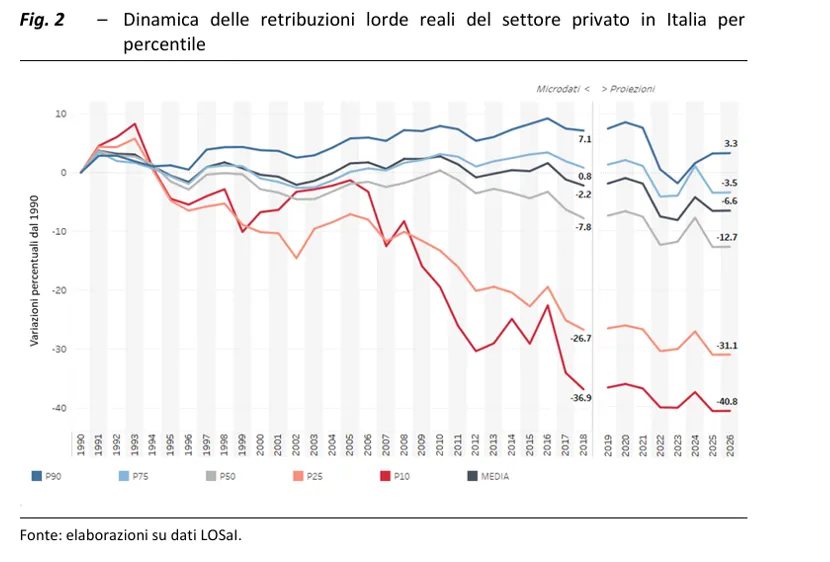
The Note then indicates the research methodologies and the related statistical sources. A first element that emerges from the analysis of the administrative microdata is the confirmation of the decline in real wagesAs shown in figure 2, on average, in the sample used, wages decreased by 2,2% between 1990 and 2018 and by 6,6% until 2026. The average change summarises divergent trends between the different segments of the wage distributionAt the lower end, the tenth percentile (P10) recorded a particularly sharp contraction, equal to 40,8% in real terms. In the central part of the distribution, the trend appears less unfavorable: the twenty-fifth percentile (P25) shows a decline of 31,1%, while the median (P50) decreases by 12,7%, a more pronounced change than the average. At the top of the distribution, the seventy-fifth percentile (P75) records a limited reduction (3,5%), while the ninetieth percentile (P90) records a growth of 3,3%.
Since 1990, Irpef has moved from a moderately progressive tax on employee income to a markedly progressive system, characterized by strong support for lower incomes and an increasing tax burden on higher incomes.
The UPB's conclusion: the tax authorities protected the most vulnerable incomes.
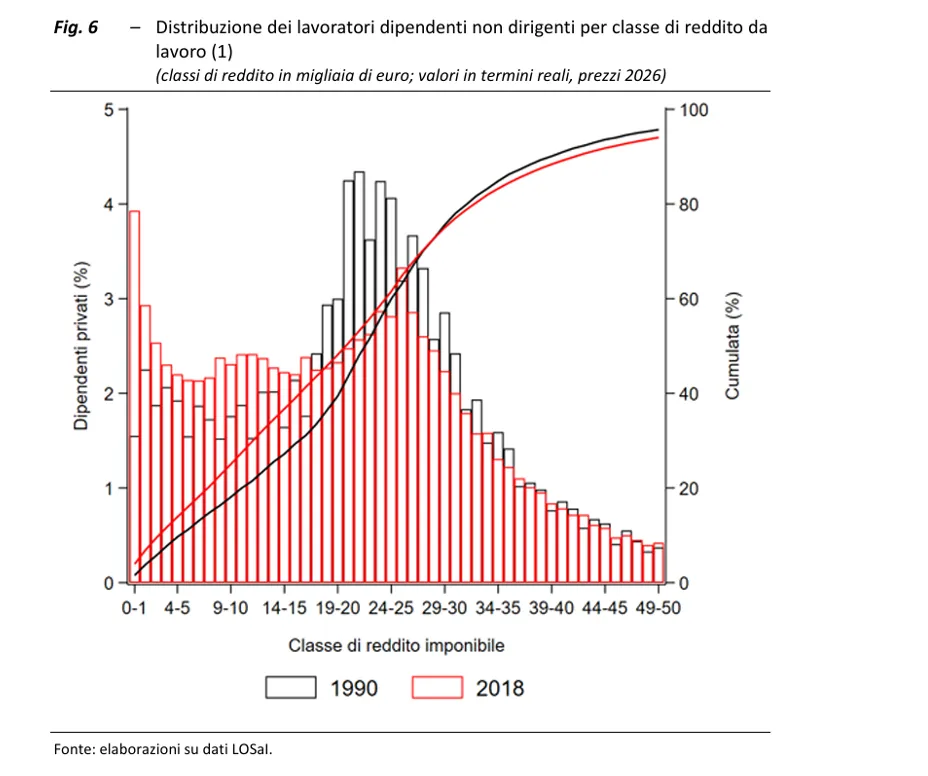
To fully understand the scope of this transformation, it is useful to identify the threshold which allows you to divide the income distribution in the two segments characterized by opposing tax trends. This threshold was calculated by identifying the level of taxable income, net of social security contributions paid by the worker, at which the effective tax rates for 2026 and 1990 become equal. This value stands at approximately €35.100 per year at 2026 prices. Below this threshold, the 2026 IRPEF structure is on average more generous, in real terms, than that of 1990; above, however, it is more onerous. This inversion reflects the redistributive choices made during the observed period: reforms have progressively concentrated tax breaks on middle-lower part of the distribution, while for medium- to high-income earners, the tax burden, in real terms, increased primarily due to fiscal drag. The distribution of workers above the €35.100 threshold has remained essentially stable over time. Around 83,7% of the total number of workers and employees in the sample received an income from work below the threshold in the period 1990-2018 and this share has not changed significantly over time, going from 84,9% in 1990 to 83,3% in 2018. Although the distribution of taxable income has shown different characteristics over time (Fig. 6), the share of overall income held by workers with wages below the threshold shows only a slight reduction, going from 68,8% in 1990 to 62,3% in 2018. In contrast, the share of personal income tax paid by this segment of taxpayers (net of the personal income tax bonus) shows a more marked contraction, falling from 59,9% to 40,4%. The gap between the reduction in the income share and that of the tax share is an indicator of the redistributive and income support footprint of the Irpef revisions. In absolute terms, the number of workers and employees in the segment considered grows significantly in the period observed (from 11,0 to 15,3 million), with a particularly significant increase in components female (from 3,7 to 6,1 million), in the context of a general increase in employment.
In essence – it is good that you take note of this Maurizio Landini – fiscal measures have protected against the peak of theinflation and from fiscal drag on low-middle incomes, which then constitute the majority of the incomes of Italian private workers. Which other country can claim to have done as much? Of course, this isn't the solution to Italy's wage problem, as its effects are now behind us, and we can't penalize the highest incomes, which also concern the portion of taxpayers who bear the largest share of personal income tax revenue. But it would be appropriate to acknowledge what has been accomplished, which is remembered every time mourners shed tears over "starvation wages."