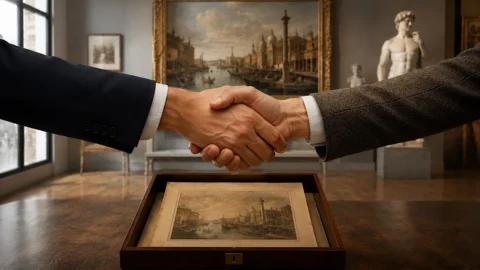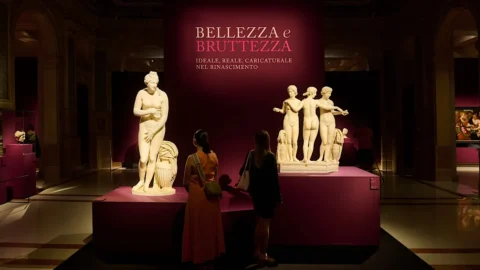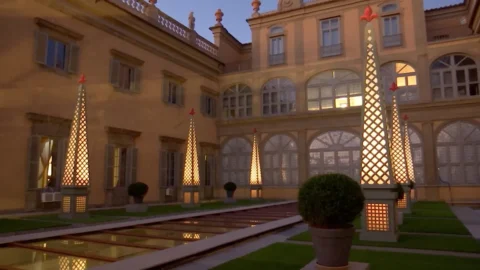
The history of the Biennale largely coincides with the history of post-World War II Italian antiques and recounts the evolution of a market that, over the course of over sixty years, has transformed from a place of buying and selling to a laboratory for research, protection, and promotion of cultural heritage. The idea was born in 1953 thanks to the antiques dealer Luigi Bellini, who imagined Florence as the ideal place to bring together the best expressions of Italian antiques. However, it was in 1959Thanks to his sons Mario and Giuseppe Bellini and the nascent Associazione Antiquari d'Italia, the first edition of the Biennale took shape inside Palazzo Strozzi. The goal was twofold: to promote awareness of Italian art and to consolidate a market capable of engaging with major international collectors.
The choice of Florence was not accidental
The city was the very symbol of Humanism and the Renaissance, the place where art, beauty, and knowledge found one of their highest expressions. From its inception, therefore, the Biennale was not conceived as a simple commercial exhibition, but as an event capable of uniting culture, research, and commerce. Its success was immediate. Collectors, scholars, museum directors, and cultural figures flocked to Florence from around the world, contributing to the event's international prestige. In the 1960s, the Biennale also became one of the most exclusive events in European cultural life, frequented by figures from film, literature, and international high society. At the same time, it helped transform the role of the antiques dealer, who from a simple dealer was gradually recognized as a connoisseur, scholar, and interpreter of art history. Not even the flood of 1966 managed to interrupt this process. Despite the grave consequences for Florence's artistic heritage and for the antiques dealers themselves, the Biennale resumed its regular schedule the following year, also becoming a symbol of the city's cultural rebirth.
Over the decades the event has evolved together with the market
After the years spent at Palazzo Strozzi, the definitive transfer to Palazzo Corsini In 1997, it further strengthened its identity, offering a framework capable of enhancing the dialogue between historic architecture and works of art. At the same time, the scientific rigor of the selection of works increased through an authoritative vetting, entrusted to art historians and specialists, based on quality, authenticity, provenance, and state of conservation. This system has helped consolidate BIAF's reputation as one of the most reliable markets internationally. The Biennale has also played a key role in bringing the market closer to cultural institutions. Collaboration with superintendencies, museums, universities, and the Carabinieri (Italian National Police) for the Protection of Cultural Heritage has fostered a model in which scientific research and commercial activity are not considered opposing entities, but complementary components of a single system for the valorization of cultural heritage.
The 2026 edition will take place during a period of profound transformation in the international art market. The changeover at the helm, with the new Secretary General, will be Bruno Botticelli, is accompanied by a vision that aims to reaffirm the value of uniqueness, authenticity, materiality, and durability in an era dominated by digitalization and artificial intelligence. Great attention will also be paid to young people, education, and the dialogue with design, fine craftsmanship, and Made in Italy, confirming the desire to expand the Biennale's role beyond the confines of a traditional exhibition-market.
The 2026 edition confirms BIAF's position among the most exclusive events on the international antique art market. The halls of Palazzo Corsini will host approximately eighty of the most prestigious Italian and international antique galleries, selected through a rigorous admissions process that prioritizes the quality, authenticity, provenance, and historical-artistic relevance of the works. This choice confirms the Biennale's desire to maintain a deliberately elitist profile, prioritizing excellence over large numbers.
This edition is expected to see the participation of thousands of collectors, museum directors, scholars, curators, advisors, market professionals, and enthusiasts from around the world. Despite the lack of an official visitor forecast, the Biennale continues to be one of Florence's main cultural attractions, helping to draw a high-profile international audience and generating significant economic benefits for the city. The event thus confirms itself not only as the most important global event dedicated to ancient Italian art, but also as a meeting point between the market, research, collecting, and cultural diplomacy.
Numbers, however, only reveal part of its importance. The true strength of the Biennale lies in the quality of the dialogue it fosters between institutions, museums, foundations, antique dealers, scholars, and collectors. It is this relational and cultural capital that, for over sixty years, has made the BIAF an international model in which the market is not separated from scientific research, but becomes a tool for its valorization. At a time when the art system is called upon to redefine the relationship between economic and cultural value, the Florence Biennale continues to demonstrate that the authority of a market stems from the credibility of its expertise and the quality of the relationships it is capable of building.
For over sixty years, it has demonstrated that the art market achieves its authority when economic value is based on the quality of research, the credibility of attributions, the transparency of provenance, and the strength of culture. This is the lesson that BIAF continues to offer the contemporary art system: the market can determine the price of a work, but only culture can build its value over time.