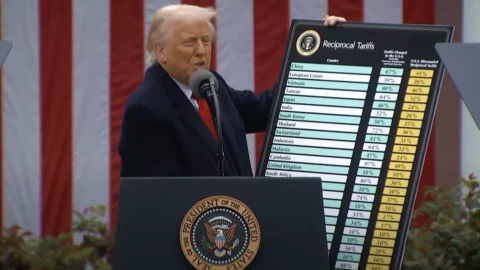
At the stroke of midnight between yesterday and today, Trump has renewed his famous tariff board imposing new rates of 10% and 12,5% on goods coming from 60 business partners, including China, the European Union, Japan, India, the United Kingdom, Canada, and Mexico. According to the White House, the measures aim to combat alleged forced laborA temporary 10% global tariff expired at 12:01 a.m. New York time after 150 days, and the new duties took effect at the same time, with goods in transit exempted until 12:01 a.m. on July 28.
"The United States has had a labor import ban for nearly a century and enforces it rigorously. It's time for our trading partners to do the same," U.S. Trade Representative Jamieson Greer said in a statement. "Today's action will begin to correct what is both a violation of human rights has always been distortive commercial practice, in order to improve the well-being of workers around the world. "
The introduction of new tariffs was expected, but the business partners from all over the world they joined together in firmly contest its justificationSome, however, noted that they would have minimal impact on current tariffs. Financial markets, more focused on the Middle East conflict, saw no significant immediate reaction.
A flurry of exemptions: from oil to cars to diamonds
The new rates, announced tonight in a notice published in the Federal Register, cover the 99,4% of imports Americans, but include numerous exemptions for certain products. Among these products are oil and gas, fertilizers, some products food. Also among the exemptions are goods already subject to the national security tariffs provided for by Section 232, such as automobiles, steel, aluminum and copper, the official said. Also exempt will be those aircraft and their components, together with critical minerals.
There were also winners. The Antwerp World Diamond Centre said that the restoration of theexemption represents significant news for the local sector diamondsIn 2024, Belgium exported $2,1 billion worth of polished diamonds to the United States. The exemption expired after the U.S. Supreme Court struck down global tariffs imposed by Trump in February.
Trump dribbles the Supreme Court
He tries again so Trump, in trying to restore his electoral vision of a near-global tariff, after the United States Supreme Court last February had cancelled the “reciprocal” tariffs of 10% to 50%, imposed last year under a state law national emergency to try to reduce the trade deficit US.
Taxes pursuant to the Section 301 of the Trade Act of 1974, the new tariffs allow the administration to maintain a minimum tariff level on virtually all U.S. imports, despite the Supreme Court's setback. These tariffs are also likely to face less legal risk than those repealed in February, as Section 301 has withstood previous court challenges.
Here are the new tariffs. For the EU, they amount to 10% or 12,5%.
The United States has imposed a 10% duty on goods from Argentina, Bangladesh, Great Britain, Cambodia, Canada, Ecuador, El Salvador, Guatemala, Honduras, India, Indonesia, Jordan, Malaysia, Mexico, Pakistan, Sri Lanka, Trinidad and Tobago.
All 'European Union, Taiwan, Japan, South Korea and Switzerland have been assigned tariffs which, added to the pre-existing tariffs under the most-favoured-nation regime, amount to at 10% or 12,5%The other 38 countries were assigned a rate of 12,5%. These include the Vietnam , which this week issued a new decree laying down more detailed rules to ban the import of goods produced with forced labor, and the China, accused by the United States of detaining the Uyghur minority (a Turkic-speaking and Muslim ethnic group) in labor camps: Beijing rejects the accusation. Trump administration officials have communicated to the Chinese counterparts lThe intention is to restore tariffs on Chinese products, introduced during Trump's second term, to the 20% level agreed upon in the November 2025 trade deal with Chinese President Xi Jinping, but not to exceed it. Before last night's move, China's tariff rate had dropped to 10%, excluding the 25% imposed during Trump's first term on industrial products.
Reactions: Expected tariffs, but the reasons are unjustified
Comments on the new tax were not long in coming. In general, the business partners they were waiting for the amount of the tariffs, but in chorus they contested the reasons contained in the provision, as they refer to forced labor. Some, moreover, have observed that they should have a minimal impact sabout current rates.
Greer had previously promised that for countries with trade agreements with Washington that cap U.S. tariffs, the new duties on forced labour would not have exceeded these limits, a point the EU underlined in its response. “The'European Union "We welcome the fact that this outcome is in line with the US tariff commitments agreed under the EU-US Joint Declaration," a European Commission spokesperson said, adding that this provides "positive impetus" to continue work to explore further tariff exemptions and deepen cooperation. The High Representative of the European Union for Foreign Affairs and Security Policy, Kaja kallas, contested the justifications given by the United States for imposing new tariffs on European products, calling the accusations that the EU does not have adequate tools against forced labor "unfounded." "This cannot be said of the European Union," Kallas told Reuters, reported by several Asian media outlets, on the sidelines of the ASEAN foreign ministers' meeting in Manila. "If you compare our labor laws with those of the United States, we have paid leave and very good working conditions for our employees. So this argument is completely baseless." Kallas added that Brussels will seek clarification from Washington, emphasizing that the European Union has fulfilled its commitments under the transatlantic trade agreement reached last year and that the new tariffs represent "a negative surprise." "We had an agreement with the United States, and we have fulfilled our part of the agreement," the European Union High Representative for Foreign Policy stated. She concluded: "That's why it's a negative surprise to see that agreement not being respected."
While contesting the allegations underlying the forced labor investigation, the Swiss government He also said that the United States is meeting its past commitments on tariff caps, in its case up to 12,5%. Britain He said the decision would have no negative effects. “This announcement does not entail any negative changes for companies in the UK "Regarding tariffs. Our agreement with the United States remains in force, and today we are seeing an improvement in our trading conditions, with the elimination of tariffs on whisky and medical technologies," a government spokesperson said.
Il Japan Japan expressed "regret" over the new tariffs announced by the United States, which includes Tokyo among the trading partners hit with 12,5% tariffs on certain products. "Japanese industry and trade are conducted according to international rules. Japan regrets that this measure imposes tariffs only because there is no ban on imports of goods made with forced labor," said government spokesman Minoru Kihara. He added that the trade agreement reached last year between Tokyo and Washington remains valid and that the United States has confirmed it will not impose further tariffs on Japan beyond those stipulated in the agreement. Japan had agreed to invest $550 billion in the United States by 2029 in exchange for a reduction in tariffs threatened by Washington from 25% to 15%, as part of the bilateral agreement concluded in 2025.
Louder protests they have arisen from some other trading partners. Australia and Brazil They called the new tariffs unjustified and said they would work to have them removed, while the Norway said there was "no basis" for them. The Prime Minister new Zealander Christopher Luxon called the new tariffs imposed by the United States on New Zealand and 59 other countries over alleged forced labor concerns "extremely disappointing." "The U.S. investigation has not provided significant evidence to support the forced labor allegations," Luxon wrote. X"Tariffs are not the solution: they increase costs and uncertainty for businesses," he added. The new tariffs, which came into effect today, range between 10% and 12,5% and also affect major economies such as China, India, and the European Union. New Zealand is expected to face a rate of 12,5%.
Il Canada, hit last Monday reacted with relative reluctance to impose new duties on goods worth $20 billion imposed by Trump. caution“We will continue to engage constructively with the United States on this matter, as well as other outstanding issues, in the coming weeks, for the mutual benefit of our citizens,” said Dominic LeBlanc, Canada’s minister responsible for trade with the United States.