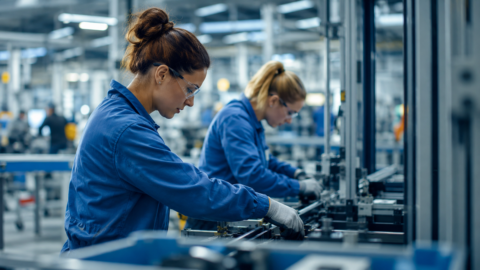
In the Italian metalworking sector, the gender gap remains a structural reality. Women continue to be less present in companies, earn lower wages than their male colleagues, and retire with significantly lower pensions. This is what emerges from the 3rd Report on the Condition of Women presented by Fim Cisl, which analyses the two-year period 2024-2025 through a sample of 1.104 companies and 387.621 workers.
The study confirms that, despite the progress made in recent years in terms of contractual protection and work-life balance, profound disparities persist both in terms of pay both on career opportunities.
Women still account for less than 20% of the workforce
The first figure concerns the female presence in the metalworking sector. Women represent just 19,6% of employees of the sample examined, a percentage that highlights how the sector continues to be predominantly male.
The report also records a divergent trend among the various professional qualifications. On the one hand the presence of female workers continues to decreaseOn the other hand, the number of women holding managerial and executive positions is growing, albeit slowly and at a still low level. This trend signals a gradual shift toward top positions, but it hasn't yet changed the overall balance of the sector.
Wages are 13,44% lower, with the gap rising to over 19% for ancillary components.
The main issue remains the wage issue. According to the report, the The average gross annual wage of female workers is 13,44% lower compared to that of men.
The gap widens further when considering variable pay components. Overtime, performance bonuses, individual superminimum wages, and benefits account for a difference of up to 19,24%, confirming that disparities concern not only base salaries but also the tools for financially enhancing professional skills.
According to the Fim Cisl, the phenomenon is closely linked to the lower continuity of female careers, to the greater incidence of care work and to organizational models that are still not very oriented towards conciliation.
The gap is also reflected in pensions
The differences accumulated over working life inevitably translate into lower pensions. Based on the INPS data cited in the study, in the first half of 2026, the average amount of new pensions paid to women stood at €1.048 per month, compared to €1.506 for men.
The pension gap thus reaches 30%, confirming the effects of discontinuous careers, periods of involuntary part-time work and greater family responsibilities which continue to fall predominantly on female workers.
The burden of care work and the training that slows down
The report also recalls the most recent Istat data on domestic and family work. Women dedicate an average of 5 hours a day to care activities and carry out the 68% of all unpaid family work, giving rise to what is defined as a real “double shift” between work and domestic responsibilities.
On the professional growth front, a slowdown in training also emerges. Well 14,49% of companies In fact, it fails to comply with the obligations set forth in the field of professional training, further limiting the opportunities for updating and developing skills.
The answer lies in collective bargaining
According to Fim Cisl, collective bargaining is today the main tool for reducing inequalities. The renewal of the National Collective Bargaining Agreement (CCNL) Federmeccanica-Assistal It introduces new measures dedicated to gender equality and work-life balance. Among the new measures are: three days of annual leave paid at 80% to assist children up to 4 years age, greater flexibility in the use of paid annual leave (PAR), the strengthening of joint bodies and the lowering of the size thresholds for the establishment of Equal Opportunities Commissions, foreseen in companies with at least 500 employees, and of the training commissions, extended to companies with at least 300 employees.
The tools envisaged also include the preventive involvement of RSU in gender equality certification processes, greater salary transparency and mandatory training courses against harassment and violence in the workplace. the general secretary of the Fim Cisl Ferdinando Uliano and the national secretary Fabio BernardiniThe data from the third report confirm that wage inequality represents not only a problem of equity, but also a constraint on the country's economic and social growth. Hence the call for cultural and organizational change that, through collective bargaining, will implement equal opportunities within metalworking companies.