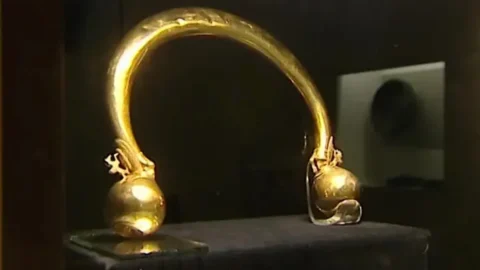
The one that was stolen was the famous torsion, the golden collar of the Princess of Vix, an extraordinary Celtic jewel from the 6th century BC, made in a single piece of about 480 grams of gold, absolute symbol of the famous Treasure of Vix.
The attack took place in broad daylight
According to initial reports, the perpetrators entered the museum posing as ordinary visitors, reached the display case containing the artifact, and quickly exited the building, in front of other tourists, without resorting to spectacular break-ins. This approach highlighted how even the most advanced security systems can be vulnerable when criminal activity exploits the normal flow of visitors. The theft takes on an even more symbolic significance because it comes just a week after a failed nighttime intrusion attempt and eight months after a previous attack on the same museum. Over the past two years, approximately €150.000 had been invested in strengthening security with new cameras, reinforced doors, and surveillance systems, but the measures adopted failed to prevent an attack planned by professionals.
The collar belonged to the so-called Princess of Vix, a powerful aristocrat who lived over 2.500 years ago.
Before becoming one of the symbols of European archaeology, the tThe death of the Princess of Vix was a tangible sign of the power of a woman who lived in the second half of the 6th century BC, at a time when Celtic Europe was experiencing intense commercial, cultural, and political exchanges with the Mediterranean. Her story resurfaced only in January 1953, when archaeologists René Joffroy, Maurice Moisson, and René Lagorgette discovered a monumental tomb at the foot of Mont Lassois, near the small village of Vix in Burgundy. Inside a burial mound lay the remains of a woman in her thirties, accompanied by grave goods so extraordinary that they profoundly changed our understanding of Celtic civilization during the Hallstatt era. Until then, it was believed that political and religious power in Celtic communities was an almost exclusively male prerogative. The burial at Vix, however, told a different story. The richness of the grave goods, the quality of the objects, and the exceptionality of the Mediterranean imports suggested that this woman belonged to the upper echelons of society, likely a princess, a sovereign, or a figure with the highest political and religious authority. Since then, she has been known simply as the Princess of Vix, although her true name remains unknown. Of all the objects deposited beside her, the most precious was the magnificent tosolid gold rque, The quintessential symbol of authority in Celtic cultures. Weighing nearly half a kilogram, crafted with exquisite gold workmanship, it features terminals decorated with motifs inspired by the Mediterranean world, evidence of the artistic dialogue between the Celtic peoples and Greek and Etruscan artisans. More than a simple jewel, it was an emblem of sovereignty: wearing it signified visibility of one's rank and prestige. Alongside the torque, another masterpiece destined to become famous worldwide was discovered: the Vix Krater, a gigantic bronze vase approximately 1.6 meters tall, capable of holding over a thousand liters of wine. It is the largest surviving bronze vase from antiquity. Likely forged in the workshops of Magna Graecia, the krater was used during aristocratic banquets and represents one of the most extraordinary examples of the diffusion of Mediterranean culture into the heart of Celtic Europe. The grave goods also included a precious silver cup, bronze vessels, ceremonial chariots, brooches, ornaments, and numerous objects from distant geographical areas. The collection demonstrated that the territory of Vix occupied a strategic position along the great trade routes connecting the Mediterranean with northern Europe via the Rhone and Seine rivers. It was not a periphery of the ancient world, but one of its main crossroads.
For over seventy years the torque has always been kept at Musée du Pays Châtillonnais, Trésor de Vix, becoming the symbol not only of Burgundy, but of European archaeology as a whole. Its importance lies not in the value of its gold, but in the history it embodies: it speaks of a Europe already deeply connected, in which goods, ideas, artistic techniques, and cultures traveled well before the birth of modern states. Therefore, its recent theft represents a loss that goes beyond a museum's holdings. When an artifact of this nature is stolen, not only a precious object disappears: the dialogue with a civilization that, through that work, had continued to speak to humanity for over two thousand five hundred years is interrupted. The Princess of Vix's torc was not only a masterpiece of ancient goldsmithing, but one of the finest testimonies to Europe's ability to build its identity, from its very origins, through the encounter of diverse cultures.
Archaeologists fear, above all, that the jewel could be melted down, permanently erasing not only a work of art but an irreplaceable source of knowledge. Following the theft, the French Ministry of Culture announced a new national plan to strengthen museum security, recognizing that protecting cultural heritage today requires strategies capable of countering increasingly sophisticated forms of crime.