A light food, rich in nutrients and boasting numerous beneficial effects on the body, and extremely versatile in the kitchen, asparagus has a long and fascinating history spanning millennia and various civilizations. Historical sources show how this vegetable has been prized not only for its flavor, but also for its symbolic, medicinal, and cultural value. The earliest traces date back over 2000 years, with a probable origin in Mesopotamia and the regions of Asia Minor. The Egyptians were among the first to consume and use asparagus for food and medicinal purposes, while the Greeks knew the plant and appreciated its qualities. But it was the Romans who perfected its cultivation and preservation. Pliny the Elder described varieties and preservation techniques in his Naturalis Historia. Asparagus was considered a delicacy on aristocratic tables, so much so that the Romans even built boats dedicated to harvesting it, called asparagus.
After the fall of the Roman Empire, cultivation continued in medieval monasteries, where monks preserved their botanical knowledge. From the 16th century, cultivation spread to Germany, Spain, England, and later to North America, where it flourished in states such as New Jersey, Michigan, and California.
While they were loved for their taste, they were also appreciated for their countless beneficial properties. Rich in vitamins C, A, K, and B complex, as well as minerals such as potassium, which helps maintain normal blood pressure, phosphorus, iron, and calcium—nutrients that support the immune system, bone health, and metabolism. But above all, thanks to the amino acid asparagine, they stimulate urine production and promote the elimination of excess fluids. This helps reduce water retention and supports kidney function, while fiber helps lower LDL cholesterol, and antioxidants and flavonoids protect the arteries. And that's not all, because saponins, found primarily in wild varieties, have been found to exhibit potential anti-tumor effects in preliminary studies, particularly against colon and breast cells.
So why not take advantage of the favorable season to prepare a healthy and tasty asparagus dish?
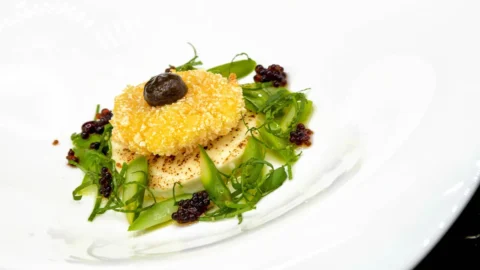
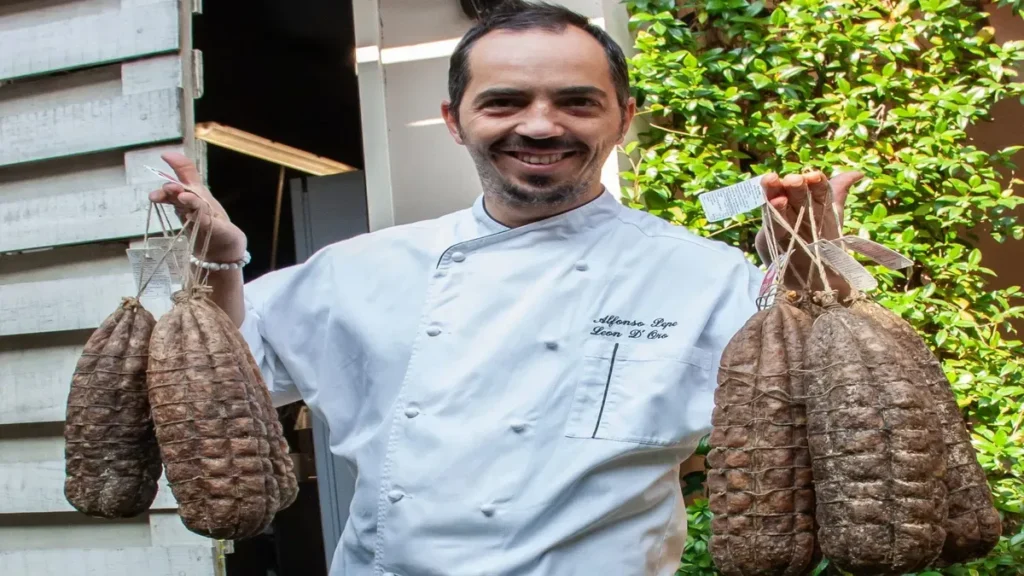
A high-level preparation to also make a good impression at a lunch with friends comes to us from chef Alfonso Pepe of the Michelin-starred restaurant Locanda Leon d'Oro * in Pralboino (BS) who offers an original “Crispy egg yolk, burnt primo sale, asparagus with basil and truffle”.
This dish—explains the Chef, who takes great care in his cuisine to combine the flavors of the seasons with those of the earth in a synthesis of great formal elegance as well as flavor—is a chromatic and flavorful synthesis of the Brescian spring, a tribute to the cycles of nature that renew themselves with the same strength and simplicity as in times past. Behind this recipe is a desire to ennoble the humble through technique.
The egg is the beating heart. Not just any egg, but one from dedicated free-range hens, a symbol of a new life and a purity that must be protected. The yolk, encased in a golden crunch, remains soft and alive, a guarded secret that explodes at the first cut.
Primo Sale—he adds, recalling his Salerno origins—has been and is for me a bridge between Campania and Lombardy. There's a memory I carry within me, indelible: that of my homeland, the land of Mozzarella. When I think of the flavor of milk, my palate longs for that immediate freshness, that tenacious yet delicate texture of Fior di Latte, provola, or buffalo mozzarella.
When I arrived here in Cigole, I searched for that gastronomic "feeling" in local products and found it in Zani's Primo Sale. Although they are cheeses with different histories, I saw a profound similarity: the essence of milk: both are children of purity. Primo Sale has no superstructure, no maturation. It is naked, exactly like a great Fior di Latte. In this dish, Primo Sale plays the role that mozzarella would play in Naples. It has that "intriguing and soft" structure. Placing it on the plate with asparagus and truffle is like saying that cuisine has no boundaries: I bring my past into my present, using the hands and products of my neighbors.
The asparagus, reminiscent of a stroll through the fields, brings a crunchy, vegetal note, while the black truffle adds an earthy depth and a light, yet never ostentatious, touch of nobility, elevating the dish to a complete sensory experience. In this dish, we seek a subtle balance: the delicate acidity of the primo sale cheese meets the enveloping richness of the egg, the aromatic freshness of the basil lightens the dark tones of the truffle.
The story of this Michelin-starred chef, who has jealously preserved a respectful and humble approach to raw materials and an exemplary (and rare among Michelin-starred) attitude to a human and empathetic dimension in his relationships with his team and with his interlocutors at all levels, began not in prestigious schools, but behind the counter of a café at just seven or eight years old, where he learned early that everything has a value and that independence is earned through hard work. "I still remember the pride of when, as a child, I brought home my first 'four lire', earned by serving coffee in the offices and streets of my hometown." Humble, yes, but with great willpower: while his peers played, he chose to hang out with the grown-ups, to steal the trade with his eyes and understand how the world worked. This allowed him, after hotel management school, to accelerate his training to become a chef in excellent kitchens, working under masters such as Ferrante, Vissani, Troiani, and Barbieri.
Twenty-five years ago, he arrived at Locanda Leon d'Oro, a "corner of the world where you always feel at home," as the Michelin Guide puts it. "Entering Leon D'Oro is like returning to old friends and being hosted in rustic, pleasant surroundings, with two elegant dining rooms and a welcoming garden for summer evenings. The cuisine reflects the region, but also the sea, with more traditional recipes paired with some more delicious and modern ones. There are two tasting menus, both devoted to the sea and water, while from the extensive menu, we recommend the truly excellent marubini pasta with Marsala reduction and Parmesan, or the sturgeon au gratin, with Mediterranean mince, milk, and sprouts. Also worthy of praise is the lemon, caper, and licorice delight in the desserts. Finally, be sure to browse the beautiful and extensive wine list, featuring vintages now on the verge of extinction and vertical tastings of great crus."
What more could I add?
The recipe for Crispy Egg Yolk, Burnt Primo Sale Cheese, Asparagus with Basil and Truffle
Ingredients for 4 people:
4 large fresh eggs
400 g Primo sale
1 bunch of asparagus
8 basil leaves
1dl Garda oil
100 g breadcrumbs
1 l Oil for frying
50 g black truffle
50 g of brown butter
1 dl of vegetable broth
10 g soy sauce
1 g of agar agar
Procedure:
For the eggs:
Cook the eggs at 62°C (140°F) for 30 minutes, immerse them in ice water and cool. Crack them open and carefully remove the yolk, which will be breaded, fried, and salted immediately.
For the cheese:
cut the primo sale into slices of 1 cm or a little less, cut it with a pastry cutter and burn it on the flame to taste
For the asparagus:
Break the asparagus into pieces and cook them for about 7 minutes in salted water, cool, and chop as desired. Season with salt, oil, pepper, and basil.
For the black truffle cream:
Thoroughly clean the surface of the truffle, vacuum-pack with salt, pepper, and vegetable broth. Cook at 83°C (185°F) for 40 minutes. Drain the liquid and set aside for the pearls. Blend thoroughly with the brown butter and place the resulting cream in a squeezer or piping bag.
For the pearls:
Boil the truffle cooking broth, soy, and agar agar for 1 minute. Using a syringe, drop the still-hot liquid into the cold oil, drain, and rinse.
Plating:
Place the primo sale cheese in a deep dish, surround with the seasoned asparagus, place the freshly fried egg (leaving it soft in the center), the truffle cream, the pearls and the basil.
Restaurant: Locanda Leon d'Oro
Via Gambara, 6
25020 Pralboino (BS)
P. 030 954156