Ithe story is incredible of the US SanDisk, which on the Nasdaq managed to obtain a rise of 3.280% in a transition year and still over 400% since the beginning of 2026 even if yesterday it lost 10,7%. Which new chapter will tell Next 5 August when will the quarterly data? In his history there are extraordinary events, changes in strategy, challenges of a market with a deep and persistent gap between supply and demand. Like in a movie, one wonders if it will have a happy ending.
SanDisk was acquired da Western Digital in 2016 and then it went back to being a publicly traded company independent in February 2025 Through a spin-off, Western Digital shareholders received shares of the new SanDisk in proportion to their holdings. The Californian company closed its first day of trading as an independent a about 36 dollars. From that moment on it was a wild ride, albeit with some volatility, until reaching the 52-week high of 2.354,39 at the end of last June in a moment of market effervescence after the extraordinary quarterly data of the competitor micron Technology, dragging the same into the race Western Digital.
Subsequent geopolitical events and fears that the stratospheric levels reached by the sector were excessive, have made investors take advantage and SanDisk closed yesterday at 1.599,27 dollars, but the average of target price The 12-month forecast indicated by analysts is now at $2,197,32 with a +37,40% increase indicating an increase.
Faced with such a stratospheric run in two years by SanDisk, comparable only to that of Bitcoin which however took almost a decade, one cannot help but wonder what the future will be. future of a company that produces memories, historically one of the most successful businesses cyclical in the world, in a market that shows a strong demand, but also many competitorsAccording to analysts, SanDisk no longer appears to be profoundly undervalued, as it might have appeared immediately after the spin-off. However, it does not appear to be significantly overvalued either: the market has already incorporated many positive expectations, but if the implementation of products with higher added value and long-term contracts will continue, there is still room for improvement another moderate rise.
SunDisk's memory business is very different from what it used to be
SansDisk specializes in “Nand” flash memory, the one used to store data inside phones, laptops and AI servers, but also in Enterprise SSD, a storage drive designed for intensive professional use, featuring superior endurance, continuous operation, and advanced protection against data loss. Training and running artificial intelligence models in it they consume enormous quantities, andsupply can't keep up.
The substantial difference that characterizes SanDisk's growth compared to the past is that it is now not driven by consumer electronics, but rather from the unprecedented expansion of the data center for the'Artificial Intelligence. “This memory cycle is very different from historical ones, because it is fueled exclusively by the very strong demand from AI data centers,” he also observes. Morgan Stanley in a note in which he even defines a “false signal” that coming from smartphones, PCs and consumer electronics, markets that have contributed to fueling the recent pessimism among investors.
The gap between supply and demand remains very wide
In reverse, Morgan Stanley he says there are persistent and growing memory shortages in data centers and a price growth of memory by at least 25% on a comparable basis from the second to the third quarter of 2026. The memory shortage will continue into 2027 and 2028, it says.
This belief echoes the recent statements of top managers of SK Hynix to the South Korean Chamber of Commerce and Industry, according to which the 2027 will be the worst year in the history of the memory industry from the supply point of view.
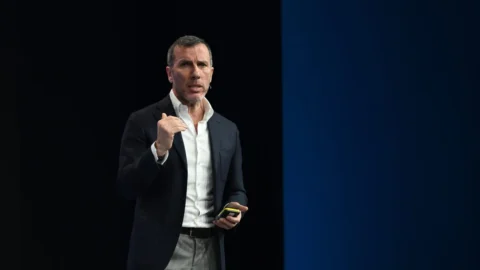
All this translates into the expectation that the Nand flash manufacturers how SanDisk are well positioned to benefit from this prolonged imbalance between supply and demand and then the profits SanDisk appears safe. Two things anchor the bet. The new model SanDisk's business already covers more than a third of its bit shipments for fiscal 2027, backed by more than $11 billion in financial guarantees. And theextension his production joint venture with Kioxia until December 2034 SanDisk invested $1 billion in Nanya to secure DRAM supplies. David Goeckeler He was clear that the model is about stability, not discounting: “We are not trading duration for price,” he said. “The value proposition is the continuity of supply, and the price is the price.”
In third quarter i datacenter revenues SanDisk's revenue increased 233% sequentially, and Enterprise SSD reached about 25% of total revenue, up from about 10% in the previous quarter, confirming that, unlike the cyclical memory booms of the past, demand is more structural due to its origin in artificial intelligence infrastructure. Speaking at the Mizuho Technology Conference in June, Goeckeler He explained why the shift in the supply mix is still in its infancy: “We have one side of the portfolio in full bloom” while “we now have the second leg of that growth coming in,” referring to the enterprise product who began to recognize revenue this year alone. The question comes from a source that management says is constantly expanding: the capital budget of data centers which have been revised upwards “14 times,” Goeckeler said.
The test will be on August 5th with the fourth fiscal quarter accounts.
Investors are preparing and making predictions for the quarterly results that will be published next year. August 5th. For the fourth fiscal quarter, SanDisk It has provided revenue forecasts between 7,75 and 8,25 billion dollars, a gross margin non-GAAP (i.e. net figures that provide a clearer picture of current business performance) between 79% and 81%, and a EPS between 30 and 33 dollars. Comparing these data with those already published in third quarter, it is clearly visible the trajectory. The company had forecast EPS between $12 and $14 for its fiscal third quarter, but ultimately delivered $23,41, nearly double the upper limit of its forecast and about 60% above the analyst consensus of $14,66. Each quarter, it has not only exceeded expectations, but has pushed them higher.
What are the possible risks?
Despite opinions mostly pointing towards an increase in the stock price, there are doubts. Of course, se big tech companies slow down infrastructure spending AI, demand for enterprise SSDs could decline, slowing SunDisk's earnings. Furthermore, the challenge would also come from competition of colossi like Samsung Electronics, SK Hynix, Micron Technology, kioxia.
And then there is the theme of the review, even compared to its competitors. SanDisk It trades at about 8,6 times earnings. of the next twelve months. Samsung Electronics, the world's largest memory manufacturer, trades at about 4,5 times earnings. This premium is defensible only if SanDisk's new business structure provides the earnings visibility a retail giant lacks.