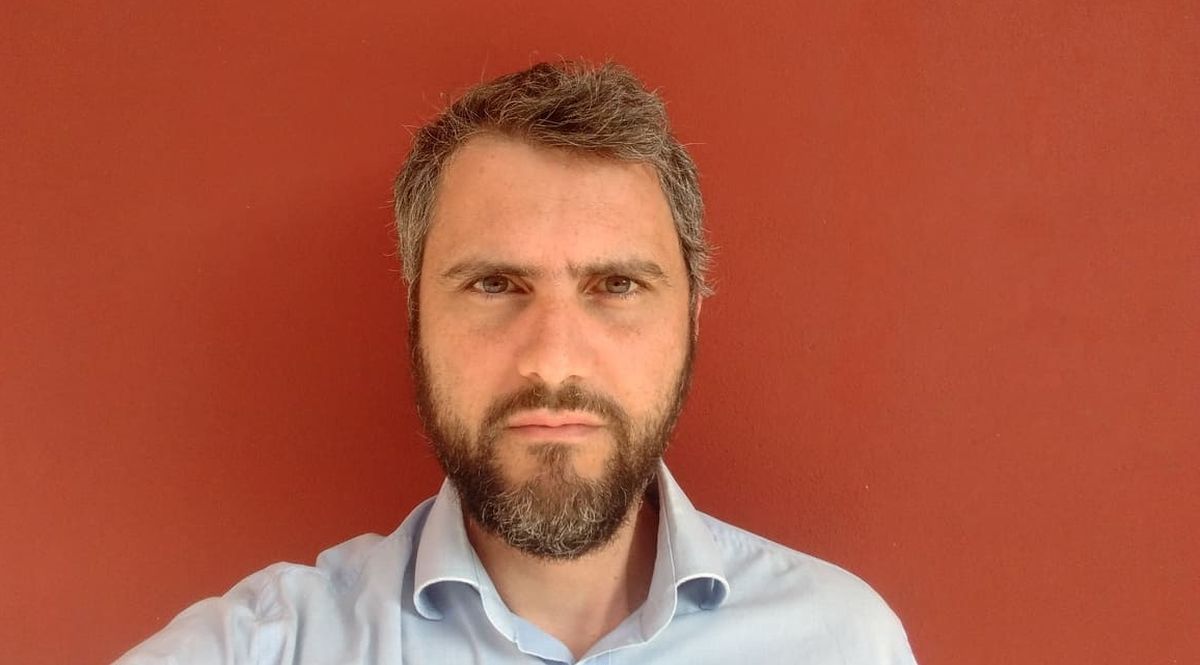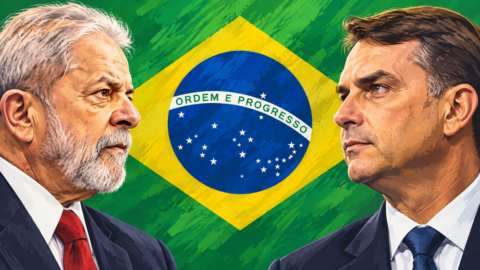
Sunday October 4 nearly 160 million Brazilians eligible will vote in the first round of the presidential elections, to choose who will be the President of the Republic for the next 4 years: it will be Squid to succeed himself, at 80 years of age and for a fourth and final term, or will the senator prevail Flavio Bolsonaro, son and designated political heir of Jair, president from 2018 to 2002 and still very popular, although sidelined by legal troubles (he is under house arrest with a 27-year sentence for attempted coup)?
Polls indicate a tie, very high probability of a runoff
All recent polls indicate a technical draw, with the near certainty that the result will be a draw. second round, scheduled for Sunday, October 25, on the eve of another election on which the international community's spotlight will be even more focused, the one in Israel. A week later there will be the American midterm vote, and in the end everything will be intertwined because the Brazilian right, now led by Bolsonaro junior, is openly supporter of Benjamin Netanyahu and Donald Trump, so much so that flags of the United States and Israel regularly appear at Flavio's election campaign rallies.
Lula slams Trump's meddling: "Brazil belongs to Brazilians."
Geopolitical positioning has been and is one of the themes of this election. To counter the right's markedly pro-American stance, Lula insisted on placing Brazil at the center of his communications, with slogans such as “Brazil belongs to Brazilians”, "For a sovereign Brazil" and "Brazil is nobody's backyard", with a polemical reference to the return of the Monroe Doctrine. A way to send not too much indirectly a message to Trump, which for a couple of years has entered forcefully into South American affairs, first through tariffs, then with a very harsh program of repression of narcoterrorism that led it to clash first with Venezuela, then with Colombia and finally with Brazil itself.
Brazil is isolated: it is not part of the Shield of the Americas, the military alliance launched by Trump in South America.
While in fact almost the entire continent is today governed by right-wing leaders, even extreme ones, with whom Washington has no difficulty getting along, from the Argentine Milei to the Chilean Kast, from the Ecuadorian Noboa to the Colombian De La Espriella, in Brazil – which is the largest and most populous country, as well as the first economy in South America – he encountered resistance from Lula himself, who responded blow for blow on the duties and did not even give in to the Shield of the Americas, the Shield of the Americas, the military cooperation launched by Trump with the Latin American far-right to combat drug trafficking, targeting Brazilian criminal organizations, such as the Comando Vermelho.
Flavio wants to leave the BRICS and Mercosur to ally himself with Washington
Brazil, among other things, was among the countries in the world hit by the most severe trade tariffs, and for this reason he has continued on a path already traced by Lula, that is, to distance himself from dependence on the United States by looking elsewhere, in particular towards the East and China but also towards Europe. While in fact Bolsonaro would like bring Brasilia back on the White House axisThe socialist president is a supporter of multilateralism: he is a friend of several European leaders, supports the importance and urgency of the effective entry into force of the EU-Mercosur agreement, and engages in open dialogue with Beijing and Moscow within the BRICS alliance, calling for Brazil's membership.
A confirmation of Lula would provide more guarantees of dialogue with Brussels
Flavio, on the other hand, taking inspiration from his Argentine friend Milei, would like to break both the axis with the BRICS and the Mercosur trade union (which includes, in addition to Brazil, Argentina, Paraguay, Uruguay and soon Bolivia), distancing their country from China to realign it with Washington, to other countries in the area governed by the right and to an economy more closely tied to the dollar. This is why the Brazilian election is being closely watched by Brussels: a confirmation of Lula would mean the continuation of dialogue and intensification of trade relations which are fundamental in this historical phase, given that Brazil is the world's leading exporter of ten agri-food commodities and also the planet's second largest reserve of rare earths.
Brazilian resources are also useful to Europe, but China has the advantage
Europe needs to get at least some of those all too important resources in times of energy difficulties and explosion in the development of Artificial IntelligenceToday, however, minerals and rare earths will almost all end up in China, while oil – which Brazil is also rich in, especially after the recent discovery off the mouth of the Amazon River – will end up in mostly American hands: the enormous offshore crude oil reserve discovered by Petrobras will be extracted in a joint venture with Exxon, while other blocks in the same area have already been assigned to Chevron and China National Petroleum Corporation. In short, Europe is also cut off here, and with Bolsonaro Jr. it could be even more so.