Il fuel price continues to decline. The credit goes mainly to the companies that last week announced the application of a temporary price cap on the price of gasoline and diesel. Eni, which on Friday also extended the ceiling to the agricultural and fishing world. Then it was the turn of Ip, Q8 and TamoilMeasures that help the Meloni government, certainly, but above all alleviate the suffering of citizens and do "a service to what was once called reason of state", says Professor Julius Sapelli, A leading expert in the oil sector, Sapelli served on the board of directors of the Six-Legged Dog from 1996 to 2002. "We're facing another twenty or thirty years of war," the economist predicts, emphasizing the need for policies that allow Europe—forced to import not only oil but also gasoline and diesel—to expand refining, increase the number of plants, and diversify sources. In the meantime, "if we don't want to go downhill like we did during the oil crisis of the 70s," Sapelli tells FIRSTonline, "It's time to save fuel".
Professor, what is your assessment of the price cap on gasoline and diesel introduced by Eni and subsequently by other companies? In your opinion, what are its true origins and purpose?
Eni has always been a company with national interest in its DNA, and the goal of this price cap is to ensure there is as little suffering as possible, both economically and in the daily lives of citizens who are suffering the effects of the wars that have erupted in recent years. The origins, in fact, can only be understood by looking at the bigger picture. The illusion that after the Cold War there would be no more conflicts is now gone. There is the war between Russia and Ukraine, and there are the wars in the greater Middle East. The blockades of the Straits of Hormuz and Bab el-Mandeb, and the difficulties in the Suez Canal, risk having increasingly serious consequences. If the transit routes for global trade are not unblocked, the situation will continue to worsen.
From oil we get to gasoline and diesel…
People often think that cars need oil to run. But actually, they need gasoline, which is the refined product. It's no coincidence that refineries are being bombed during ongoing wars. Due to European regulations, or rather, European environmental fanaticism, there are very few plants in Europe, and refining is extremely complicated. The result is that we import not only oil, but also the vast majority of gasoline and diesel. However, Eni still owns a few refineries, like the one in Gela, which also produces some biofuels.
Is this what allows it, along with other large companies, to implement initiatives that smaller ones can't afford, such as capping fuel prices?
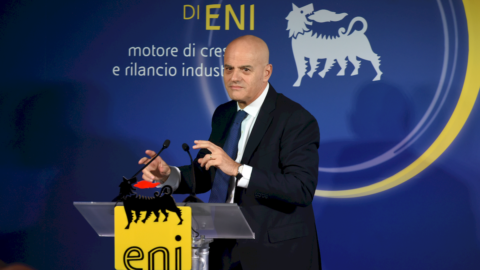
Yes, Eni isn't just any company; it's an integrated one. It's one of the few long-running companies in the world: it extracts, accumulates, refines, and finally distributes. In recent years, thanks to the intelligent strategy pursued by CEO Claudio Descalzi, it has also surrounded itself with smaller companies that provide services, such as Enilive. These are stars rotating around the core of extraction and refining. By managing the entire chain, Eni is the company whose balance sheets suffer the least from these price declines. And therefore, it doesn't harm the Treasury and CDP, which hold 33% of the company's capital, nor does it harm its shareholders. A similar, though not identical, argument can be made for other large companies which, given their size, can afford to temporarily reduce their profit margins, assuming this actually happens.
To date, the government has spent around two billion to control prices by adjusting excise duties. Could an operation like the one carried out by Eni and involving IP, Q8, and Tamoil have been unimaginable before?
We specialists knew full well that the excise tax changes would have no effect, other than hurting the state coffers and increasing the public debt. It really wasn't the right time to implement them. Why now and not before? Because companies like this can't decide on such a delicate matter overnight; it requires studies, board meetings, and so on.
Some argue that the price cap is also a move to respond to the government's moral suasion...
Anyone who says that Eni is doing the Meloni government a favor with this move is wrong. This aid concerns public order. The company is serving what was once called raison d'état, because it means less unrest and suffering, providing concrete answers to citizens. Of course, it also helps the government, but it does so in the right way, respecting corporate governance.
Is the desire to avoid the tax on extra profits also involved?
If this also avoids the tax on extra profits, humanity will be benefited. Extra profits are the product of a theory by Ezra Pound. They don't exist in neoclassical economics, Keynesian economics, or Marxist economics. If you open an economics book, you won't find anything about extra profits. Perhaps you'll find them in a book about magic or malice. Perhaps they're even in the books read by Giuseppe Conte and Matteo Salvini. My good old student Matteo, who is wrong to support these theories..."
The price cap operation is estimated to cost Eni around €100 million per month, a cost that is certainly sustainable but which, according to some, will reduce the Treasury's dividend and therefore cost taxpayers: what is your opinion?
"These are calculations made by pseudo-professors who don't know anything about the oil industry. There are lines at gas stations, and they'll probably end up making even more."
Speaking of traffic jams, don't you think the price cap could send the wrong message to drivers, boosting consumption when it actually needs to be cooled because oil supplies aren't infinite with the ongoing wars?
There's no doubt that we should curb consumption. Eni itself has been preaching for years that the best way to protect the environment is to save energy. This isn't just about turning off the lights, unplugging when you leave the house, or using your car sparingly. Although that doesn't hurt. Leaving your car at home when you go out for dinner or drinks would save lives and be good for the environment too. In any case, we've now entered the era of permanent wars; we have twenty or thirty years of war ahead of us. The time has come to save fuel.
So shouldn't we consider more structural measures to respond to energy shocks? What would you focus on?
"Many things. First, we need to expand refining and increase the number of plants, including biofuel plants that can help us combat CO2. We also need to implement other means of transport, which, however, require oil because they run on electricity. If we don't want to run out of fuel, as happened during the oil crisis of the 70s, we need sources."
Professor, in this interview you listed numerous problems. I'll add another one that's been talked about these days: Trump considering a ban on diesel exports. What effect could this have on Europe?
"Very negative. The European Union has a large portion of its fleet, especially cars and trucks, that runs on diesel. But Europe doesn't govern, it regulates. And by regulating too much, it forgets that it has to govern, and that to do that, it also requires transportation. Diesel is a means of transportation. The fact that we don't have diesel, that we no longer produce it and have to buy it from the United States is a catastrophe, especially considering that in the past, we were one of the most advanced producers in the world."
One last question about the bidding war that's starting on electricity bills. What's your opinion?
“Even in this case, Eni has an advantage because it is an integrated company, while the others will have greater difficulty in intervening on prices and maintaining the discounts over time.”