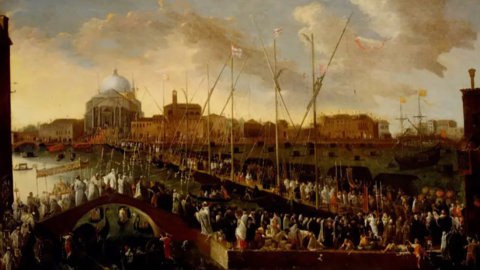
Canaletto is one of those painters for whom Venice ceases to be just a city and becomes an idea. Not simply a view, not a postcard ante litteram, but a mental construction in which architecture, water, light, movement, and daily life combine to define a precise idea of urban civilization. Giovanni Antonio Canal, known as Canaletto (Venice, 1697–1768), left behind images of Venice that today we recognize almost as eighteenth-century photographs. Yet calling him simply a "painter of reality" would be reductive. His greatness lies precisely in his ability to transform reality into a vision.
Canaletto, when the city becomes a work of art
There's something surprisingly contemporary about Canaletto's views. Looking at them today, almost three centuries later, we don't just see eighteenth-century Venice: we see a city that has already grasped its own value. The Grand Canal, the Riva degli Schiavoni, Piazza San Marco, the basin, the palaces, the gondolas, the boats, the merchants, the citizens: everything appears ordered within a rigorous perspective construction. But that precision is never cold. Light enters the scene, reflects on the water, caresses the facades, identifies a figure, opens a perspective. Canaletto doesn't simply paint what he sees: he decides how Venice should be seen. This is perhaps his most modern insight. The view thus becomes a tool for urban narration. The city is no longer just a physical place: it is a story.
The almost optical precision of his compositions has also been associated with his use of the camera obscura, but the National Gallery emphasizes a key point: Canaletto didn't simply mechanically record what was before him. The composition was planned and modified according to artistic needs, to achieve the best possible vision. And here emerges a fundamental difference between documenting a city and interpreting it.
Venice as a theatre of modernity
Canaletto lived in Venice, still a major commercial and cultural power, but also a city deeply aware of its international role. His audience consisted largely of foreign travelers, especially British, participants in the Grand Tour. His views thus became a highly sophisticated form of memory, but also of representation. The city thus entered the nascent international art market through painting. The view became simultaneously art, narrative, memory, and an object of desire. It is no coincidence that many of Canaletto's works are now outside of Italy. Grand Tour travelers purchased them and brought them back to their countries, contributing to the painter's extraordinary international success. The National Gallery notes that Canaletto was particularly appreciated by English collectors and that he lived and worked in England between 1746 and 1756.
Where to see Canaletto in Venice
If you want to meet Canaletto in his hometown, the place to start is Ca' Rezzonico, the Museum of 18th-Century Venice. Here are two important early views: The Grand Canal from Palazzo Balbi to Rialto and Rio dei Mendicanti. The museum considers them the only two views by Canaletto still held in Venice's public collections. They are two particularly interesting works because they show two different faces of the city. Grand Canal from Palazzo Balbi to Rialto, Venice appears in its monumental dimension: the water becomes the perspective axis through which the city organizes and recognizes itself. In Beggars' RiverCanaletto, on the other hand, takes his gaze beyond the more celebratory image of the city. It is a popular Venice, less monumental, almost everyday. This too is Venice. Ca' Rezzonico also preserves a nucleus of drawings related to vedutism and, in the recent initiative In the name of Venice, also exhibits two studies of Canaletto's views from the Italico Brass collection, which document the artist's working method. The museum also offers an interesting option for those who can't immediately travel to Venice: through Google Arts & Culture, you can view them in high resolution. The Grand Canal from Ca' Balbi towards Rialto, with a level of detail that allows you to even grasp the pictorial material and brush strokes.
And then London
To fully understand Canaletto's international dimension, however, you need to go to London. The National Gallery houses some of his most famous works, including The Stonemason's Yard, one of his most important Venetian views, now in Room 33. In the same room are Venice: The Doge's Palace and the Riva degli Schiavoni and Venice: Piazza San Marco and the Colonnade of the Procuratie Nuove. But London also offers another perspective: that of Canaletto observing England. The National Gallery exhibits London: Interior of the Rotunda at Ranelagh, painted in 1754 during the artist's English years. This is a crucial passage: Canaletto is not just the painter of Venice. He is the painter who made the city a universal subject.
New York and Washington: Venice on the move
Another important Venetian view is found at the Metropolitan Museum of Art in New York: The Grand Canal, Venice, Looking South toward the Rialto Bridge, currently on display at Fifth Avenue, Gallery 644. It is a particularly interesting work because it adheres to the serial logic with which Canaletto and his patrons constructed groups of Venetian views. The same city could be observed from different vantage points, almost as if the painter were constructing a visual map of the city. In Washington, the National Gallery of Art also holds a significant collection of Canaletto's works and drawings. The institution's online catalog lists 135 of the artist's works, although not all are on display at the same time.
Where to see Canaletto: the places
- Venice — Ca' Rezzonico: The Grand Canal from Palazzo Balbi to Rialto e Beggars' River, as well as studies and drawings. Ca' Rezzonico
- London — National Gallery: The Stonemason's Yard, The Doge's Palace and the Riva degli Schiavoni, views of Piazza San Marco and works from the English period. National Gallery
- New York — Metropolitan Museum of Art: The Grand Canal, Venice, Looking South toward the Rialto Bridge, currently listed as exposed. The Metropolitan Museum of Art
- Washington — National Gallery of Art: important nucleus of works and drawings, with 135 works listed in the online catalogue, not necessarily all of which are on display. National Gallery of Art