REAL INDICATORS
I gifts Saint Lucia brings them, for some, Santa Claus, for others, Baby Jesus, for still others, and the Befana, for those who love to end the holidays on a high note. Certainly, the Central Banks don't bring them, even if they had accustomed us until a couple of years ago to "free" monetary conditions.
The markets, however, are following comet star of the descent of inflation and they set out to hear the announcement of the good news: monetary tightening gives way to easing. But what material is this comet made of? Of two elements which, mixed, strengthen each other. The first is theperformance of the real economy.
From month to month, economic data have signaled theweakening of demand and production. And November is no exception, according to the first indicators, albeit qualitative.
The components production and orders of the survey among purchasing managers (SMEs) confirm that, globally, one and the others are still. It is true that some glimmers of revitalization can be seen in orders, which in the sum of manufacturing and services have stopped falling (positive second derivative).
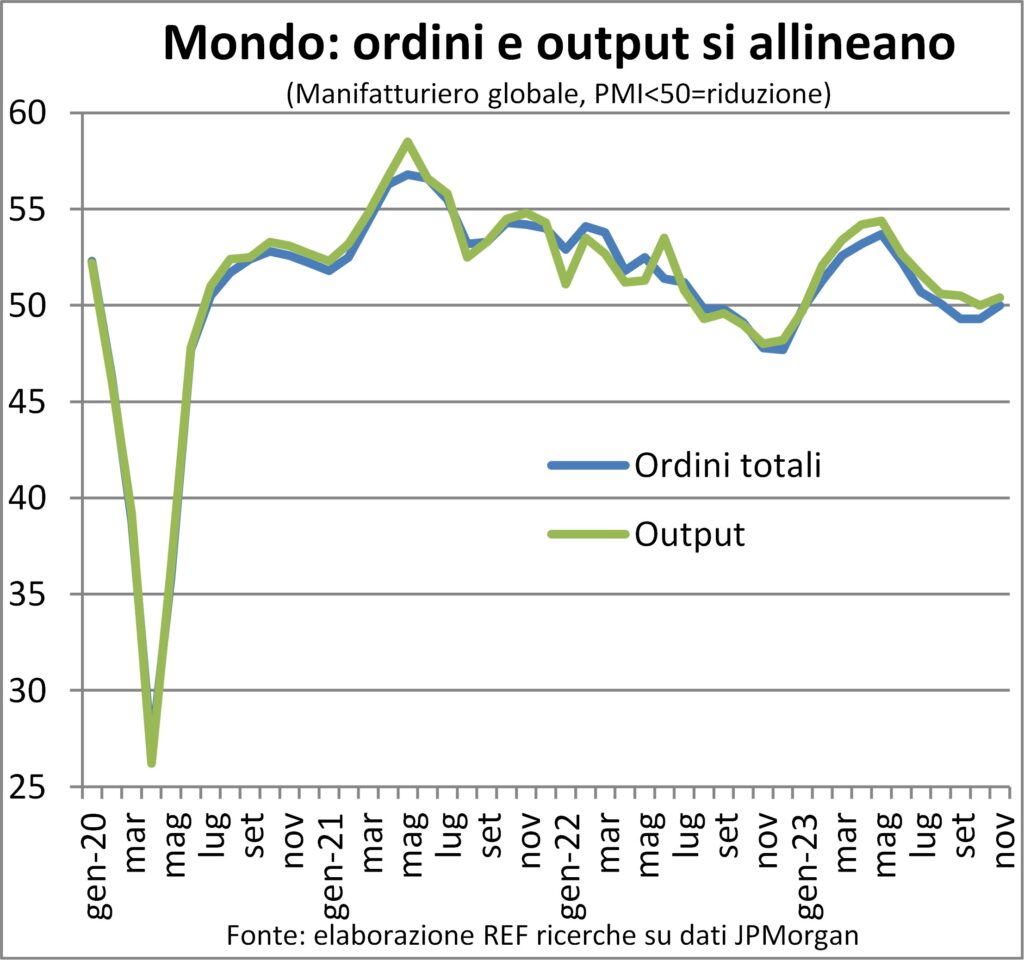
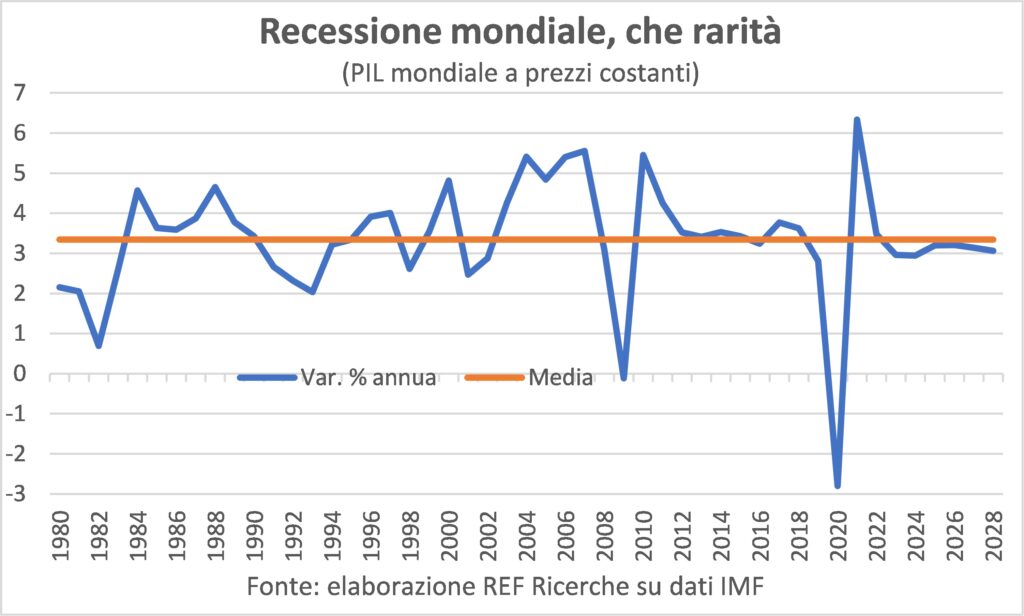
However, let us remember that it is very rare for the world's GDP to decline and that its stagnation is equivalent to a recession, at least in terms of GDP per capita, given that the world population continues to expand.
But something else emerges from the PMI graph comforting fact: between summer and autumn 2022 these indicators were in worse shape than in recent months. In other words, at that time the blows of the energy crisis and the war in Ukraine had already been felt, while now the signs of resilience to rising rates of interest. It is true that these operate with variable delay and, as explained some Lancet ago, the effects of the crises of recent years have increased the delay. But, the debt positions of the private sector, which were adjusted after the Great Financial Crisis, make it less vulnerable to increases in debt servicing.
Not all cats are gray in this economic night. Or, if you prefer, there are many shades of gray.
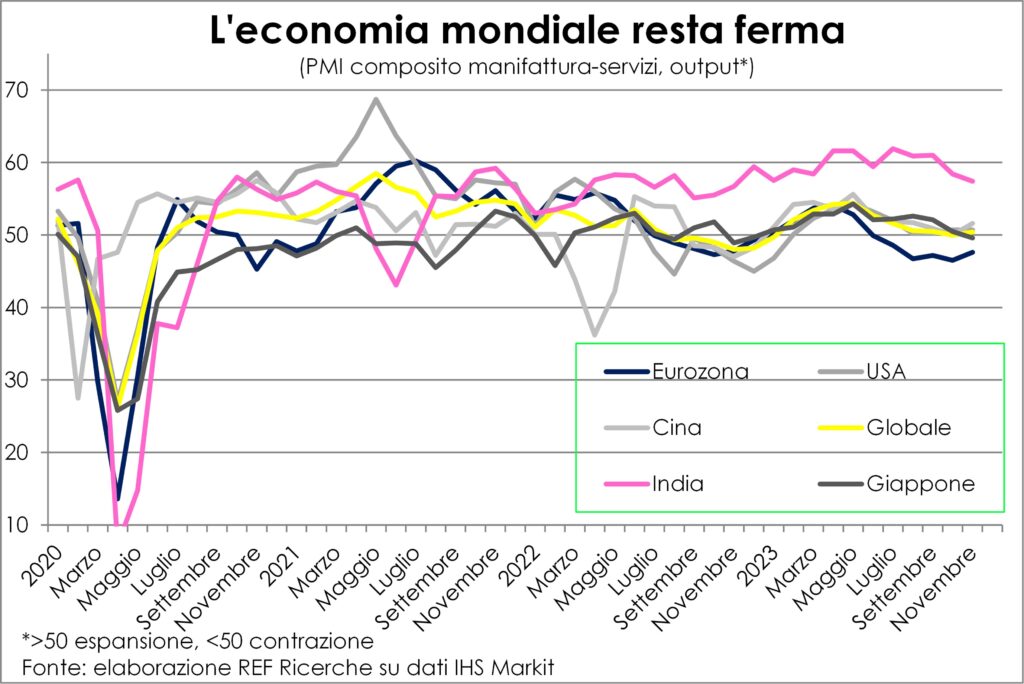
A gray tending towards pink (if such a shade ever existed) is that ofIndia, as it continues to expand, only at a slightly slower but still very robust pace. There is the opposite the pitch black of the Eurozone, which is experiencing a second consecutive quarter of decline in GDP and, therefore, could also record a recession in terms of the canonical statistical definition. In the middle there are "two and a half giants": the China, which continues to alternate slight accelerations with slight braking, and in fact is unable to find the sprint it was; The USA which are mainly affected by consumer spending, which could reveal tiredness during that orgy of shopping that is Christmas (so say the forecasts of the American retailers association); the half giant, by size, is the Japan, where activity fell again for the first time since December 2022.
Regarding China it is worth remembering that for some years now Beijing has reoriented growth towards consumption and services. So, even if it accelerated, the effects on traditional industrial raw materials would be much more limited than they once were.
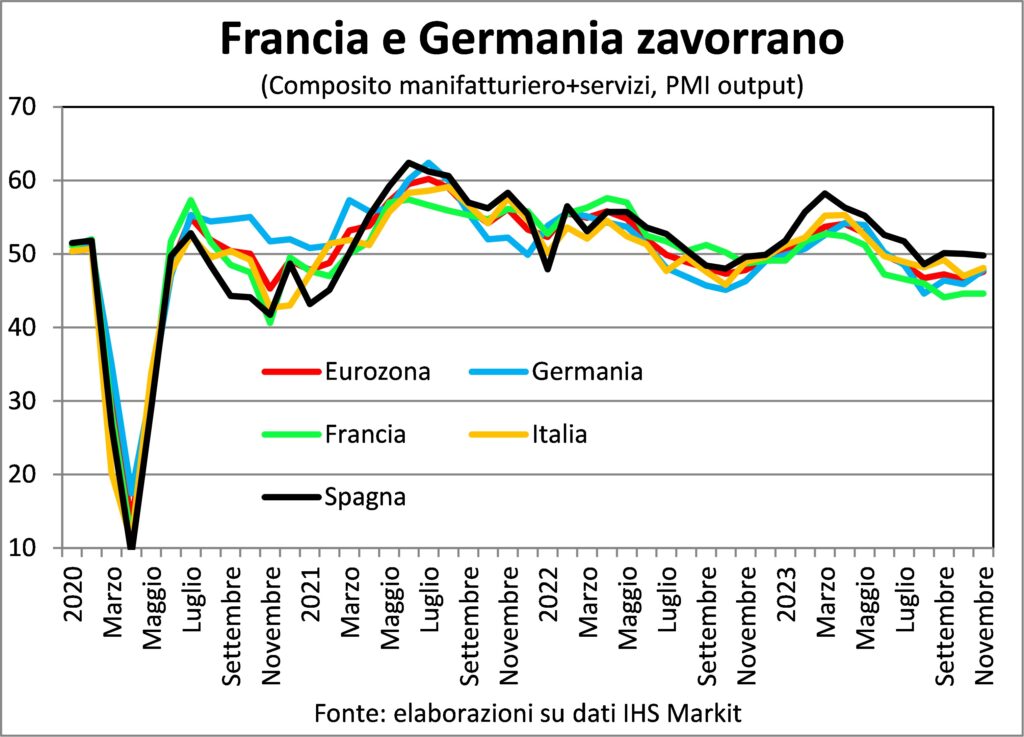
Within the Eurozone, then, there are other significant differences: the France remains stuck in a strong contraction, Germany e Italy they get less worse but still bad, and the Spain has returned to recessive territory, although VAR is needed to notice it.
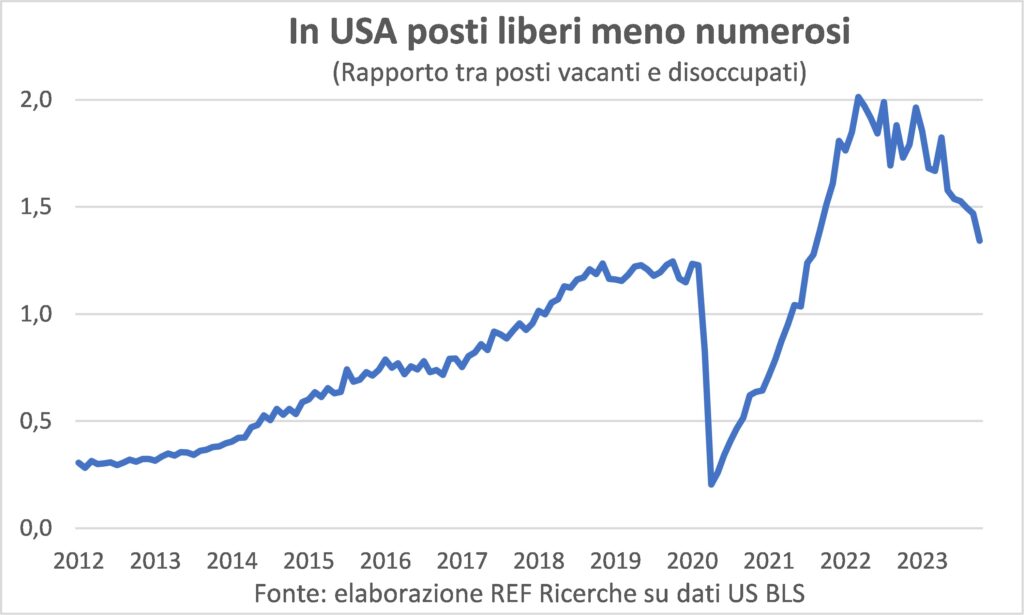
Inside the real economy, the job market continues to be solid, but not like a short time ago. In the USA, the creation of new jobs is normalizing and the gap between vacant positions and the unemployed has fallen significantly from its peaks, although it remains above the values of 2019, when it was already high compared to the post-Great Crisis period. Consumers, however, continue to perceive job opportunities as abundant (plentiful) rather than difficult to find; but the gap between the two has narrowed somewhat. It remains that the increase of 199 thousand positions in November, even net of the almost 30 thousand due to the end of the strikes in the automotive sector factories, is equal to approximately double that necessary to keep up with the increase in the workforce (and in fact unemployment has started to fall again). The real wage bill recorded a significant monthly increase (+0,8%), after three months of stagnation. In short, the landing of the US economy could prove to be really soft.
In Eurozone (and in Italy) unemployment remains at historic lows; However, PMI surveys say that employment fell in November for the first time since January 2021.
The weakening of demand and employment accelerates the ongoing process of disinflation, which is the second element of which the star followed by the markets is made.
INFLATION
La disinflation has reached a very advanced point. At least if we look at the overall measurement of consumer prices, which in Italy rose by 0,7% in November over twelve months (in Belgium they even fell by 0,8%), in the Eurozone by 2,4%, in the USA by 3,2% (October data), in Japan (home of permanent deflation) of 3,3% (also October). China also makes history in itself during this episode of rising price dynamics, having recorded a peak of just 2,8%. And, speaking of peak, for appreciate the speed of the decrease of the price temperature, we recall that in November 2022 inflation was 12,6% in Italy, 10,1% in the Eurozone, 7,7% in the USA (also October) and 2,7% in Japan (ditto).
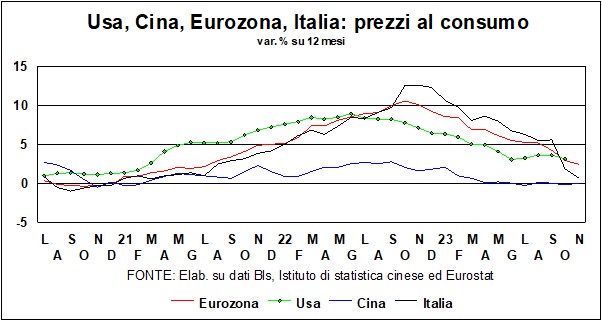
All's well that ends well? Already Lancet of last month underlined that up to now there has been the "simple" part of the decline in price dynamics. Simple because it was aided by the fall of the prices of primary energy sources, oil and gas. But even this fall was not like that of manna from heaven, but rather due to the prompt and drastic reaction of governments to diversify sources (even more coal, as well as more wind and sun) and supplies (away from Russia, obviously), and other assorted sizes. Help also arrived from mild climate (for once, global warming has played favorably) and by the slowdown of economies, which have reduced the demand for fossil fuels, at the same intensity.
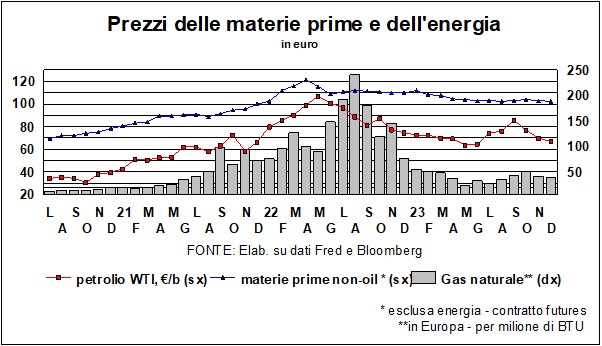
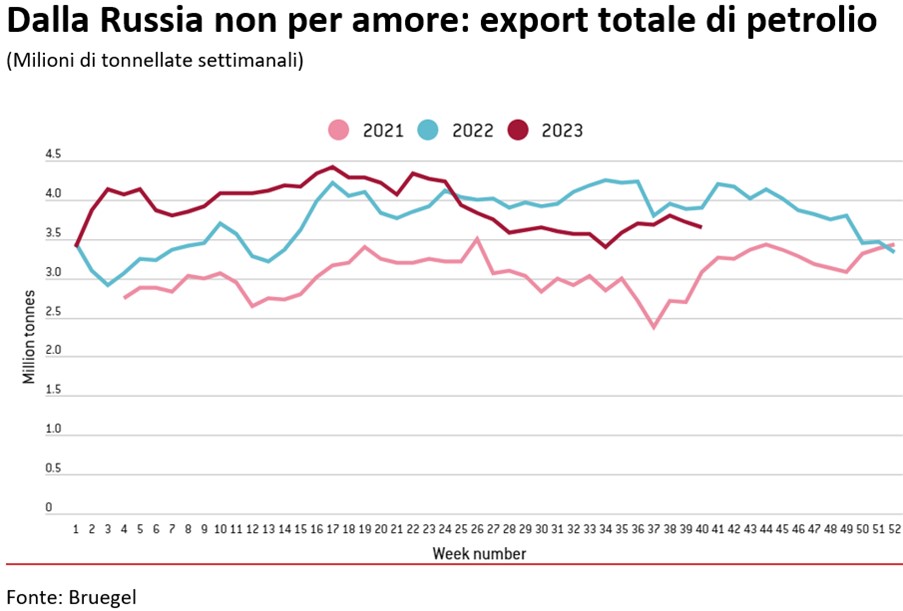
Talking about oil quotations, what is happening to them? Why are they so weak, despite the supply cuts of the cartel of exporting countries? The most obvious explanation is the one indicated above: the world economy is slowing down and needs less black gold. But there is another, even less pleasant: theRussian offer continued to remain high and flood into market. In fact, Russia exports more today than it did before the start of the war and the Western embargo: China, India and other non-European countries have replaced the EU, Japan and other NATO-aligned countries.
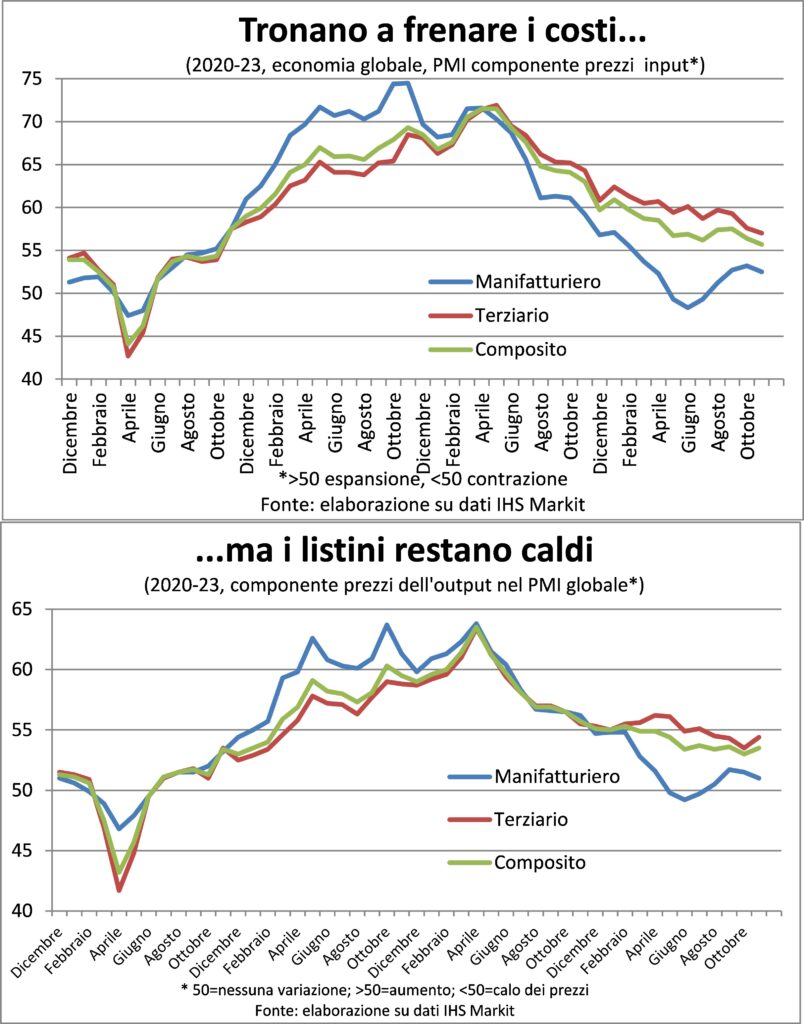
The contribution of the reduction in the cost of energy will continue beyond the direct effect constituted by the prices paid by families for bills and supplies, because it will lead to reduce the costs of those products that use energy, that is, everyone. Clearly, in very different proportions, with greater incidence in artefacts, especially durable ones. And now that demand for such manufactured goods is sluggish, there is a great incentive to pass on the lower production costs to customers. This can be seen clearly in the trend of the prices paid and prices charged by companies component.
On the contrary, i wages are still rising significantly. nell 'Eurozone their annual variation has accelerated, according to the negotiated component of the pay slips, but then there are the individual increases which become more significant when companies cannot find workers, as has been the case up to now. In the United States, where labor market statistics are light years ahead, wage increases are normalizing. Normalizing to what? At pre-pandemic values. However, these were approx one percentage point higher than in the period following the Great Financial Crisis, when the increase was at the limit of compatibility with the FED's objectives, and even a little beyond. The direction, however, is the right one.
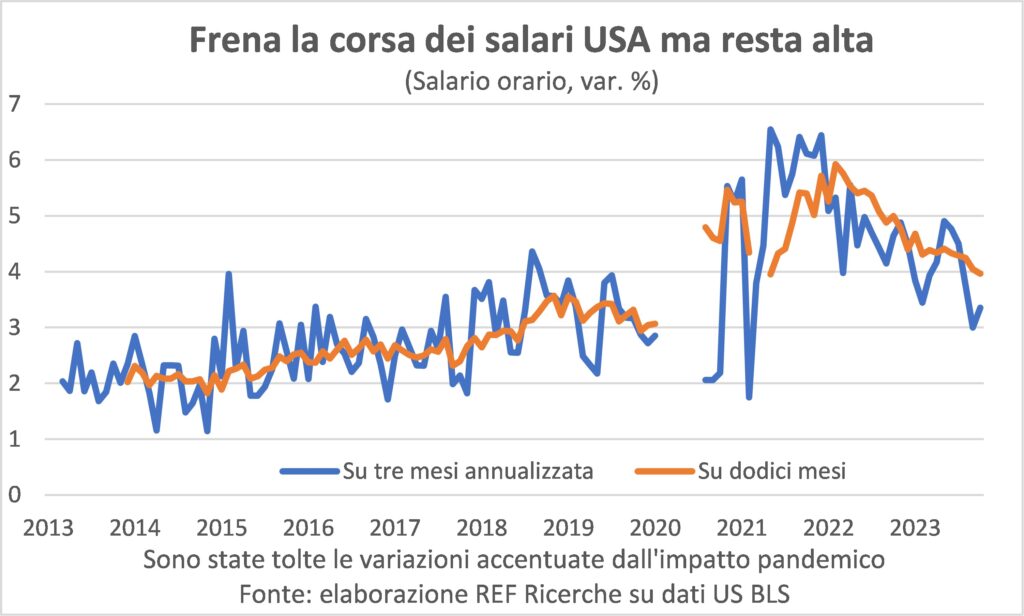
Because the cost of labor weighs heavily much more in the formation of service prices, which explains why this component of consumer prices continues to travel at a somewhat fast pace to be acceptable to the central banks. To clarify: 4% per year in the Eurozone (from 5,6% last July), 5,5% in the USA (3,0% without rents). So the second part of the disinflation will be more gradual and longer. Making central banks cautious (but not helpless) in letting go of the monetary reins.
RATES AND CURRENCIES
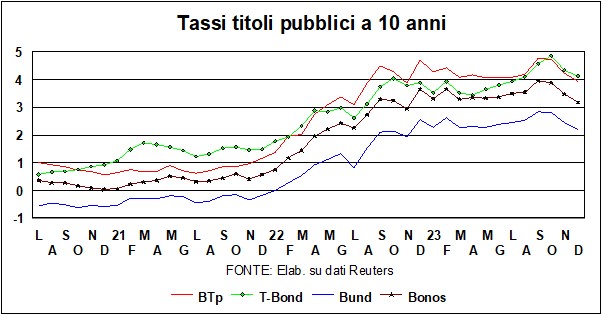
The guide rates are firm, but the 'guided' rates – that is, those in the market – don't really want to be guided, and they continued on the descent already noted in Lancet” last month. We said, then, that the markets are at one turning point: The long season of rising rates had come to an end, but what wasn't clear was how long rates would remain on the plateau before falling back down to the valley. What was not clear to the thoughtful analysts seems to be clear to the markets, which are betting on a turning point in the near future. Of course, 'turning points' are delicate moments that stir instability: with every storm of data the markets wonder what the effects will be on the determination of the central banks in defending the rate fort and - opinions being, as often happens, divergent - the Stock and bond prices are torn on one side and on the other.
But underlying trend is quite clear: both the actions and the bond they were protagonists of a everything rally: just look at the rise of various ETFs – stocks, bonds and junk bonds – to ascertain the power of a decline in rates in rekindling the 'animal spirits' of the markets (not to mention the parallel comfort given to – a safe haven asset – et al Bitcoin – a toy good). Some have calculated that November's choral rise was the strongest rally since the chaotic times of the Great Recession of 2008.
Those who complain about the fact that central banks still keep rates high can console themselves with the thought that the gun is loaded and the ammunition is in the Santabarbara; so, if there was a need to fight the recession and reduce the cost of money, Banks have ample space to support the economy.
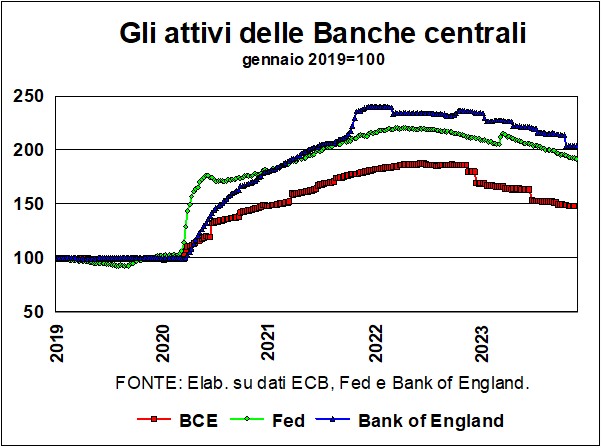
Regarding monetary policy, the Banks - for some time now - had acted on two channels of restriction: rates on the one hand, and the QT (Quantitative Tightening) on the other: selling the securities purchased in the dark years of the pandemic on the market, and thus replacing "quantitative easing" (QE) with symmetric quantitative restriction (QT), which removes liquidity from the economic system. Well, as can be seen from the graph (which shows the balance sheet assets of the ECB, Fed and Bank of England), the ECB was very (too?) diligent in selling the securities (technically, it is not a question of selling them, but of not renewing them upon expiry, thus placing the honor and burden of financing the needs on the market). Compared to the peak of the period, the ECB reduced assets by just over 20%, compared to 13% and 15%, respectively, by the Fed and BoE. This undue severity reinforces the hope that, in the not too distant future, it should be the ECB that leads the decline in rates. Inflation has fallen more than expected and the economy is suffering more than expected. Real interest rates have become positive for Italy and for the Eurozone average, and higher than the (de)growth rate of the economy.
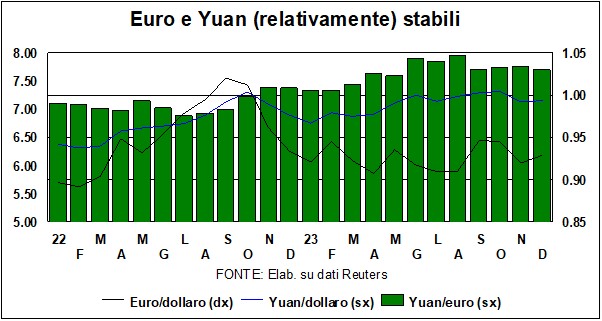
In currency markets the crucial exchange rate dollar/euro is (relatively) calm: for a year now it remains in the 1.05-1.10 range, and there are no strong reasons to think he can get out of it. The same can be said for the (relative) stability of chinese coin. China has a growth rate that continues to be higher than the West and the world average. But they are noticeable crepe is in its development model both in relations with the rest of the world. And the stock market (see the graph, which compares the Chinese and American stock markets) transmits feelings of weakness.
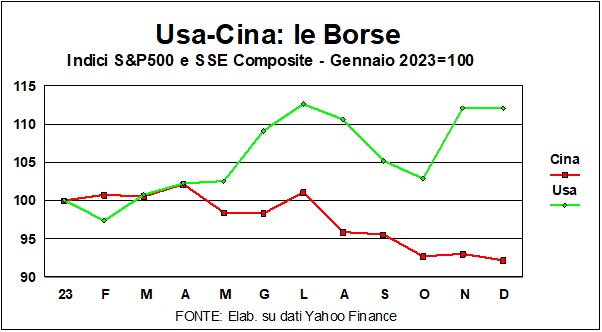
In the rest of the markets, here too falling rates – peppered with reality and hopes – spread the poor magical thing on the prices. And not only in stocks and bonds but also, as mentioned above, in the corners of the markets where the anxiety to protect oneself (gold) and the insane gambling addiction (Bitcoin) dominate. But who did best among the various asset classes?
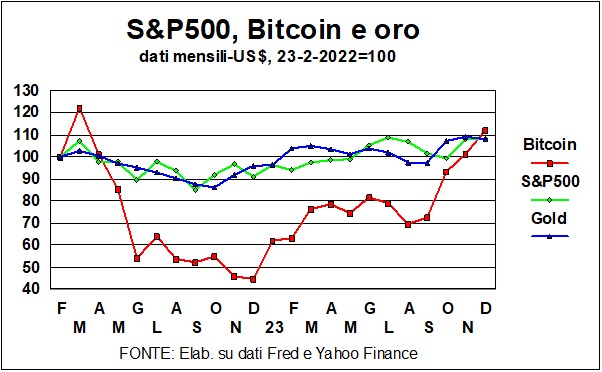
Starting from the day before the unfortunate Russian invasion of Ukraine – followed more recently by the war in the Middle East – how they behaved Series B assets (gold and Bitcoin) compared to Series A (S&P 500)? The graph shows that they all end up more or less at the same point. And, while there isn't much difference between stocks and gold (aside from the fact that the latter doesn't pay dividends), Bitcoin's rise only makes up for the previous decline, which caused worries for gold players. 'I gamble. The conclusion? Might as well stay with stocks…