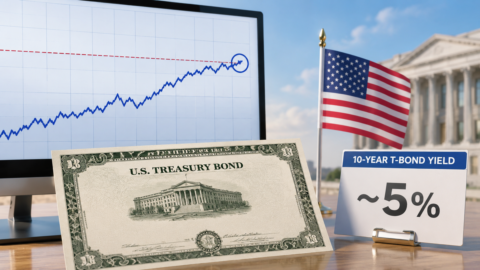
Sometimes the red lights they light up just when something goes off certain threshold. For US citizens More than the price of oil, which is perhaps far from their radar, another product, much closer to their daily life, could have a greater impact: diesel price that for the first time in history he rose above the $6 a gallon. But in terms of target audience there is another one that creates quite a few headaches and that is the US 10-year yield which is located in sight of the key threshold of 5%.
Diesel at $6 a gallon, $8 in California: Here's why it's a cause for alarm.
Il Diesel It is a key factor in many areas of the economy and its rise increases the risk of further inflation tied to energy prices. Geopolitical turmoil has drastically reduced the world's capacity to produce and ship sufficient quantities of diesel fuel, with fighting around the Strait of Hormuz and the loss of refining capacity limiting production and distribution. Today, oil Brent reached a four-month high of $109,97 a barrel, after a 6% jump the previous day, before reversing the trend slightly to settle at around $106, but is still on track to close the week with a gain of around 10%. According to theAmerican Automobile Association, the national average price of gasoline stands at $6,0556 per gallon. In California, the price hovered aroundor $8 a gallon.
Il diesel is used in every field, from electricity generation to home heating, and affects food prices, transportation and construction costs, and even farm machinery and trucks, meaning the impact of record prices will be felt by consumers. Demand also increases with the arrival of autumn, coinciding with the growth in consumption for heating and agriculture. The surge in costs could prove crucial in Maine, where the percentage of households using diesel to heat their homes is the highest in the nation, and in agricultural states like Ohio, Kansas, and Iowa.
The surge is particularly problematic for the Republican Party of President Trump, just over 50 days after midterm electionsBut the White House has few policy levers at its disposal to lower domestic prices, aside from further releases from the Strategic Petroleum Reserve or an export ban. U.S. Interior Secretary Doug Burgum said every idea was on the table, responding to a question about diesel export controls, but added that such measures have actually driven up prices in the past.
The US 10-year is approaching 5%: Here's why it's a critical threshold.
But there is another number that worries investors and consumers and that is the US 10-year benchmark bond yield, in view of the 5% threshold which could not only attract shoppers looking for discounts, but, as global bond benchmark, represents the reference price for the bond markets around the world, They too are under pressure. A breach of the 5% threshold could be enough to destabilize stock markets tooRising yields have an impact on the cost of capital practically to the extent that everything and for everyone, including interest rates mortgage loans Americans, already at their highest levels in over a year, a politically relevant parameter for American voters in view of the mid-term elections.
Il 5% level is “considered by some as a threshold beyond which financial markets could to collapse"He said to Bloomberg John Higgins, chief economic advisor for financial markets at Capital Economics. “While we are not convinced that 5% is that 'magic' number, higher Treasury yields would certainly pose a risk to the sustainability of public finances Americans, as well as threaten the stock markets".
The yield of US 10-year bonds rose nearly 20 basis points this week, settling just below the psychologically important 5% threshold: this morning it is around 4,95% after previously touching a nearly three-year high of 4,979%. Similarly, the yield on thirty-year bonds reached a new 19-year high of 5,3836%, before falling back to 5,359% this morning. The yield on titles at 2 years hit a new 14-month high of 4,5961% after a 12 basis point surge on Thursday. short-term part of the curve Yields are rising on expectations that the Fed may raise rates in the next two months. Instead, yields in the long-term part are increasing mainly due to debt and deficit problems, and persistent inflation. This afternoon, data on US consumer prices which will provide further information to the Fed on the state of theinflation which has exceeded the central bank's target for five years. Market participants have raised the probability of a rate hike on Wednesday, September 16, to 70%.
For US bond market, which is worth 32.000 billion dollars, the achievement of the 5% threshold for the 10-year bonds it would represent a further challenge for the Secretary of the Treasury Scott Bessent, which has already tried, without success, to curb the sell-off of bonds, especially now that the mid-term electionsYesterday, its Treasury Department bought fewer bonds than expected in a buyout operation. repurchase On a large scale. Bessent sought to downplay concerns fueled by the latest price collapse, saying the Treasury market is in "excellent shape," highlighting the strength of two auctions held in recent days and the US's outperformance compared to other markets. In fact, the Bloomberg gauge of total returns on US Treasuries is down 1,4% this year, compared with a 1% decline in a broader global indicator.
Yields rise worldwide. Concerns about French oats.
These movements have spread to the bond markets of Worldwide. The benchmark 10-year government bond yields for the G7 economies They rose an average of nearly 19 basis points this week, marking the worst weekly price decline since the war began. Two-year yields, more sensitive to changes in inflation and interest rate expectations, rose an average of 22 basis points, with the largest increases recorded in major energy-importing countries. European Central Bank raised rates yesterday and warned that price pressures could persist.
The yields of 10-year German Bunds, Eurozone benchmark yields settled at 3,503%, after hitting their highest since 2011 earlier in the week. Oat French at 10 years old, who saw the worst performance among European countries this week, they are around 16-year highs, at 4,429%. Also weighing on French government bonds this month is the internal politics, with the risk that the budget deficit of the country exceeds 5% this year, which has pushed the premium the French government has to pay to borrow money at 10 years compared to the German government (the spread) to highest level since 2012 around 95 basis points.
Yields are also not exempt from an increase BTP, with the 10-year bond at 4,36% this morning, but maintaining its gap with the Bund at around 85 basis points. Yesterday, at the Italian Treasury auctions, 3-year BTPs were placed at a yield of 3,43%, 45 basis points higher than the yield at the previous similar auction, which took place on July 10, 2026. 7-year BTPs were also placed at a gross yield increased to 3,98%, 48 basis points higher than the yield at the previous auction.
Government bond yields from Japan 10-year yields rose 6 basis points to 2,97%, and are expected to Bank of Japan to raise rates next week to a 31-year high, possibly signaling more rapid monetary policy tightening in the future.
Reference yields Australians reached levels not seen in more than a decade on Friday, while Japanese equivalents held close to the key psychological threshold of 3%.
The bonds New Zealanders They performed particularly poorly, with two-year yields rising 25 basis points. A gauge of global yields reached its highest level since 2007.