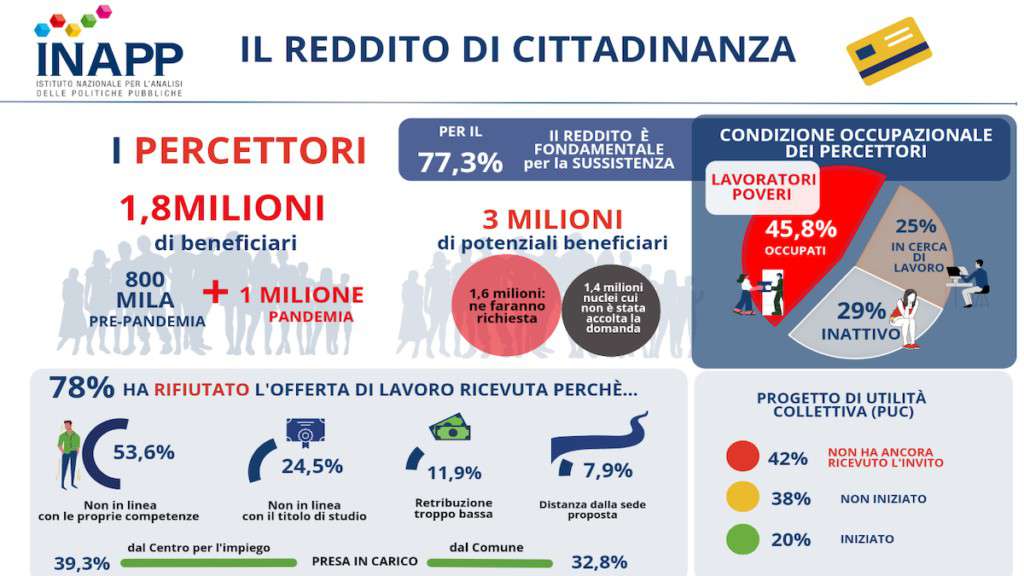
The audience of recipients of the Citizenship Income is approximately 1,8 million families. To these beneficiaries are added about 3 million potential applications but pending or excluded due to the same formal access requirements or due to lack of information on the policy. Many have never ceased to benefit from its approval, also thanks to the weaknesses of the labor market and the wide diffusion of the poor work in Italy. This is what emerges from a new INAPP survey which underlines some critical points of this measure in the context of active employment policies, representative of the entire national territory on a sample of over 45 thousand individuals aged 18 to 74 years.
The heated debate, two years after its approval, on the modification or abolition of the social economic support for families below the poverty level does not seem to have encouraged the creation of new occupation, but highlighted a much more pressing problem: the spread of poor work in our country.
From the results of the Inapp, over 814 thousand citizens, representing as many families, received the Citizenship Income even before the health emergency, equal to 45% of the recipients. Just over 1 million families (55%), on the other hand, began to receive the Cons during the Covid-19 pandemic. For a total of 1,8 million households. In addition to these beneficiaries, there are approximately 1,6 million families who intend to apply for the short-term support measure and 1,4 million households whose applications have not been accepted.
Almost half of the earners are working poor
Furthermore, of these almost 2 million, 46% of the recipients are employed (552.666 standard and 279.290 precarious) with jobs such as to force them to resort to the RdC for subsistence, 25% are looking for work while 29% are inactive. To halve the current number of recipients of the measure, the pay and working conditions of these workers should be improved, observes the Inapp.
Moreover, even the great potential demand reveals 49,8% of similar "working poor", explains Sebastiano Fadda, President of INAPP. And he confirms the major criticality of the RdC which goes beyond the simple number of employed but concerns "the quality of work, wages, productivity, and the reduction of precariousness".
Basic income: how many and why they refuse employment
If for 77,3% income is essential for subsistence, 78% declared that they had rejected the offer received above all for other reasons: the majority (53,6%) because the proposed job was not in line with their skills, while 24,5% because it was not in line with the qualification. The low salary and the distance from the proposed location also had an impact (11,9% and 7,9% respectively).
For the Inapp, the difficulty of social services and employment centers emerges in taking charge of the beneficiaries and that of local authorities in activating projects of collective utility. Only 39,3% declared that they had been contacted by employment centers and 32,8% by the Municipalities. But of that approximately 40%, in turn, only 40% signed the employment agreement, and only half of these received a job offer (moreover, rejected by 56% of them, for the reasons mentioned above ).
Instead, among those contacted by the Municipalities, only 30% signed a pact for social inclusion, and of these, only 20% participated in projects of collective utility.
Benefits of a psycho-social nature perceived by the users of the Basic Income
It is also important to consider the psycho-social benefits perceived by the users of the RdC: 64% declare that they have greater trust in the institutions, 63% that they have had more time to look after their children, 61% that they have improved their condition economy, 58% have done voluntary work, 54% perceive an improvement in their psycho-physical health and, in general, 1 out of 2 declares that they have increased their confidence in themselves, in the future, in relationships with others and in the class politics.
Fadda: "A useful measure against poverty worsened by Covid but needs changes".
According to the president of INAPP, the Italian socio-economic system was already very fragile before the pandemic, certainly the health crisis and the consequent economic crisis have worsened its dynamics. In this scenario, the Citizenship Income has proved to be a useful measure "to deal with widespread poverty", but "the perimeter of the population in a vulnerable condition is wider".
As regards the tools alongside the RdC, according to the aforementioned data, they have shown themselves to be ineffective in promoting better job placement and greater social inclusion. The problem "is not only that of the availability of resources, but that of using them efficiently in the context of an integrated planning of labor policies with industrial policies and development policies in general", added Fadda. “It is urgent to look at the causes to arrive at one organic restructuring both of the system of active employment policies and of social services and to avoid that even the last two programs launched in this regard (GOL and Fondo Nuove Competenze) prove to be ineffective".