
Compared to other countries of the Union, in terms of pensions, ours - among many demerits - certainly has one merit: that of having managed to standardize retirement rules, despite starting from an inextricable jungle constituted by the alluvial construction of the system in the context, between the two wars of the last century, of a corporate culture as the foundation of the state system. Thirty years ago when the ordeal of reforms began (often followed by counter-reforms) they were there dozens of regimes. In the mid-90s the structure of the Italian mandatory pension system for employees and self-employed workers consisted of 47 pension schemes (administered by social security institutions).
The incorporation of the myriad of organizations and funds into the INPS
This plethora passed the test of the new one practically unscathed Constitution which in article 38 (the cornerstone of Italian welfare) in paragraph 4 states: ''The tasks envisaged in this article will be carried out by bodies and institutions set up or integrated by the State''. We know that today, in addition to the homogenization of the rules, a strong one has come forward unification of institutions and funds which now, having passed through partial aggregations, are all incorporated into the INPS (the accident prevention regulations are managed by INAIL), alongside a balkanization of the Caisses and Funds of freelancers, real monads ''without doors or windows''.
Obviously, homogenization processes have safeguarded particular types of work (think of the pilots) e wearing and uncomfortable operating conditions, overcoming, however, regimes pertaining to a real status (such as belonging to the PA and to categories defined as special or to the private economy) which were recognized as real caste privileges. Some legacy remains. The government noticed this in the budget law for 2024, when it tried to modify a rule that allowed the healthcare personnel, of local authorities and of two other minor categories, capable of claiming, with reference to seniority equal to or greater than 15 years as of 31 December 1995, even a single year in the salary calculation (at the most by redeeming one year of university attendance ) to acquire a substantial benefit on the pension amount. On this point, however, the government was forced to backtrack, introducing rules gradually returning to the general rule for subjects who had not yet acquired the right at the end of 2023.
In other countries, resistance to privileged treatments persists
Why did we say that homogenization is our point of merit? In the other countries (see in particular the France) the greatest resistance to the reforms came precisely from the categories that have privileged treatments. While in our country the battle for the uniformity of the rules and not only for new hires has been fought by the large confederal organisations, facing resistance even within their associative bodies, in particular in the public sector and services. Having said all this, it goes without saying that, since the pension is a projection of work activity, it is not surprising if the pension benefits of public employees are affected (especially for women) by a work history.
Pensions for public employees
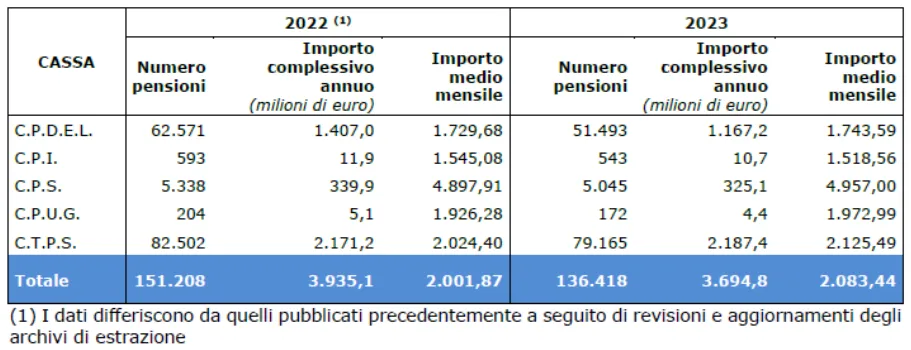
Let us now examine the data provided by INPS for the public employment, recalling, within the scope of the GDP, the managements involved: CTPS for state administration employees, CPS for healthcare personnel, CPDEL for employees of territorial and local authorities, CPUG for judicial officers, CPI for private primary school teachers or equalised. The number of pensions of the Public Employees Management (GDP), in force on 1 January 2024, is equal to 3.137.572, an increase compared to the previous year, in which it amounted to 3.107.983 pensions, by 0,9%; the total annual amount of pensions (total monthly amount multiplied by 13) is 90,1 billion euros, with a percentage increase of 8,2% compared to the year 2023, in which the amount was 83,3 billion EUR. The breakdown by pension fund in force on 1.1.2024 highlights that 58,3% of pension payments are provided by the CTPS, followed by the CPDEL with 38,1%; the other Banks represent a total of 3,6% of the total. With reference to the overall annual amount, it appears that 60,4% is paid by the CTPS, which provides average monthly amounts of 2.289,50 euros, 32,4% is paid by the CPDEL with average monthly amounts of 1.876,30 and the remaining 7,2% is paid by the other Funds, with amounts ranging from 1.682,60 euros per month for the CPI to 5.077 euros per month for the CPS
Over half of the pensions are senior/early
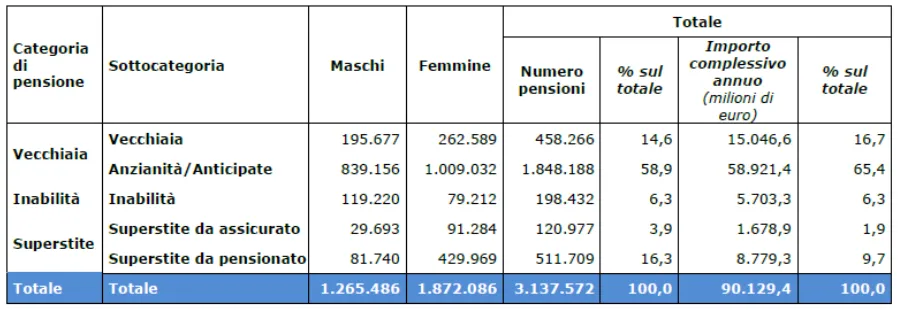
With regards to pensions in force on 1.1.2024 broken down by category and sex, it emerges that 58,9% of pensions are of seniority/early, with a total annual amount of 59 billion euros; 14,6% are old age pensions with a total annual amount of 15 billion euros; the pensions of incapacity are 6,3% and the remaining 20,2% is made up, overall, of pensions paid to active and retired survivors.
As can be seen, public employees are able to make use of the early treatment. In the distribution of pensions by category and gender, it is observed that 59,7% of the total pension payments are paid to women, compared to the 40,3% paid to men. In all pension categories, except the category of disability pensions, there is a greater presence of female pensioners among male pensioners, with maximum differentiation in survivor pensions in which females represent 16,6% of the total pensions and males 3,6%. ,XNUMX%.
While in private employment advance payments are predominantly a prerogative of men, in public employment the number of women is higher. The difference depends on the working condition which, in the public administration, is stable and continuous even for female workers, as also emerges from the distribution of pensions paid in 2023 by pension category. Similarly to current pensions, the category of seniority/early pensions is the largest with 44,2% of the total and a total annual amount of 1.957,2 million euros (53% of the total). Survivors' pensions represent 30,4% of the total in number and 18,2% in amount. Finally, the old age pensions they are between 22,1% in number and 25,8% in amount and those of disability are around 3% both in number and in amount.
The distribution for geographic area of the number of pensions in force as of 1.1.2024 highlights that the greatest number of benefits is concentrated in the northern area of the peninsula with 41% of the national total, followed by 36,5% of the benefits provided in the southern area, islands included. Finally, Central Italy has the minimum value, with 22,3%.