
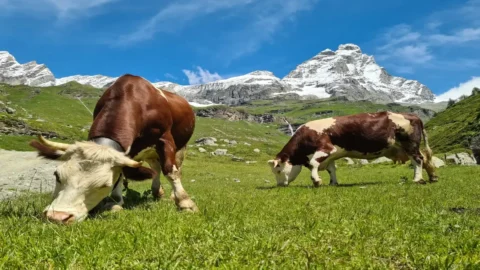
Fontina DOP Alpeggio, a European excellence recognized as a Protected Designation of Origin since 1996 and protected by the Consortium of Producers and Protection of DOP Fontina, enters the heart of the season. At dawn, the herds set out along the paths that rise from the valley floor. It's the mountain herding: the cows move up the mountain following an ancient rhythm that, even today, marks a concrete part of the Aosta Valley economy. At stake is not just a tradition, but a production chain that produces approximately 400 wheels of Fontina DOP every year, nearly 70 of which are produced exclusively on mountain pastures. It is here, between 2.000 and 2.700 metres above sea level, that Fontina DOP Alpeggio is born, its rarest and most distinctive expression, accounting for just 15% of total production. A niche production, producing approximately 70 cheeses a year, it showcases, through transhumance and climate adaptation, the vibrant mountain economy, which relies on approximately 125 active mountain pastures, true micro-mountain dairies, where everything happens at high altitude: the milk is milked, processed, and transformed directly on site, often in just a few hours. The milk, strictly raw, is transformed in the mountain pasture a few hours after milking. This is not a requirement imposed by the regulations, but an intrinsic characteristic of a production that is born and developed at high altitude, in close contact with the territory. No intermediate steps, no standardization: each cheese is born where the cows graze and carries with it the characteristics of that grass, that season, and that altitude. This year, the mountain pasture season opens under the sign of increasingly changeable weather. The high temperatures and low rainfall of recent weeks pose a challenge for those who work in the mountains. Yet, mountain pasture, by its nature, is an adaptive system. The herds move following the grass and water: if the heat accelerates the maturation of the lower pastures, they ascend earlier; if some areas dry out, they seek higher altitudes or better-exposed slopes. It is a continuous mobility, made up of intermediate stops – the so-called tramuti – which punctuate the climb towards the higher mountain pastures. Practical knowledge that allows us to manage even complex climatic conditions, taking advantage of a natural advantage: at high altitudes, temperatures remain milder, ensuring better animal welfare and superior milk quality. Despite the lack of rain, the season is progressing positively. The presence of natural water reserves, including alpine streams and glacier-fed basins, still supports mountain grazing today. In this context, Fontina DOP Alpeggio confirms itself not only as a product, but also as a sensitive indicator of the territory. Each wheel reflects the changing seasons: alongside the traditional lactic aromas (milk, butter, cream, melted butter), herbaceous, floral, dried fruit, woody, and undergrowth notes develop, varying from mountain pasture to mountain pasture, giving the product its inimitable uniqueness. Production follows a flexible schedule, tied more to the weather than to dates. The first mountain pastures begin between late May and June at lower altitudes; in July and August, the altitude rises steadily above 2.000 meters, while between late August and September, the herds gradually descend back to their initial pastures before returning to the valley. The alpine grazing season lasts approximately 120 days in total. Between the end of August and the beginning of September, once the minimum 80-day maturation period has ended, the first forms of Fontina DOP Alpeggio will be available. "We're talking about a limited but strategic production: approximately 70 wheels that represent the most identifying value of our PDO" — underlines Fulvio Blanchet, Director of the Consortium of Producers and Protection of PDO Fontina — the mountain pasture is a dynamic system, capable of adapting even to difficult climatic conditions. This is where the resilience of our supply chain and our ability to combine tradition, sustainability, and quality are measured." Beyond production, in fact, mountain pastures continue to be a resource for the mountains: grazing keeps the slopes alive, prevents abandonment, and contributes to the stability of the Alpine ecosystem. In a context where climate change is reshaping balances and seasons, Fontina DOP Alpeggio tells the story of a mountain that continues to be inhabited, worked, and interpreted. And as the herds continue to grow, day after day, the season enters its most intense moment.

Fontina DOP mountain pasture cheese, the mountain pasture movement has begun: the ancient rhythm of the mountain pastures ensures the production of the Aosta Valley's signature cheese.
A quintessential expression of the Aosta Valley's cheesemaking tradition, only 15% of the total Fontina DOP production is produced on mountain pastures between 2.000 and 2.700 meters above sea level. Each wheel reflects the changing seasons: alongside the traditional dairy aromas (milk, butter, cream, and melted butter), herbaceous, floral, nutty, woody, and undergrowth notes develop.

Luke Vespignani
He is a collaborator of Mondo Food of FIRSTonline, a journalistic magazine of the great Italian food and wine tradition of excellence. Everything that is upstream of Italian food and cuisine, the heritage of our agriculture, enology, agri-food Made in Italy told by a team of journalists and food and wine experts coordinated by Giuliano De Risi, a professional with proven experience, former director of national news agency. A showcase of Italian gourmet excellence, seen through the stories of the protagonists, the history, the culture, the tradition, the work of men, the recipes of the greatest chefs, the testimonies of Italian biodiversity, to touch all the senses of the knowledge of great Italian cuisine. According to the principle that when we sit down at the table, the great book of our life opens.
You might also be interested ...
-

SK Hynix debuted with a bang on the Nasdaq. It's now ramping up chip production because demand still significantly exceeds supply. But for how long?
-
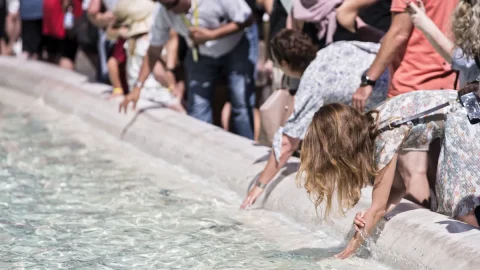
Extreme heat continues to linger in Italy: the third wave continues, with temperatures reaching 40 degrees Celsius. This weekend's weather forecast.
-
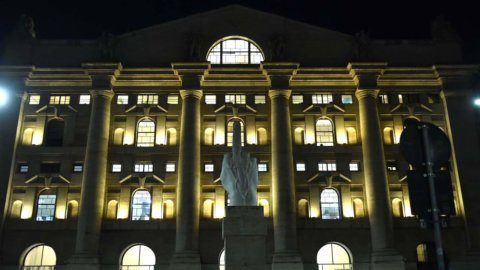
Listed public companies, the 15 largest listed on the Ministry of Economy and Finance, are nearly worth €395 billion (+28,5%): here's a comparison with the entire stock market.
-

Inflation is no longer a concern. The Fed and ECB will keep key interest rates unchanged. The dollar is stronger, and the US economy is weaker. Stock markets are leaving their peaks.