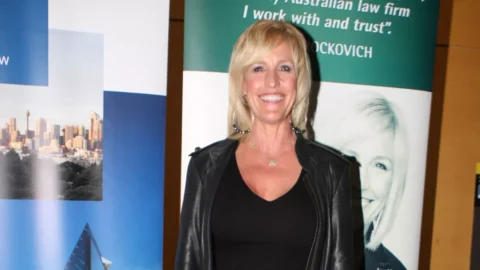
It was 2000 the year in which “Erin Brockovich – The Force of Truth”, the film by Steven Soderbergh that won an Oscar for its protagonist, Julia Roberts, but above all made the history of thelegal assistant and activist, Over the years, she has become the emblem of a modern heroine, capable with limited resources of taking on multinationals that, in the name of profits, trample on the environment, businesses, and health. A blonde and tenacious "David" who fights against the "Goliaths" of the moment. In Anglo-Saxon parlance, "to Erin Brockovich" has even become a verb meaning "to investigate and then defend a cause without ever giving up," explains the American magazine. The Atlantic.
Today, Erin Brockovich is 66 years old, with a little more money and a lot more fame than she was when she started out, and she continues to be an activist. In recent months, she has decided to focus on another important cause: data centers, huge factories that are springing up like mushrooms in the United States and beyond and which serve to operate the systems artificial intelligence.
Erin Brockovich and the data center map
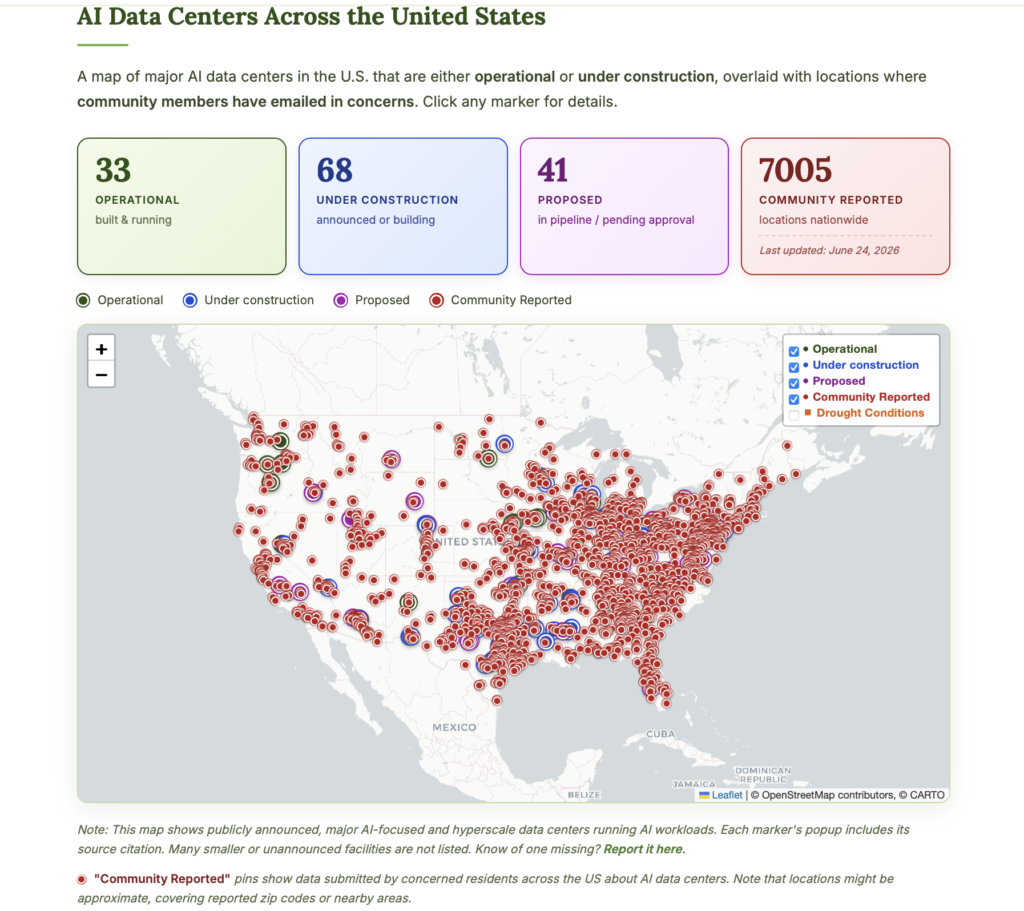
In the US, in particular, the situation is becoming increasingly delicate and protests across the country are becoming more and more heated. On April 27, Brockovich therefore published an appeal on his website, asking anyone concerned about a data center built near their home to contact her. In just over two months, over 7 reports have arrived, from which the activist has created a map of the main data centers dedicated to artificial intelligence in the United States, including both those already operational and those under construction, and overlaying the locations from which citizen reports were received. Currently, there are 33 operational data centers, 68 under construction, and 41 planned. Many of these facilities span acres and were built overnight, unbeknownst to local communities, who were often presented with a fait accompli, defying any form of transparency.
In the emails he receives every day, Brockovich sees growing concern among citizens who wonder why they haven't been informed and what will happen in the future. "Data center developers often stipulate confidentiality agreements with local authorities, making it impossible to understand why these projects were approved without environmental impact studies or without the involvement of residents,” Brockovich says in a long interview with GuardianAnd if any local authority decides to stop, heeding residents' protests, it's taken to court with eight-figure compensation claims. "No one is capable of sustaining a lawsuit like that," explains the activist.
An example is Hill County, in Texas, where county commissioners, taken by surprise by citizens' vehement opposition to the construction of a data center, voted for a one-year moratorium to suspend construction. In response, the developers responded by demanding $100 million in damages and, according to the Texas Tribune, the county was forced to backtrack.
So far I am 79 municipal administrations scattered around the United States that have approved moratoriums, but many have been immediately hauled before a judge. Temporary suspensions have been approved in Georgia, Maryland, Michigan and South CarolinaWhile in Maine a moratorium was blocked by the governor's veto.
All data center problems
“This is not a story about artificial intelligence,” Brockovich clarifies. GuardianThe real problem, he says, are the huge data centers that are being built to house the immense computing power required by AI. These facilities, he explains, occupy “hundreds and hundreds of acres” and have a enormous environmental and social impact.
One of the main problems concerns exploitation of water resources. According to an analysis by the British newspaper, two-thirds of the plants planned in the US will be built in areas already affected by drought. The largest ones can consume up to 5 million gallons of water per day (18 million liters) for cooling, an amount equivalent to the average daily consumption of 50.000 people. Not to mention the very high energy consumption, of the electronic waste that these plants produce, of the visual and noise pollution: lights always on and constant buzzing, twenty-four hours a day, which, in addition to scaring away the local wildlife, makes life impossible for those who live in the surrounding area.
And then there is the impact on the wallet: citizens who live in the areas where the first data centers were built are experiencing very high increases on electricity and water bills. “People are reporting skyrocketing bills to me,” Brockovich said, citing one resident whose water bill went from 22 to beyond dollars 350 per month.
The incredible story of Erin Brockovich and the landmark lawsuit against PG&E
Over the course of her long career, Erin Brockovich has already faced several giants without ever giving up. And she has no intention of doing so now, faced with enormous factories behind which, in many cases, silent and anonymous, US tech giants lurk.
Her story, after all, speaks for itself. And for those who haven't heard it, there's even a beautiful film that tells it. It was 1993, the year in which, as a simple assistant in a law firm, she built the case against the Pacific Gas & Electric (PG&E), accused of having contaminated the waters of the town of with hexavalent chromium Hinkley, California, causing cancer and other serious illnesses in residents. Three years later, following the battle led by Brockovich and Ed Masry, the energy giant was forced to pay a compensation of $ 333 million to the approximately 600 residents of Hinkley. A very high number for the time.
Since then, Brockovich has continued to work on environmental protection and listen to communities who report problems to her. Recently, she has focused on Pfas, synthetic chemical compounds used to make products resistant to water, grease, and stains and associated with numerous health problems such as fertility disorders and some types of cancer.
Now it's the data centers' turn. And not just the US ones. The activist has also been contacted by people living in Australia, India, Scotland, and Ireland.It's a question that concerns the entire planet”, he further explains to Guardian. “It's something huge. To face it, you need courage, the courage to step forward. And that's not easy when you're up against forces that have all the money, all the intelligence, and all the technological capacity in the world. Besides, I'm getting too old for all this,” she concludes with a smile, convinced, however, that this challenge, too, can be overcome in the end. After all, the meaning of the verb that bears her name is clear: “To Erin Brockovich,” meaning to defend a home without ever giving up.