They are now It's been eight years since Sergio Marchionne disappeared, and today more than ever the European automotive industry needs a manager like Marchionne to avoid giving up in the face of China's preponderant advance.
In his fourteen years at the helm of Fiat Marchionne became one of the most famous managers in the world, precisely for having managed to renew a company that was losing five million a day in 2004 and bring it to profits of 3,6 billion in the last year of his management.
At the beginning of the new millennium Fiat's financial problems, with a debt of over 4 billion, seemed truly insurmountable and such that even those "in the know" predicted its imminent failure. After the presidencies of Romiti and then Fresco in the 1990s, on February 28, 2003, an Agnelli, Umberto, the brother of Gianni, who had died a month earlier, returned to the helm of the company.
While Gianni Agnelli was known everywhere as the Lawyer, in the company the term "the Doctor" referred to Umberto AgnelliUmberto Agnelli's presidency lasted only 15 months, when he passed away from an incurable disease on Friday, May 27, 2004.
Over the course of the weekend immediately following the then pro-tempore CEO Giuseppe Morchio he is trying to assume full powers, trying to have the board of directors appoint him not only as CEO but also as President of Fiat.
In the company's history only one person had combined the two roles, Professor Vittorio Valletta, from 1946 with the Presidency handed over by Senator Giovanni Agnelli, the founder of Fiat, to 1966 when the Presidency was taken over by another Giovanni Agnelli, then already known as the Lawyer and also a senator for life since 1991.
To what was at the time defined as a real attempt at a "managerial coup" the last of the charismatic figures of the family, his sister Susanna, known as Suni, strenuously opposed it.
Susanna Agnelli's tough opposition, supported by Gian Luigi Gabetti, who has always been the family's trusted advisor, following Morchio's move, led the board of directors to appoint Ferrari President Luca Cordero di Montezemolo as President of Fiat on the night of Sunday 30 May.
Morchio, who at this point would have found himself dependent on one of his former subordinates, as Ferrari was a subsidiary of the Fiat Group, immediately resigned and on the morning of the following day Sergio Marchionne was appointed CEO, always on the advice of Susanna Agnelli.
Moreover Morchio, who had joined the company only a year earlier, had proven himself, to use an appropriate English term, totally “unfit”, particularly when it came to factory management.
For example, when production at the Melfi plant, where the Punto was produced, was blocked for 21 days, from 17 April to 9 May 2004, due to a trade union dispute, widely reported by the mass media and debated on television talk shows, concerning changes to working hours and the revaluation of performance bonuses, Morchio paid attention to it only a few days before the shareholders' meeting., fearing that it would be the subject of discussion, ordering the company delegation at the union table that it was appropriate to close the negotiations by accepting the unions' demands and even paying for the days of strike!
Obviously Morchio's orders were ignored and the dispute ended with an "honorable" agreement for both parties, without upsetting the historical framework of industrial relations at Fiat. Marchionne's appointment surprised not only the markets and the trade press, but also the company's management.
It was thanks to a timely note from the company's Internal Relations office, sent early in the morning to management on the "blackberry" of the time, that we were made aware of Marchionne's professional curriculum, known to most only by name as the independent member co-opted by Umberto Agnelli to the Fiat board of directors the previous year.
A few days later, Marchionne came to Mirafiori to meet the Austrian Herbert Demel, appointed CEO of Fiat Auto only in October 2003 and coming from the Volkswagen group (the first non-Italian to hold a top position in the company's century-long history).
The meeting between the two was not immediately among the most positive, so much so that Demel resigned three months later with their argument during the Paris Motor Show in front of several people.
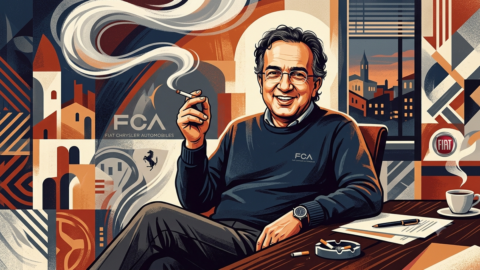
What most likely aggravated the situation in that first meeting in June was Demel's refusal to allow Marchionne to smoke in his office, justifying it with the company's anti-smoking policy and the statement of the Mirafiori Office Building designated a “no smoking” building.
This directive was issued in 2000 (the Sirchia Law will be from 2005) when Fiat Auto, following the joint venture, implemented the “Code of conduct” from General Motors including a ban on smoking in the workplace.
Ironically, compliance with the application of the “no smoking building” It was assigned to me, a known smoker. So that morning, when Sergio Marchionne burst into my office, he asked me, without further ado, if I was the one who banned smoking.
I got up, went to open the window, and from under the desk I pulled out the ashtray and my pack of Marlboros. Marchionne burst into laughter and said: “Thanks, but I smoke Muratti”.
In that brief puff of a cigarette, he simply told me that if he had been there, the union would not have implemented the "Melfi blockade." I didn't ask him why, because it seemed like a useless provocation to me. However, a solidarity was born among smokers which continued over the years.
In meetings, with rare exceptions, it was just the two of us smoking, and for him it was always a suffering to attend union meetings without being able to light a cigarette.
After my retired from the company in December 2011, I met Marchionne at the annual meeting of Florentine industrialists in June 2013.
Last autumn, in a video forum, Matteo Renzi, then mayor of Florence and candidate in the center-left primaries, had attacked Marchionne on his investment strategy in Italy, accusing him of mocking workers and those left-wing politicians who considered him the "good bourgeois."
Marchionne's caustic response was immediate: on the sidelines of a meeting of ACEA, the European automobile manufacturers' association, of which he was President, which was held in Brussels, he underlined that Renzi was not a Barack Obama but only the mayor of a poor town.
The reconciliation between the two it happened with a handshake at the aforementioned Confindustria assembly held at the then Teatro Comunale in Florence.
Marchionne was invited to attend the Florence meeting, following the tensions of the previous year. following Fiat's exit from Confindustria, also marked a reconciliation with the world of industrial associations.
On this occasion Marchionne launched an appeal for the United States of Europe and for a Marshall Plan to restart the European economyAt that time, I was in Siena as a consultant for Monte dei Paschi, working on the management and redeployment of redundant staff and, in particular, on the outsourcing of the bank's back-office activities to the Florentine company Bassilichi, a leader in payment and electronic money services.
I was also invited to the event by the President of Confindustria Florence Simone Bettini, currently President of Federmeccanica, for our shared past as members of the Federmeccanica Board itself.
At the end of the meeting, Marchionne and I met at the exit of the Theatre to go and get, as per tradition, a coffee in a bar on Corso Italia and then take a stroll to the nearby Lungarno while smoking a classic cigarette.
As we walked he reminded me of the motivation I had given him for my idiosyncrasy in speaking English, even though I had started my professional life in the American conglomerate WR Grace & Co., whose President, as Marchionne told me, was his friend Peter Grace.
The thing was, I didn't like speaking the waiters' language (with all due respect to waiters, of course)! We said goodbye, knowing we'd probably never have another chance to see each other again or smoke another cigarette. I quit smoking on July 25, 2018.