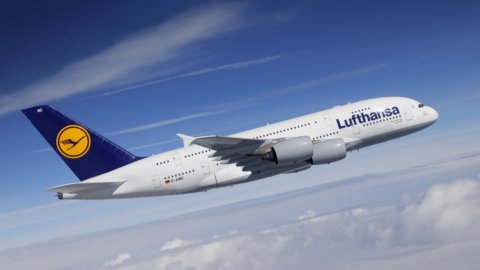
Lufthansa collapses on the stock market after one disappointing quarterly and 2026 estimate cutThe German company's shares lost more than 9% in Frankfurt, reaching their lowest level since March, after a second quarter closed with a EBIT rectified down by 56% to 383 million euros and a net profit that plummeted by 88% to 123 million. The main factors that weighed heavily were the expensive fuel, which added approximately 750 million euros in costs, the tensions geopolitical and strikesThe group has thus revised downwards its forecasts for 2026 operating profit, now expected between 1,7 and 2,2 billion euros, while accelerating its cost reduction plan and confirming the integration path of Italy Airways.
Lufthansa's quarterly results under pressure: EBIT drops 56%
The slowdown in prospects comes after a difficult second trimester for Lufthansa. The group closed the period with a EBIT adjusted by 383 million euros, down 56% compared to the same quarter of the previous year and below estimates analysts, who expected a result close to 477 million euros.
Even heavier the decline in net profit, down 88% to €123 million. The result was also impacted by the comparison with the positive tax effect recorded in the previous year and the expenses incurred during the period.
The decline in profits occurred despite revenue growth. In the second quarter, Lufthansa recorded revenues for 11,1 billion euros, up 8% on an annual basis, confirming a still solid demand for air transport. Profitability was therefore not held back by the lack of passengers, but above all by theincrease in operating costs.
Lufthansa under pressure from high fuel prices and the Iranian crisis
The main factor putting pressure on the accounts remains the expensive fuelLufthansa recorded approximately 750 million euros in additional costs for kerosene compared to last year, an impact that significantly weighed on margini of the group.
For network airlines – Lufthansa, Swiss, Austrian Airlines, Brussels Airlines e Eng Airways – Fuel costs increased by more than €600 million compared to the previous period. Despite the group's ability to increase ticket prices, especially on Asian routes, the increase in revenue was not enough to fully offset the increase in expenses. Geopolitical tensions also complicated the situation, with conflict in Iran which contributed to the volatility of energy prices, and the April strikes, which have had an impact on the group's operations.
“The second quarter was challenging, once again marked by multiple geopolitical crises and uncertainties,” explained the Chairman and CEO Carsten Spohr, stressing that the improvement in load factor and the increase in unit revenue were not enough to fully offset the sharp increase in fuel costs.
Lufthansa cuts flights and fleet to contain costs
To react to pressure on margins, Lufthansa has accelerated the cost reduction plan and fleet optimizationThe group has decided to eliminate Lufthansa CityLine flights from its service offering, resulting in the retirement of its entire sub-fleet of 23 Canadair CRJ-900s.
The company will also proceed to early retirement of the Airbus A340-600s, long-haul aircraft characterized by higher fuel consumption, and the temporary grounding of two Boeing 747-400s since the beginning of the winter flight program. According to Spohr, these measures will allow reduce fuel consumption, reduce fleet complexity and improve the group's competitiveness in a context still characterised by high volatility.
Capacity growth plans have also been revised. At the beginning of the year, Lufthansa had expected a 4% increase in flight capacity, later reducing this to 2%, until it decided to abandon the expansion planned for the year.
In the second quarter, the total number of passengers carried by the group fell by 4% to 35,6 million, also due to the reduction in offerings linked to the reorganization of regional activities.
Lufthansa Cargo and Technik support the group, passengers in difficulty
The slowdown did not affect all divisions of the group. lufthansa Cargo e Lufthansa Technology They actually recorded an increase in adjusted operating profits, helping to at least partially offset the weakness of the passenger sector.
The network's airlines, which include Lufthansa, Swiss, Austrian Airlines, Brussels Airlines, and ITA Airways, closed the second quarter with an adjusted EBIT of 137 million euros, almost 500 million less than the previous year.
Even the point-to-point segment, which includes vectors such as Eurowings, entered negative territory with an operating result of -37 million euros, also influenced by the costs related to the subsidiary SunExpress.
Lufthansa confirms the integration of ITA Airways and focuses on financial solidity
Despite slowing results, Lufthansa maintains a solid financial position. The financial director To Streichert It indicated available liquidity of 10,7 billion euros, underlining how cost discipline, network optimization, and continued strong demand could help offset some of the cost increases.
On the strategic front, the central role remainsintegration of Ita AirwaysLufthansa confirmed that in June it exercised its option to increase its stake in the Italian airline, bringing the share from 41% to 90%. The transaction, expected to be completed in completion early next year, will lead to ITA Airways being fully integrated into the Lufthansa Group, both organizationally and financially. The goal, Spohr explained, is to build a more competitive international airline group, structured into four main business areas: network airlines, point-to-point carriers, logistics, and maintenance, repair, and overhaul services.