There is a constitutional law approved by Parliament in April 2015, after a very extensive debate and exhausting filibustering, to which more than 15.000 amendments have been presented that have touched every aspect, even the grammatical and syntactic form. This law must be submitted to a confirmatory referendum: the citizen is therefore asked to declare whether he intends to ratify the resolution of his representatives or not.
In the latter case, the current constitutional arrangement will remain in force. Therefore, it is not a matter of expressing an assessment of its merits and even less of a method, which already took place in the trial phase, but of deciding whether we want to confirm it or change it by adopting the new rules approved by the reform law.
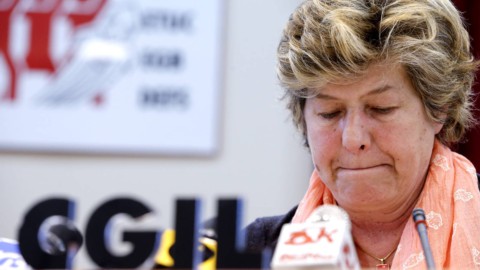
It is therefore worrying and disconcerting that the CGIL has formally expressed a radically negative judgment on this constitutional reform law which, it is worth remembering, was approved by the large majority of the two Chambers in triple reading; though pharisaically she refrained from calling on her subscribers not to vote for her approval. Reading the cumbersome text of the document approved by the Executive Committee of the Confederation, which is also recommended for the use of a jargon between politicking and professorial (which says a lot about its hidden inspirers), one wonders how these constitutional reforms contain provisions which may damage, directly or indirectly, the individual and collective rights of workers and their representative organisations.
On the contrary, if a note can be made in this regard, it would be regrettable that the opportunity was not taken to favor the implementation of articles 39, 40 and 46 of the Constitution. If this has not occurred, it is only due to sensitivity and respect for collective autonomy. Of course, nobody can be denied the right to express their opinion on matters of general interest, but it is necessary to know how to avoid the confusion of institutional roles and to assume responsibility for the political consequences of one's actions.
A trade union that declares its aversion to a constitutional law and invites its members to vote no cannot fail to be aware that it is carrying out a political act of which it knows the consequences in terms of political, economic and financial instability with the consequent social effects, both more than he knows perfectly well that the mass of forces that supports the no is united only on the objective of overthrowing the Renzi government and is unable to express either a different project or an alternative coalition, while it is in the union's interest to have a political interlocutor with whom to talk and, when he has ownership, to negotiate.
The assumptions and conditions that justify an act that will only lead to increased political isolation of the CGIL and a deepening of the union division are lacking. So why engage in a conflict from which she will emerge defeated anyway? The truth is that the real issue is governability and that is the institutional conditions that guarantee the power to govern to the party that wins the electoral majority; which means that the political decisions of the majority should not be conditioned by the preliminary search for a consensus in the form of participation in the management of power through exchanges or compensations.
Instead, this was the perverse logic of coalition governments both in the proportional form and in that of the alternative poles, but it was also the philosophy and practice of concertation that led to the practice of the trade union's right of veto on legislative activity and government that has been paid for by the workers through contractual sclerosis, corporatism, the drop in productivity and the decrease in employment and by the citizens with the increase in public debt, the tax burden and a low level of growth.
The constitutional reform puts the government in a position to assume its responsibilities by involving social and economic subjects and agencies through participation in the formation and elaboration phase and in the control phase, but keeping the consultative functions clearly distinct from those of government . The key to governance is the possibility of fully assuming the responsibilities that the parties that make up the electoral majority have assumed before the citizens.
The hidden sharing of power between the majority and the opposition and between the government and intermediate bodies is eliminated and replaced by free forms of participation. This is bitter medicine to drink, but it creates the conditions for uprooting the informal systems of power that impede good governance and fuel corruption. The rule according to which it is necessary to guarantee the majority the power to govern is in Italy one of the fundamental conditions for making democracy work.
And that democracy works is a vital interest of trade unions if they are to understand and interpret workers' interests. Anyone who speaks of the risk of creating an authoritarian regime ignores or pretends to ignore that an authentically authoritarian power often hides under the cloak of assemblyism or consociationalism; a bad plant that takes on changing, apparently modern forms, like the 5-star movement.
A deliberative and governing democracy is by its very nature extremely transparent because it is based on direct representation between elector citizens and governors on the basis of a programmatic pact whose avoidance automatically implies its forfeiture.
Workers believe, starting with the members of the CGIL, that a reform of the Constitution that speeds up the legislative process, increases the weight of local autonomies in the government of the state through an unelected and unpaid Senate of autonomies, reduces the number of parliamentarians elected in the Chamber of Deputies and the consequent expenses guarantee governance, stability and participation, it is not in their interest and that the current situation must remain unchanged.