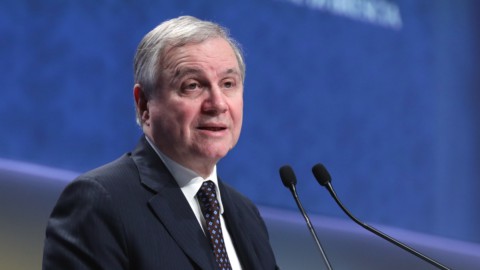
"The ongoing crisis has shown that, especially in the presence of high levels of leverage and pronounced maturity transformation activity, potentially systemic risks can arise in the mutual fund industry." The alarm was sounded by Ignazio Visco, governor of the Bank of Italy, who spoke on Friday morning at the 96th Savings Day, organized by Acri online to comply with the anti-Covid measures.
“While in the years following the global financial crisis the regulation of the banking sector was made significantly more stringent – he added – only now is the question of adapting the rules of the non-banking sector being tackled with a certain determination; it is necessary to continue working at an international level, in particular within the Financial Stability Board, to equip itself with tools, including macro-prudential ones, which help to deal with the risks that may arise in this sector”.
Visco then underlined that, since the beginning of the pandemic, the growing pessimism of consumers "has been reflected in a considerable increase in the propensity to save", which risks remaining "at high levels also in the coming quarters". This situation, "if it is not accompanied by an adequate recovery of investments and productive activity, can cause a decrease in aggregate demand and incomes, in turn fueling a further growth in saving intentions for precautionary reasons and triggering, thus, a vicious circle” which is holding back the recovery.
As for the public debt, "it is sustainable - Visco continued - but its permanence at high levels leaves us exposed to the risks and costs deriving from tensions on the financial markets or from new economic shocks". For this reason "the government has announced its intention to start reducing the weight of public debt on GDP as early as next year, to bring it back to pre-pandemic levels by the end of the decade".
BANKS, GUALTIERI: "THE REAL CHALLENGE WILL BE ON NPLs"
Italian banks have made great progress on strengthening them, but now “the main challenge in the coming months will be to manage the growth in NPL exposures brought about by the pandemic crisis, which can lead to significant destruction of value”. This was stated by the Minister of Economy, Roberto Gualtieri, speaking via streaming at the Savings Day.
"We therefore need a proactive attitude on the part of the European and national authorities, identifying measures to diversify and enrich the toolbox of the authorities themselves - he added - In this perspective, the Ministry of the Economy has called for more reflections on a possible update proposal of the regulatory framework".
Gualtieri then said that "GDP growth in 2021 could be lower than the 6% expected" in the update note to the Def, "but the recovery would only be postponed, not jeopardized".
In any case, “it is reasonable to believe – continued the minister – that the longer the pandemic crisis lasts, the greater the risk of deeper damage to the country's economic and social fabric, as well as the burden on public finances. It is for this reason that we have intervened so promptly this week with the Refreshment decree and it is for this reason that the tone of the budgetary policy will remain expansive for as long as necessary, using the room for maneuver within the 2020-2021 net borrowing estimates of the recent Draft Budgetary Plan and, if necessary, also intervening greater".
PATUELLI (ABI): "AVOID NEW EXPLOSION OF NPL"
Antonio Patuelli, president of ABI, also spoke at Savings Day, according to which "every effort must be made by institutions, companies and banks to prevent explosions of impaired loans, which must not be the result of underestimating risks and too strict rules . Even the deadlines of the moratoriums must be rethought with the prolongation of the pandemic. It is essential not to interrupt the measures for families and businesses too soon in the prolonged emergency: it is useful for all businesses that guaranteed loans do not run out on December 31st and can be requested until June 30th, as permitted by the EU ".
As for the coupons, "banks - continued Patuelli - are companies that must be able to return to having ordinary relationships with their shareholders: if, after prudent and far-sighted provisions, they produce profits and have solid capital ratios, including forward-looking ones, under the control of the supervisory bodies as before the pandemic, they must be able to distribute dividends".
PROFUMO (ACRES): "REDUCE TAXES ON FOUNDATIONS, QUINTUPLICE IN 10 YEARS"
Taxes for foundations of banking origin have increased fivefold in the last 10 years, "reaching the record figure of 510 million euros in 2019. So much so that it could be configured as the first sector of intervention of foundations, much more than what they allocate to welfare (335 million) or to Art and Culture (240 million)”. This was stated by Francesco Profumo, president of ACRI, in the opening speech of the 96th World Savings Day.
“For some time – he added – we have been talking to the government to try to review the taxation to which foundations of banking origin are subject. The issue is not a corporate claim at all. The resources that the foundations pay to the tax authorities are subtracted from their disbursements: i.e. to voluntary organisations, social cooperatives, cultural associations, young researchers, all those subjects who contribute to making Italy a more inclusive and livable country for everyone".
LOCKDOWN EFFECT: SAVINGS DOUBLE, BUT DOES NOT BRING GROWTH
from Acre/Ipsos research presented on the occasion of Savings Day, it emerges that - due to the collapse in consumption caused by the pandemic - in the first six months of 2020 Italians doubled their gross savings (the part of disposable income not used for final consumption). In particular, at the end of June the propensity to save was 18% of disposable income, against 8% at the end of 2019. The propensity to keep cash in the current account is confirmed in line with last year (63% ). Among those who invest, 33% choose safe financial products, while only 9% focus on riskier products.
“The lockdown and the climate of uncertainty we are still experiencing have caused private savings to grow overall, but it is an accumulation that does not translate into investments, it is not an engine of development”, comments Profumo. "The crisis is serious for the vast majority of Italians, but the concerns related to the spread of the infection and the response capacity of the health system are moving forward fears about the economic repercussions of the pandemic in our country and in the world".