Some good soul should take it upon themselves to explain to the Alloy how the world turns in terms of pensions before in the budget session for 2027 (the last before the elections) its exponents – Salvini in the lead – return to waving the same old proposals aimed at "overcoming" the Fornero reformAbove all, it would be necessary to induce Claudius Durigon and allies to organize and coherently present their demands. We maintain – and will try to demonstrate – that the League's objectives on pensions are at odds with the positions on immigration (even more so with the ) and with the needs of the productive North which, at the time of Umberto Bossi, constituted the electoral base of the League: a party that declared itself to be of “territorial representation” and inter-class.
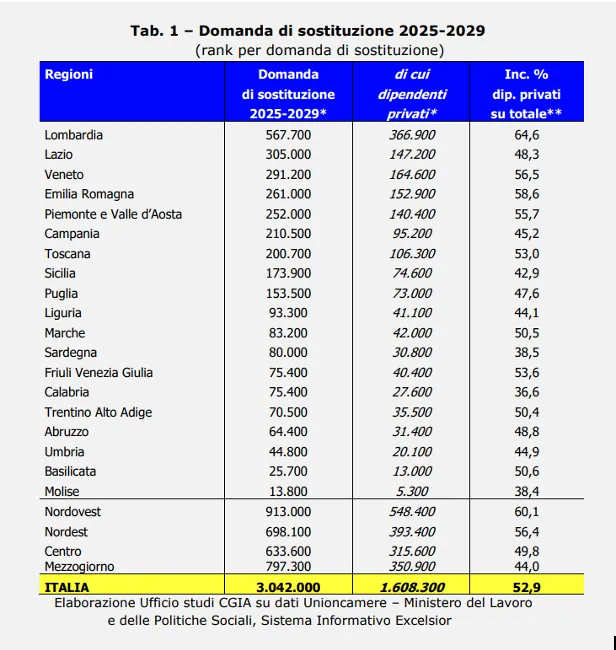
No later than a week ago (we have written about it extensively on First) we dedicated ourselves to aprocessing of the Cgia of Mestre from which – through the synthesis of numerous official sources – it resulted that in the space of a few years there will be 3 million new pensioners in Italy, without it being possible to replace them due to the effect of the falling birth rateIncidentally, in 2025, 355 children were born compared to 660 deaths: but this is only the culmination of a long period of negative demographic balances that have not been offset by the influx of foreigners for over a decade. The CGIA had divided the exodus based on economic sectors: just over 1,6 million will be private sector employees, 768.200 public employees, and 665.500 self-employed. The regions most affected by the retirements and the substitutions will be the Lombardia, where the incidence will reach 64,6%, theEmilia Romagna and Lombardy with 58,6% and the Veneto with 56,5%: these are the three regions with the highest manufacturing density, where private sector employment accounts for the largest share of total employment and where, according to the CGIA, replacement falls almost entirely on businesses, not on public tenders. For more complete data on the northern regions, simply look at the table, which shows a 60% replacement requirement in the Northwest and 56% in the legendary Northeast.
Early retirement: the issue of turnover in the workforce
The proposals that the League is putting into circulation do not attenuate this rush towards the retirement (mostly premature), but they increase it with the addition of so-called forms of flexibility which would greatly expand the options for exodus due to the demographic and occupational characteristics which characterise the generations of the baby boom candidates for retirement in the coming years. These are generations that entered the labor market early, with stable and continuous employment relationships that have allowed and will allow them to reach the requirements for early retirement at an average effective age of 61,7 years. It is all too obvious that lowering these requirements would cover a much wider audience. The proposals of the Alloy concern the possibility of retirement at 64 years of age and 41 years of contributions paid, to extend also to those who are in the mixed system what is foreseen in the contributory system (64 years and 25 years of contributions) if the liquidation of the treatment is accepted entirely with the contributory calculation. Then the request for abolish the indexation of requirements compared to the increase in life expectancy, which not only guarantees a minimum level of sustainability for the system, but which remains the only element of solidarity with the new generations required to finance the pensions of the previous ones.
Work and immigration: the challenge of manpower shortages
How do we deal with the demand in the labor market in the face of aconstipated and inadequate offer? And here we come to the growing need for foreign workers. No problem – they say in Via Bellerio – regular workers are welcome. We want to defend the borders from irregular and clandestine migration. But – we point out – the story of Ceuta It has not only highlighted the gravity of the problem, but above all the impossibility of solving it. Even the circumstance that until a few weeks ago was entrusted to a joke, "they'll even get there by swimming," has come true. Anyone who has read the book by Paul Franks (*The Irregular – A Life of Gianni De Michelis*, Marsilio Editore) will realize that this Italian statesman was the first to see the problems we deal with today without solving them. Franchi recounts that in 1991 he and other journalist colleagues from the past had attended a dinner with De Michelis, during which the politician had surprised them by predicting, based on a number of figures that no one at the time was paying attention to, that within twenty years, large-scale migration, even more than the environment, would become the problem of problems: a million would went through, maybe to ARTISTIC, Mediterranean destined to become the border between the North and the South of the world.
Obviously, faced with cases like Ceuta, we can't ignore them, especially since we're witnessing the hardships faced by immigrants camped on the beaches and, conversely, the enclave's residents. But we need to find legal access routes that are coordinated with the real needs of our economies. If you think about it, in Italy the main option for regularization for many years consisted of amnesties. Now, foreigners arrive, perhaps with a tourist permit (the desperate people who cross the sea are a minority), after which they hide away waiting to obtain a permanent residence permit. The only managed procedure, albeit with the risk of click day, is the one relating to seasonal work. Bossi-Fini law It must be reviewed. A company cannot be forced to hire a foreigner based on rules that resemble those of a proxy marriage.
Migration and Work: What the Post-War Era Teaches Us
In the immediate post-war period, when there were 11 million refugees in Europe (many of whom had fled from the communist regimes of the East), the top (Intergovernmental Committee on European Migration): a forum where—between countries in need of labor and those facing overpopulation problems, given the economic and social conditions of the time—the quotas assigned to the various countries were agreed upon, also specifying the professional profiles required. Alcide De Gasperi addressed young people, inviting them to study languages and travel abroad. Of course, the phenomenon of migration Today it has causes and dimensions that cannot be traced back, except to a minimal extent, to the provision of organised and regular access channels. But at least they could serve to cover a good part of the manpower requirements confirmed. Unfortunately – for reasons of vile propaganda – it has been forgotten that on the pedestal of the Statue of Liberty once stood a verse from a sonnet by the Jewish poet Emma Lazarus (1849-1887): “Give me your tired, your poor, your huddled masses yearning to breathe free.” Different times.