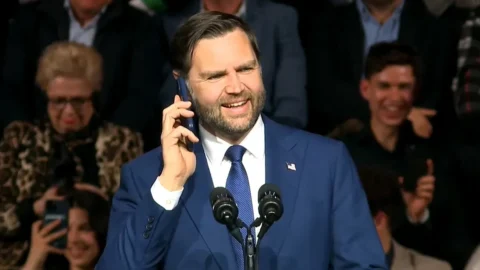
The campaign in view of the 2028 US presidential election It's already begun. Two of the candidates who are most likely to win their party's nomination – California Governor Gavin Newsom in the field democratic, and JD Vance, the deputy of Donald Trump, in that republican – they are currently facing each other through memoirs. Newson has published Young Man in a Hurry: A Memoir of Discovery (Penguin) at the end of last February. Vance just responded with Communion: Finding My Way Back to Faith (HarperCollins).
Communion, Vance's conversion
Communion It presents itself as the sequel to Vance's previous best seller Hillbilly Elegy: A Memoir of a Family and Culture in Crisis (HarperCollins, 2016; Italian translation American elegy, Garzanti, 2017) and delves into some considerations on its conversion to Catholicism which the current vice president had already explained in a more synthetic way in the essay How I Joined the Resistance, published in the Catholic-inspired bimonthly The Lamp in April 2020. The volume retraces Vance's tortuous spiritual journey, which has passed through various phases. The maternal grandmother (affectionately called Mamaw), who read the Bible every day and followed the television broadcasts of conservative Baptist preacher Billy Graham, although she was wary of other televangelists, introduced him as a child to a Christianity that was not tied to any particular denomination.
His father's fervor led him to the Pentecostal Church in the late 1990s, when he was a teenager. The Case of Terri Schiavo, a woman in a vegetative state due to ischemia, to whom exponents of conservative Christianity wanted to deny euthanasia in 2005, triggered Vance's departure from the faithIndeed, he had the strong feeling that the Churches were neglecting the concrete daily problems of their faithful to focus obsessively on that single issue, certainly painful but far removed from the needs—not only material—of Americans. Upon returning from a mission with the Marines in Iraq in 2006, Trump's future vice president no longer felt like a Christian, and indeed, religion began to provoke only a sense of frustration in him.
The following years at the university were marked by theatheism And Vance stopped worrying about "God's will" and focused exclusively on his own. His goals became material success and enrichment, above and beyond any ethical considerations.
Finally, now thirty-five years old, he converted to Catholicism in 2019, under the guidance of two Dominican friars, choosing Augustine of Hippo as his patron saint. The birth of his first son – Ewan – and the desire to become a good father constituted for Vance an opportunity for spiritual “redemption”. Catholicism became the moral compass not only of his life but also of his efforts to raise his son as a good person, although Vance admits – half-jokingly – that the first thing he did once he knew the gender of his unborn child was to go to Google and type in “challenges of raising a boy.”
Vance, the centrality of religion
Vance argues in the introduction that Communion It is "the story of a man. Nothing more, nothing less." However, just as the 2016 volume was not a mere reconstruction of a troubled youth spent in the Appalachian region, but rather a denunciation of the situation that had caused the impoverishment and consequent social hardship of the Euro-descendant families of this economically depressed area of the United States, so Communion goes beyond the dimension of the author's confessional experience to claim the central role that religion, according to the author, should have in public life.
Drawing on the reflections of Dutch neo-Calvinist theologian Abraham Kuyper, who not coincidentally was also Prime Minister of the Netherlands between 1901 and 1905, Vance argues that the practice of Christianity cannot remain confined to the most strictly private moral issues, such as marital relations and reproductive rights, but must address all areas of human existence, including the public sphere. In his opinion, “Separating political considerations from morality makes us less human”More generally, for Vance, Christianity, which enabled him to redeem himself personally, also points to solutions to save the United States from the crisis it is currently experiencing. "My greatest fear," he says, "is not death but the fact that we have inherited a great civilization and are letting it fall into ruin."
Communion and Catholicism in the United States
The book comes to print at a particular moment not only for Vance but also for American Catholics. The faithful of the Church of Rome, who number over 70 million people, represent approximately one-fifth of the country's population. They are, therefore, an absolute minority in a society where Protestants alone reach nearly 45 percentHowever, the fragmentation of the Reformed denominations into a multiplicity of denominations (to limit ourselves to the main ones: Methodists, Episcopalians, Pentecostals, Baptists – with the latter in turn divided between the Southern Baptist Convention and the National Baptist Convention) means that Catholics are the largest group among Americans who are neither atheists nor agnostics.
Catholics have long been viewed with suspicion by other Americans, to the point of being considered agents at the service of a foreign leader such as the pontiff. Again in the 1928 election, Democrat Alfred E. Smith, the first Catholic presidential candidate of either major party, suffered a devastating defeat because Protestants feared that his entry into the White House would enslave the United States to the will of the Vatican.
The political acceptance of Catholicism at a national level (in addition to Smith, governor of the State of New York in the two-year period 1919-1920 and then from 1923 to 1928, there had already been Catholic mayors and governors) occurred only in 1960 with the election of the Democrat John F. Kennedy to the presidency.
Catholics now occupy positions of power. Beyond the Vance case, for example, six of the nine Supreme Court justices practice CatholicismA seventh, Neil Gorsuch, left the Church of Rome as an adult to marry an Episcopalian. Furthermore, in 2020, a second Catholic president, Joe Biden, was elected. Communion remember only for the short-sightedness of foreign policy, Laxity in the fight against illegal immigration and rising inflation in 2022. Vance could become the third Catholic occupant of the White House, also considering the fact that, after having generally sided with the Democratic Party until the mid-1960s, Catholics have recently become increasingly oriented towards the Republican Party.
In 2024, Trump received 59% of the overall Catholic vote and 63% of the Euro-descendant component. Today, in addition to being fully integrated into its own country, far from being the Vatican's alleged instrument of control over the nation, American Catholicism has ended up occupying the top of the Holy See following the election of Cardinal Robert Francis Prevost to the papal throne in 2025.
Relations with the Vatican and attention to the world of work
Vance laments the lack of synergy between the Papacy and the United States government, using a euphemism for the pontificate of Benedict XVI: “The Vatican has expressed skepticism about the Trump administration's immigration policies.” He could have added the criticisms of Leo XIV to Washington's attack on Iran. But Communion he never mentions this war event, probably because the volume was already in print at the time of the bombings that began on February 28th.
Vance observes that "too many American Catholics treat the pontiff as a political figure and should instead maintain a more respectful distance from Vatican politics." He then complains, however, that, precisely on the issue of illegal immigration, the Church of Rome "seems to refuse to move beyond stale platitudes in exercising its moral leadership."
Vance's controversy with the Vatican does not end here and takes the form of a removalIn a book of almost 300 pages, the current pontiff is mentioned only twice: to recall Vance's trip to Rome on the occasion of his consecration and to invite readers not to confuse him with his predecessor. Leo XIII, whose encyclical is exalted rerum Novarum (1891) for his denunciation of the exploitation of workers. Vance writes that, the first time he read it, he thought of his relatives who were forced to skip Thanksgiving (the main national religious holiday in the United States, after Christmas and Easter) and to skip Mass because they had to work.
Passages of this nature also serve to wink at the vote of a declining working class, thanks to which Trump won the White House twice. Vance, in fact, never misses an opportunity to emphasize overcoming the times in which his stepmother was alive, when the Republican Party was "on the side of the rich" and was not interested in the fate of the working classVance attributes his 2024 vice presidential election to the Republicans' working-class base, the component of the party that he claims is most religiously motivated.
Vance and his relationship with the electorate
Vance argues that the purpose of Communion is share your religious experience to help others get closer to God. However, the suspicion remains that The volume also intends to put the vice president in a position to reconcile with the Catholic electorate in anticipation of the race for the White House in 2028.Trump's harsh attacks on Leo XIV, in defense of both his own foreign policy and measures to combat illegal immigration, have shocked American Catholics, causing their approval rating for the president to plummet to 38%.
Following the alignment with the tycoon's positions, especially after Vance went so far as to declare in April that the pontiff "should be more careful when he talks about theology", Even Trump's vice-presidential approval ratings are sharply declining among American Catholics, with only 42% having a positive opinion of him.The partial electoral intent of Communion It can also be seen in the author's attempt to scale down some of his controversial statements from the past, from the Christian perspective of admitting his own errors. Therefore, for example, Vance regrets calling Democratic voters 'childless cat ladies' who were leading the United States to ruin, also because – according to the vice president – his words would have ended up diverting attention from what would have been his true intent: to push Americans to abandon their “pathological hostility” to reproducing.
Vance: Another of the Lord's anointed?
In view of a possible candidacy for the White House in 2028 Vance also presents himself as a miracle workerAfter the attack in Butler, Pennsylvania, on July 13, 2024, Trump declared that God had saved him so he could restore the United States to its former greatness. While not being so explicit about being "on a mission from God," to quote the Blues Brothers, Vance recalls what he considers "a supernatural experience." Returning from Mamaw's funeral in 2025, while driving at high speed, he lost control of the car on the rain-slicked asphalt. He could have been hit by a vehicle coming in the opposite direction, crashing into the guardrail or – if the latter hadn't held – even fall into a ditch. Instead, the car stopped just a step away from the guardrail and Vance escaped with a serious scare but without a scratch.Something beyond his comprehension stopped the car, defying the laws of physics.
The Christian vision of Trump's vice president
In a succession of personal anecdotes, interspersed with frequent biblical quotations and theological references, it is possible to grasp some qualifying points of Vance's vision which, with the exception of love of firearms (i.e., for the defense of the interpretation of the Second Amendment of the Constitution as an individual right to own pistols and rifles), are based on those that Communion defines the “Christian antibodies” for the problems of society: the promotion of birth rate, opposition to voluntary interruption of pregnancy, the creation of conditions for allow Americans to work less so they can spend more time with their families and eliminate the deterrents to having children (considered humanity's greatest added value), overcoming the marriage between economic prosperity and spiritual poverty that leads Americans to see their personal fulfillment in access to material consumption.
“God created us to work,” Vance writes, “but to work for the purpose of living and creating beautiful and extraordinary things,” adding that An economy oriented towards growth and the spread of dignity is bound to generate greater real prosperity than an economy aimed at the pursuit of financial accumulation.It seems a bit paradoxical that the vice president should rail against the accumulation of wealth for its own sake, especially given that before entering politics, he worked in venture capital. Nonetheless, one might think that those who have worked in this sector are also those who best understand its flaws.
Vance's words are, however, an echo of the traditional Catholic polemic against American materialismIt is no coincidence that considerations on the loss of values, in an America where the laughter of children in the streets is fading and synthetic opioids are spreading like wildfire, are preceded by a reference to the Gospel passage of Christ's expulsion of the merchants from the Temple of Jerusalem.
Vance and his admiration for Peter Thiel
With Communion Trump's neopopulism, with its supposed defense of workers affected by globalization, is tinged with Christian overtones, and the book seems to lay the foundations for the establishment of an ethical state founded on Christian values, as interpreted by Vance. The highly subjective element of the vice president's interpretation is not a secondary aspect. The struggle of the forces of Good, aligned with the Almighty, against materialism and selfishness, fueled by Satan, is one of the themes of The city of God of St. Augustine.
Nevertheless, by his own explicit admission, Vance has as his model not some Father of the Church, much less a pontiff or a theologian, but rather Peter Thiel, which defines “perhaps the most intelligent person I've ever met”. Based on the reconstruction of Communion, it was a lecture by Thiel that made Vance understand, when he was still a university student, the misfortune of a hyper-competitive society but incapable of facing and solving the existential problems of its members due to the brakes placed on technological progress.
In addition to being Vance's venture capital employer between 2016 and 2017, Thiel is also the political mentor of Trump's vice president, although Communion Don't mention it. He was, in fact, a supporter of Vance's victorious campaign for the Senate in 2022 and the main sponsor of his 2024 vice presidential bid. High-tech billionaire co-founder of PayPal and Palantir Technologies (the big data analytics company he chairs), Thiel is also a fierce critic of representative democracy. Aims to replace it with an oligarchy of Silicon Valley corporations and those like him who control themHe is also a self-styled expert on the Antichrist, a figure to whom he has dedicated numerous conferences, some of which in Rome last March. More than an individual, for Thiel, the Antichrist is the expression of market regulation, suffocating government bureaucracy, constraints on technological innovation, and control over the applications of artificial intelligence.
Vance reminds readers that Thiel considers himself a Christian and cites him to disprove the cliché that “religious people are stupid and brilliant people are atheists.” From this perspective, Communion represents the theorization of the marriage between Thiel's techno-right and the most reactionary component of American Catholicism engaged in politics dating back to the reflections of William F. Buckley Jr. (1925-2008), who – from the columns of the National Review, the still existing magazine he founded in 1955 – was a fierce critic of America's secularization and a tenacious supporter of the principle that religion should be the source of not only moral inspiration for society.
...
Stefano Luconi teaches History of the United States of America in the Department of Historical, Geographical and Antiquity Sciences at the University of Padua. His publications include The "Indispensable Nation." A History of the United States from the Colonies to Trump's Second Presidency (2026) US institutions from the drafting of the Constitution to Biden, 1787–2022 (2022) The black soul of the United States. African Americans and the difficult path to equality, 1619–2023 (2023). The race for the White House 2024. The election of the president of the United States from the primaries to beyond the vote on November 5 (2024).