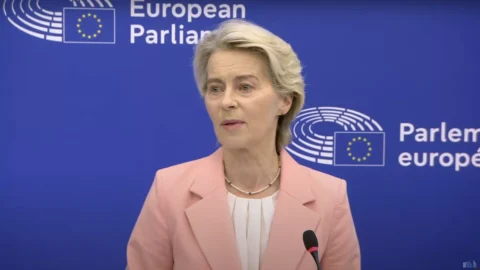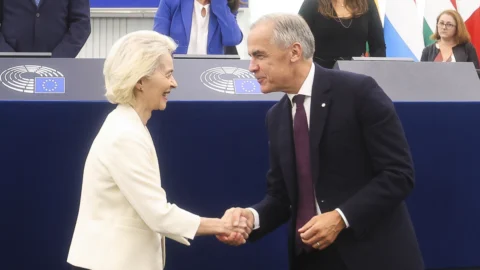
A speech, that of the President of the EU Commission, Ursula von der Leyen, on Wednesday in Strasbourg which photographs more of a “State of Disunion” than the traditional, annual “State of the Union”. Nevertheless, von der Leyen is rallying what remains of the sense of belonging to European values among European citizens by setting a timetable aimed at countering sovereignist tendencies internally and the increasingly aggressive tendencies of the Russian Federation externally. A strategy that also looks at strategic alliances outside the EU such as the one that Von der Leyen proposes with Carney's Canada.
Ursula von der Leyen opens to alliance with Carney's Canada
In her speech, the president of the European Commission acknowledged that "the speed of change is incredible. The challenges are exceptional. So, looking at Europe today, my view is this: the state of our Union is stronger than everThe State of Our Union It may also seem more precarious than everThese two statements may seem incompatible. But they are both true. And they reflect these exceptional times. This complex era, filled with great opportunities and great dangers, which all countries are trying to navigate. In this world, Europe has chosen to chart its own path.
Von der Leyen was keen to point out that she was aware of the daily concerns of 450 million citizens Europeans on the eve of important elections next year. Far-right nationalist parties are gaining support in major EU countries – including alternative for Germany, who won his first German state election, and Rassemblement National, which is poised to lead Marine Le Pen to the French presidency next year. But a survey conducted by the Public First institute in three major EU countries found that only a fifth of respondents in Germany and Spain said the Commission president is doing a good job; in France, only 12% expressed the same opinion.
Nearly half of Germans have a negative opinion of the EU President's performance.
Nearly a third of respondents in Spain and France, and 45% in Germany, instead claimed that von der Leyen was doing a poor job. The negative assessment of her performance at home was largely driven by those who said they would vote for the far-right Alternative for Germany party, and more than half of these voters said she was doing a "very bad" job. In reality von der Leyen's speech seemed a little vague on the issues that represent the focus of the Commission's action and much more detailed on global and geopolitical issues that fall outside the remit of the Community executive.
“In this new world, we urgently need to rethink our partnerships,” von der Leyen said, adding that the EU intends to “build global coalitions for our resilience and for our democracies. And here too, only Europe, with its size and strength, can take a leading role.” offer Canada associate member status, von der Leyen proposed to bring together the leaders of United Kingdom, Norway, Canada and Ukraine in a new "European Security Council" that would operate outside of NATO, offering a platform to discuss hybrid threats without US involvement. He also proposed that, with Europe playing a coordinating role, like-minded countries could jointly address challenges ranging from climate change to Chinese industrial overcapacity to the risks of artificial intelligence.
On the economy, the reference is the Draghi Plan
Among the issues on the Commission's agenda, the focus is on strengthening the European economy by implementing the Draghi report. Among the urgent issues is the Completing the single market with the 'One Europe, One Market' packageFurther efforts are then needed to strengthen the Banking Union. For "social capitalism," measures on "housing" and "welfare" will be strengthened and a “European Care Deal” is promisedRegarding energy prices, we must move forward with the green transition, which will give Europe sovereignty and competitiveness, while also enabling us to combat climate change.
On this point, von der Leyen promised three new interventions: an alliance for climate change insurance, a European plan to combat heatwaves, and a European Water Initiative. Regarding Artificial Intelligence, the President promises a European approach to AI and announces a meeting of AI leaders in Brussels to jointly "manage" the challenges of the future, but in the meantime Social media should be banned for children under 13 and limited to those under 15, as provided for by the Kids Act.
L’impegnp sull’immigrazione: i fatti di Ceuta servano da lezione
On immigration, a greater commitment is emerging with the nations traversed by the migration chain, including a more assertive approach. The events in Ceuta must teach a lesson. Hence the suggestion of an Emergency Response Framework – emergency response – in scenarios where mass movements are orchestrated and exploited for political ends.
Finally a reflection on the European Parliament experiencing a credibility crisis in her role as co-decision maker. Mestola is heading towards a third term. Despite an agreement at the beginning of the legislature with the Socialists for a transition period starting in January 2027, the EPP is determined to have her re-elected, with the votes of the far right if necessary. Weber has made it clear that the EPP heads of state and government will meet next spring. they will not confirm António Costa as Prime Minister European for another two and a half years, if the Socialists do not agree to support Metsola.