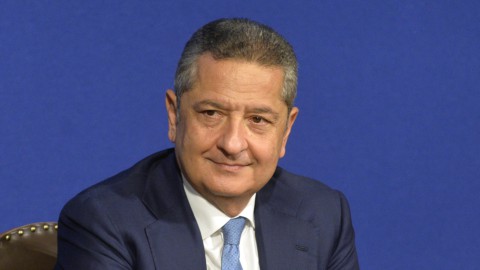
“Italy and Europe are intertwined not only from a commercial and financial point of view, but also from a social and regulatory point of view. To understand the Italian economy we must therefore start from the European one", states the Governor of the Bank of Italy Fabio Panetta speaking to meeting in Rimini, focused this year on the "search for the essential". As essential as European integration, precisely, as essential as the reforms that the Union needs to face the epochal challenges it faces. But Italy also has a strong need, as it must tackle public debt and focus on greater growth.
From the stage in Rimini Panetta talks about integration and trade, demography and the labor market, productivity and technology, immigration and investments. However, there is no mention of the ESM and its failure to ratify by the Meloni Government which is making the Italian position in Europe increasingly difficult.
Panetta: “European integration brings benefits to citizens”
Panetta's speech starts from the past, from the meaning of the European project - launched eighty years ago with the aim of creating "common interests and intentions between countries" to "generate well-being and prosperity" and pursue "the ultimate goal of guaranteeing peace" – and reviews the progress achieved to date, but also the mistakes made, such as the response to the sovereign debt crisis in 2010-12.
“Over time lEuropean integration has brought important benefits to citizens – says the governor – The abolition of internal customs tariffs has favored productive specialization and economies of scale, stimulating efficiency and competition and increasing employment and well-being”. “It is estimated that in the absence of the single market, per capita income in Europe today would be one fifth lower,” he adds.
“The European authorities have the difficult task of ensure prosperity for citizensi in a less stable and less open world", claims the number one of via Nazionale, who then cites Jacque Delors, a leading figure of Europeanism: "we need to combine the fireman who puts out fires with an architect who designs the buildings, to build a 'Strong and united Europe'.
According to Panetta, “it will be a test case confirm joint spending projects and advance towards a more complete and integrated union on a financial and fiscal level. Furthermore, it is essential to relaunch the European economy by rebalancing the dependence on foreign demand, strengthening the single market and competitiveness, progressing on the technological, energy and external security fronts".
Work, productivity, technology
“In the coming decades, the number of European citizens of working age will reduce and the elderly will increase, with negative effects on pension systems, the healthcare system, the propensity to undertake and innovate, the sustainability of public debts”, explains Panetta, supporting the need to rstrengthen “human capital” and increase “employment of young people and women”. “The entry of legal immigrants it will have to be managed in a coordinated manner within the Union, balancing production needs with social balances and strengthening integration,” he continues.
Moving on to industry, the picture is bleak: “In the last two decades the EU has accumulated a 20 percentage point delay in terms of productivity compared to the USA. European industry is trapped in intermediate technology sectors and has little presence in those at the frontier, despite the excellence of research".
The case ofartificial intelligence. “Between 2013 and 2023, private investments amounted to 20 billion dollars in Europe, 330 in the USA and 100 in China”.
“To ensure development and high incomes is an increase in productivity is necessary”, Panetta clearly states, underlining that “Europe cannot limit itself to being a simple user of technology but must aspire to an active role. The benefits go beyond the productive dimension and concern the essential rights of citizens such as the protection of personal data and pluralism of information.
“A significant presence of Europe in this sector – currently dominated by a few global technological giants – would increase competition and bring about benefits that go beyond the productive dimension and concern the essential rights of citizens, such as the protection of personal data and pluralism in the sector of 'information. Strengthening Europe – and with it Italy – is not only an economic necessity, but also the way to affirm our strategic sovereignty and our fundamental values”, says the governor.
Panetta: “Deep reforms and huge investments are fundamental”
“To overcome its weaknesses and keep pace with global progress, the European Union will have to initiate profound reforms and make huge investments in the coming years,” declares Panetta, citing among the necessary reforms “the importance of creating a common fiscal capacity, without which the current European governance – characterized by a single monetary policy and budgetary policies fragmented at national level – remains unbalanced”.
It is also necessary to focus on the "competitiveness of the European economy", expand the single market to "sectors currently excluded, such as telecommunications and energy, in order to stimulate competition and efficiency". Fundamental is “the creation of a regulatory environment favorable to entrepreneurial activity, which can attract private investments and incentivize innovation; the strengthening of links between the academic world and the production system, in order to transform research results into competitive products and services on the global market. Even on the financial markets front, where integration is very advanced, significant progress has been lacking for years completion of the Banking Union and the creation of a single capital market", listed the number one of Bankitalia.
“Huge investments will be concentrated on key sectors: the environmental and digital transition and strategic sectors such as food, energy, healthcare, defence. They will be effective if implemented at European level, with both public and private funds. They are supranational public goods that require a coordinated approach and have benefits in terms of economies of scale,” he adds.
Finally, a mention of our country: “For Italy the crucial problem remains the reduction of public debt. Our country is the only one in the euro area with public interest expenditure almost equivalent to that for education: the high debt weighs on the future of the young generations, limiting their opportunities".
“The main road passes through one prudent management of public accounts, flanked by a decisive increase in productivity and growth” concludes.