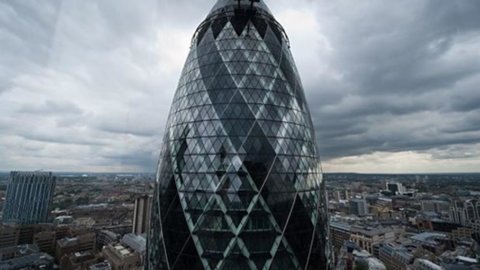
Among the major financial centers, the City of London is the one that more than others seems to be in search of a new identity to adapt to the evolution of the global geopolitical scenario. One characteristic that the great global financial centers have in common is that they are above all the main trading venues for the region or continent on which they operate: New York is the most important financial center in North America, as Hong Kong, Tokyo and Singapore are for Asia. However, the role of the main center of financial exchange for Europe seems to be tight for the City of London.
This depends first of all on the geographical position enjoyed by the City, thanks to its position straddling North America and Asia, from which it derives a particularly favorable distribution of the time zone (in fact universally indicated by the acronym Gmt – Greenwhich Mean Time), which allows it to be open both when Asia is still operating and when America begins to prepare for the day's trade, and for a good part of it. Thanks to this characteristic, the City has earned the role of the main place for currency exchanges on the planet, thus rising above the simple rank of regional hub.
Furthermore, the City finds itself to be the most important center for transactions in a currency (the euro) which does not belong to it and towards which it has always nurtured a certain diffidence, deriving from the identification of this currency with the Franco-French axis. German on which the European Union was historically founded. Hence the cognitive dissonance from which the City sometimes suffers, well aware of having been among the major beneficiaries of the combination of Thatcherite deregulation and the creation of the single currency, which led financial institutions from all over Europe to transfer their trading desks to London, thus causing the explosion of the financial services industry in Great Britain; but, at the same time, reluctant to remain anchored to a continent (and its cumbersome institutions) to which in fact she feels she does not belong, and to which she remains linked by mere opportunism. Hence the incessant search for a new role in the global geopolitical scenario.
2. The European Union has evolved far more than the British had hoped when they decided to join in 1973. In their intentions, Europe was to remain a common market from which an island power and free-trader as the Kingdom traditionally was United would have benefited enormously. From this perception has descended the typical British attitude of belonging to the common market, but at the same time of absence from the table of the institutions, blatantly manifested on the occasion of the approval of the fiscal compact and more recently in the case of the indication of Jean-Claude Junker as president of the European Commission. This position of opportunistic ambiguity could last until the other members presented the bill, demanding that the United Kingdom also pay its fair share of liability for club membership. At that point the English Liberal-Conservative government put in place the referendum on membership of the European Union, to be held between 2016 and 2017, in the event that the Conservatives win again the elections scheduled for May 2015. In this case , Downing Street has decided to rely on well-known diplomatic tricks, arguing that the Tories will campaign for permanence in the European Union provided that sufficient powers have been repatriated in the meantime.
But what would the City have to gain from a UK exit from the European Union? In the propaganda of the proponents of Brexit, the City could finally regain that regulatory sovereignty that the "perfidious bureaucrats" of Brussels would have stolen over time with directives on financial services. But the awakening from propaganda drunkenness could be much more bitter, due to the existence of the so-called "trilemma" of the international financial economy, on the basis of which the following three conditions cannot exist at the same time: financial stability, internationalization of exchanges and regulatory sovereignty. Pushing on two of the three, the third necessarily falls.
Now, given that the City wants to continue to enjoy a leading role in the mediation of international financial exchanges and - after the devastating consequences of the 2007 financial crisis - does not intend to give up the guarantee (at least on paper) of more solid financial stability , by exclusion it must yield on the ground of regulatory sovereignty. But even when economic logic is not enough, the Brussels bureaucracies have already taken steps to set the appropriate legislative stakes.
According to the new directive on financial services (Mifid II), financial institutions from non-EU countries (so-called "third countries") that intend to offer financial services to EU citizens must necessarily open a branch in a country of the European Union, subjecting themselves to the regulation Community, unless they are subject to regulation deemed 'equivalent' in their country of origin. This "equivalence" is judged by the European Securities and Markets Authority of the EU. What would happen if the UK left the EU? At that point it would become a third country, and therefore its financial institutions would be forced to open a branch in the Community territory to access citizens of the common market, thus subjecting themselves to its rules. If instead they decide to choose the route of 'equivalent regulation', they would have to put enormous pressure on the UK authorities to adopt regulation at least as restrictive as the Community one. Thus marking the end of the illusory reconquest of regulatory sovereignty on the grounds of which the exit from the EU was promoted. With the aggravating circumstance that, while as part of the EU Great Britain has a say in the drafting of the regulation, as a "third country" it would have only this power, if only of interdiction.
3. If the City cannot break the chains of the EU without finding itself more captive than before, there is yet another possibility, which London is already pursuing, and which has been indicated in part by the new governor of the Bank of England, the Canadian Mark Carney. Speaking at the celebrations of the 125th anniversary of the founding of the Financial Times, Carney, former governor of the Bank of Canada and current chairman of the Financial Stability Board, with a long experience at Goldman Sachs, outlined a future in which, following current trends, in By 2050, the assets of UK-based banks could be worth up to nine times its GDP – not counting the additional contribution of London-based foreign banks and the huge shadow banking industry. A prospect that many would regard with horror, argues Carney, but which should instead be taken seriously, if properly regulated.
In which direction should the City then turn to assume even more the role of financial super-hub, the center of world finance? It has already made a huge effort to attract both Chinese and Islamic finance, both of which are growing rapidly. As regards Chinese finance, after the first agreements for the establishment of swap lines in renminbi between the Bank of England (BOE) and the People's Bank of China (PBOC), which allowed the BOE to disburse Chinese currency in case of need, has moved on to an even stronger form of cooperation. Chinese banks can open branches in the City with simplified procedures, remaining largely regulated by Chinese authorities. One of these banks, the China Construction Bank, was then quickly allowed to become the first clearing house for exchanges in renminbi on British territory. Clearly, it is one of the major efforts to make the renminbi an international currency. Fundamental step to make China a global superpower in the coming years [...].
4. The City's desire to disengage from the European Union may not be motivated solely by the pursuit of higher profits, or more regulatory freedom. It could be the result of a hedging strategy by operators who see the geopolitical scenario evolving in a completely unfavorable way for the EU, which could cease to exist within a few years, at least in the form known to us. Indeed, united Europe, understood as the greatest experiment in the history of humanity of a zone of perpetual peace, prosperity, freedom, democracy and social protection, is at this moment under siege from all fronts: the fleeing migratory flows by poverty and war from North Africa; the continuing political-military instability in the Middle East (with at least three open fronts: Palestine, Syria and Iraq); the pressure to the northeast coming from the Russo-Ukrainian crisis. In this delicate moment, Europe should try to remain united. Instead it begins to divide, under the blows of opposing populisms, nationalisms and separatisms, in the fight against the perpetuation of a status quo which the German leadership sees as the only acceptable solution, but which the peoples who suffer the consequences perceive as too tragically similar to a zombification.
Under these internal and external pressures, the European Union risks collapsing in a few years: having actively promoted the creation of transnational macro-regions, the Europe of nation states is disappearing under the weight of the mechanisms (which have remained tragically imperfect) for regulating the single currency , which only rekindle opposing anti-euro populisms, such as that of Marine Le Pen in France and that of the AfD in Germany. Perhaps Europe could save itself by promoting the (not painless) birth of transnational macro-regions. But this process cannot take place under a leadership that promotes the maintenance of unsustainable balances. In doing so, potentially healthy regionalisms become separatisms with explosive potential, as demonstrated by the Scottish referendum. How much longer before the inevitable accident that will finally make Europe face up to its responsibilities?
Projecting ourselves ten years into the future, a City that no longer finds itself without the Europe of which it was the main financial center would end up a victim of events. But the British people, pragmatic and not inclined to sentimentality, feel they have to prepare for a different future, in which every European state (or what's left of it) could be forced to go its own way, to look for a role in the world. If this scenario were to materialize, given the steps taken today, the City would already have a leading role, once again, in a totally changed geopolitical scenario. Its ties with China and the Islamic world, in addition to the special relationship with the United States, would once again allow it to manage the table on which the most important cards are dealt.
The hope is that Great Britain does not become the detonator, with its 2016-17 referendum on the European Union, of that scenario that for now is only fearing. And to deal with which he is taking his proper precautions.
This is an excerpt from "The Empire is London", the issue of Limes dedicated to the United Kingdom and European secessionism after the referendum in Scotland.