More growth and inflation: the late summer harvest
Much water has passed under the bridges of theworld economy in the heart of summer. Certainly smelly and poisonous water is released from the two wars, with renewed increases in the price of oil and derivatives and some agricultural commodities (wheat, sunflower seeds) which translate into greater inflationary pressures.
But also “clear, fresh and sweet waters” like those of the Valchiusa Spring, in Provence, which inspired Petrarch: the economic growth has not stumbled and is actually showing renewed vigor at every longitude and latitude.
The scenario to be reviewed in three parts
Now that “summer is quietly trembling towards its end”, as Herman Hesse writes, its good and bad fruits force us to review the scenario drawn by the Lancets just two months ago.
Il war piece It's the first one that went out of place. The hopes of a lasting truce between Iran and the USA have proved to be naive, and the conflict has even spread with the entry of the Houthis into the scene in striking alternative crude oil routes to the Strait of Hormuz. Not only that: also the Russian-Ukrainian front he has become embittered, with Kiev's successes in launching drones on Russia and in particular on its refineries.
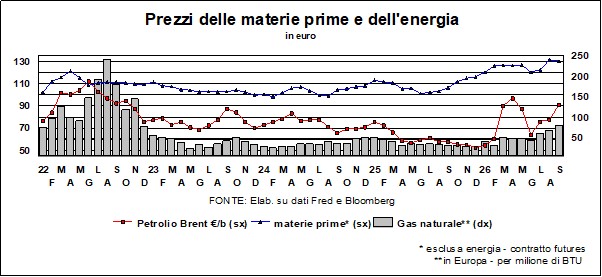
Outcome: Oil has recovered by almost 40%, touching $110 a barrel before retreating a bit, diesel it's close to the maximum historic levels reached in April and 70% above the values of mid-June, and the wheat has increased in price by more than a quarter in a few weeks. Thus the inflationary specter, Or even stagflationary, as sensationally predicted in February by some of the most renowned economists (although the current picture is a pale reminder of the real stagflation of half a century ago).
A ghost with feet of clay?
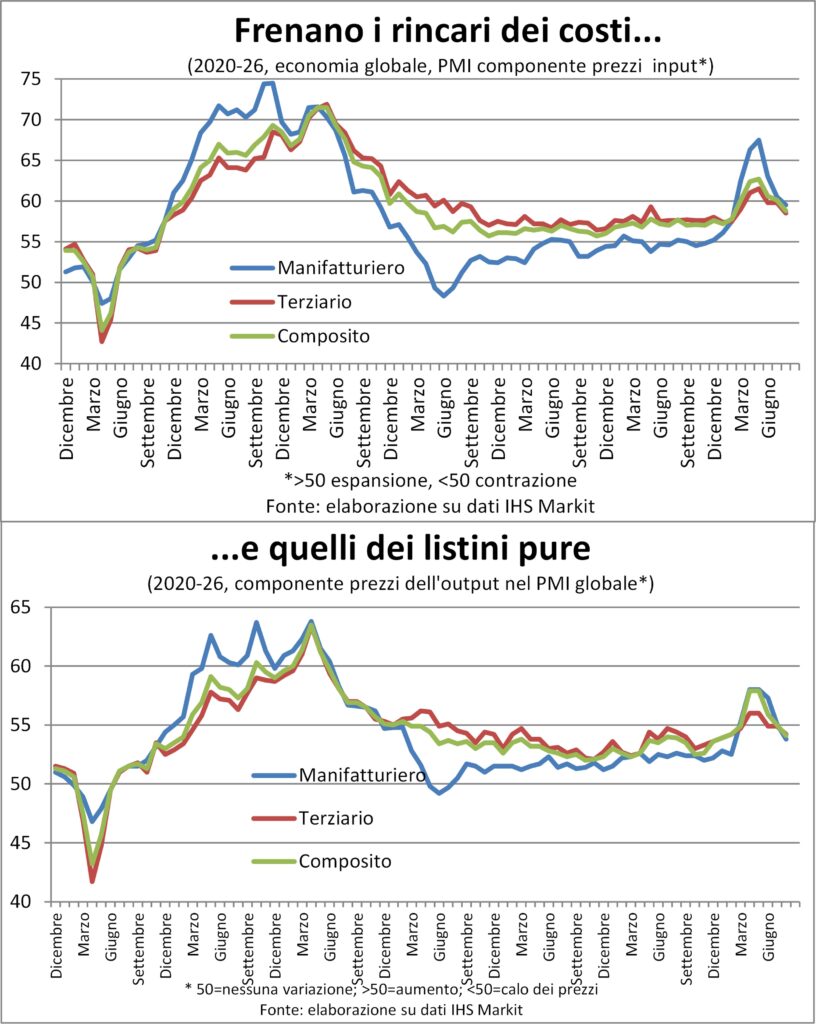
A spectre with feet of clay? Many indicators answer yes. First of all, regarding theinflation, which is until August remained under control. In fact, the companies they say that the increases in prices paid for inputs and charged for outputs They fell to their lowest levels since February (i.e., before the US attack on Iran). The September PMI survey will certainly show a worsening response, but it's important to keep in mind that a significant portion of the past price increases were linked to the congestion in value chains as everyone rushed to bring forward orders to avoid shortages of commodities and semi-finished products, having learned from the experience of 2021-22.
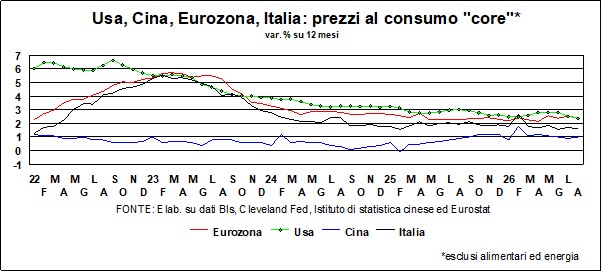
Secondly, there are no traces of diffusion effects of price increases outside of energy: thecore inflation remains cold and even cooling both in the USA and in the Eurozone. Finally, the first moving engine of any real inflationary process, that is, the wage dynamics, only sends timid signals of warming up, but they are physiological given the state of full employment and the scarcity of people active in the labor market and the lack of symptoms of a rush to recover purchasing power Lost again due to rising energy and food prices. And this recovery is unlikely to resume tomorrow because, unlike four years ago, there is no excess demand for labor, and those hiring are willing to offer modest wage increases.
The renewed vigor of growth
The other leg of the stagflationary spectrum is certainly fragile, if not nonexistent. As the now retired Fed Chairman, Kevin Warsh, said: "It wasn't that long ago that economists were talking about secular stagnation... Well, times have certainly changed... The potential for substantially higher growth is increasing."
There is no trace of stagnation, which had been predicted with Pavlovian reflexes due to what was believed to be the greatest energy shock in contemporary economic history. Likewise, the outlook for international trade had been painted bleak by the trade war declared by the US against the rest of the world, a war that continues and is forcing all other countries to make stronger agreements among themselves, detrimental to the US's role in global trade.
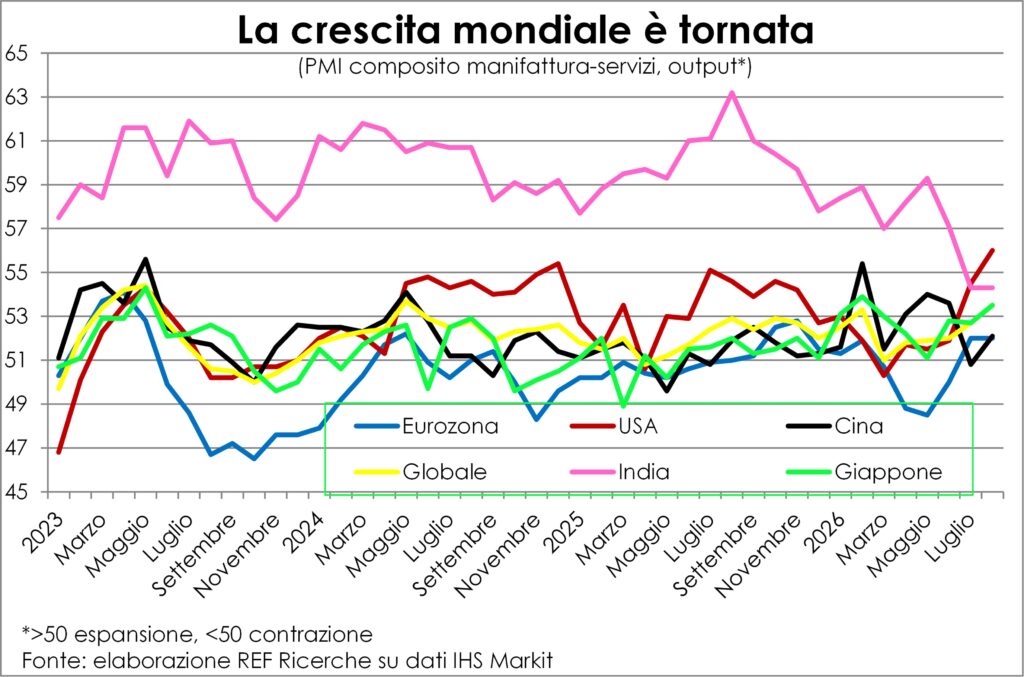
However, in July and August the economic data showed aacceleration of production and orders globally and in the main economic areas, with the sole exception of India (which, however, is only registering a slowdown from a growth rate among the world's leading). Some will say it is resilience or the ability to hold firm and adjust. adjustments certainly there are: otherwise the price of oil would be at 200 dollars a barrel and more, for example.
The two structural engines: the AI revolution…
However, by focusing on these accommodations we lose sight of the structural push factors and therefore long-lasting, one of which is mentioned by Warsh: investments linked to AI revolution and other transitions and grounding of the massive German government spending plan in various types of infrastructure and defense, a plan that is worth a few points of GDP per year.
I doubts that revolve around AI are many, of various nature and karst; they include the NIMBY syndrome on data centers and the source of the huge additional production of electric energy which will be necessary to make them work. But doubts will not be enough to derail the revolution, which has ramifications in many sectors and many countries, ramifications that make it a diffuser and multiplier of growth. China, Japan and even Germany they see orders pouring in for machinery and tools used in AI.
…and the German plan
It is difficult to quantify the amount of the Germany's plan because no provision has been made regarding the defense maximum sum neither annual nor cumulative, but we know that in 2027 core spending in this area will increase by a quarter compared to 2026, reaching 2,3% of GDP. For other types of infrastructure spending (transport, digital, healthcare, renewable energy) it is 500 billion euros to be used over twelve years; as of August 31, just over a year after its launch, over 53 billion had already been spent by the federal government. With Germany going all out the rest of Europe goes.
Manufacturing is booming and services are doing well too.
The origin and nature of the highest growth also explains another partial fallacy in forecasting At the end of spring, even the clocks: the Iranian-American truce and the reopening of the Strait should have slowed down the manufacturing sector, which had benefited from the accumulation of precautionary stocks, and revived the service sector, which had been penalized by mistrust and the surge in airfares for long-distance travel. Aside from the fact that the underlying hypothesis (the lasting truce) has vanished like snow in the scorching summer of 2026, it remains that the industrial processing is the tertiary sector they see accelerating demand and output.
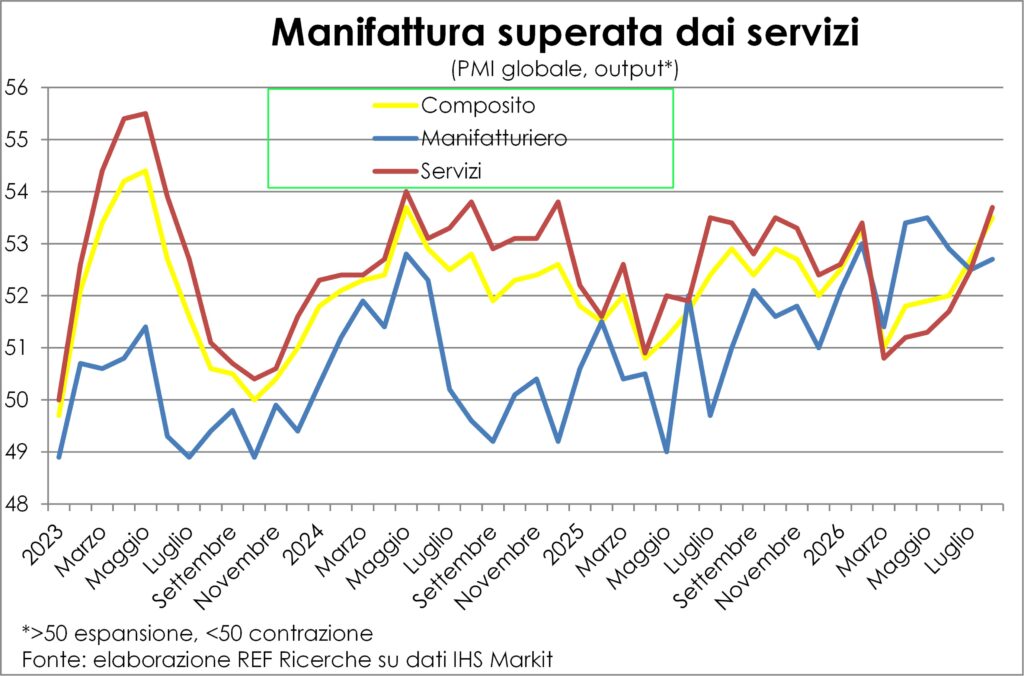
The reasons for the good performance of the first are easy to find in the two sources cited of renewed growth. For the second, one can conjecture two sources: industrial draft same which directly and indirectly increases the demand for services, and the temporary failure of the fear of war.
All this explains the upward revision of growth forecasts, which has just begun and will continue in the coming months.
Rates rise, in space and time
The above headline is the same as two months ago. And in fact, there's no reason to change it. Perhaps there's just reason to change—or, better said, to complete— the reasons for this persistent riseThe two reasons expressed several times concern:
- the needs of investments, public and private: government bond yields reflect the fact that the outlays made necessary by the various transitions – digital and environmental – weigh heavily on the public sector, not to mention defense spending. But also the investment needs of the private sector I'm no less. TheAI, unlike other industrial revolutions, requires, before being implemented, huge capital outlays, hic et nunc, outlays that have now assumed macroeconomic significance, especially in America. It was once said, to speak ill of deficits, that financing the public sector led to a crowding out of private investments. But there is no crowding out: Governments spend and waste, and so does the private sector to finance – not only in America – boasts data centers. A well-oiled financial system finds resources for everyone, but there is a price to pay: and it is the price of loan capital – the interest rate – that increases by the law of supply and demand.
- The other reason lies in the inflation expectations, still rekindled by the Petroleum and from gas designThere is some evidence of an increase in inflation expectations in America, as can be seen from the difference between indexed and non-indexed bonds, but this increase remains within normal ranges.
- We have said, however, that we must complete the reasons. And the third reason is the most normal and disarming, and it is the 'good' reason for a rate hikeWhen the economy grows, pressure on resources – financial and real – increases, and it is normal for interest rates to rise.
That said, how much have the rates in recent months? The graph shows the size of the increases, starting from the end of February (when America and Israel attacked Iran).
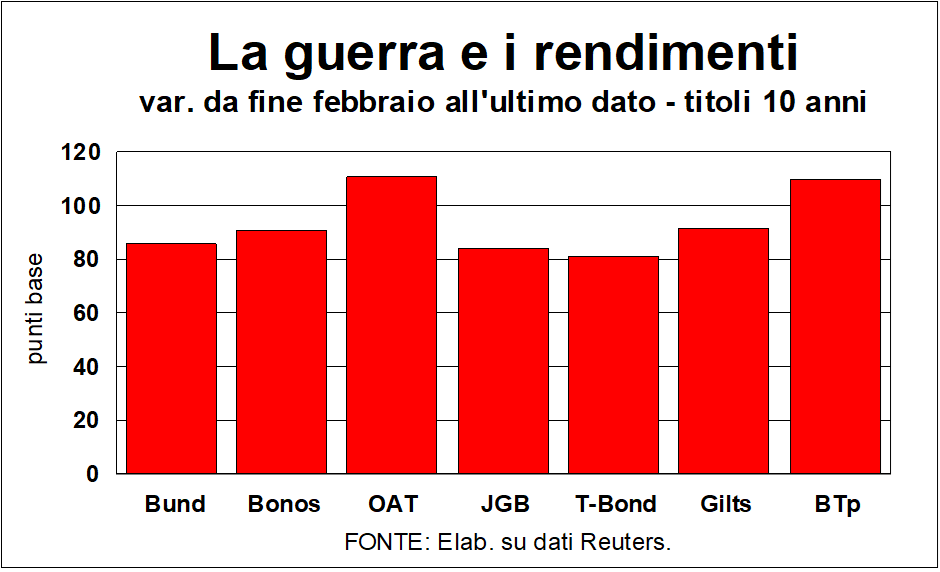
Naturally, this change collapses both the effects of inflation—actual and/or feared—and the other impacts described above. The combined effect is significant: the increases range from 80 basis points (for the T Bond) to more than 100 (for the OAT French, closely followed by BTPs). The not very honourable increases in BTPs and OATs have different reasons: for the btp, when interest rates rise in the world, they rise more in our country than elsewhere, due to the damage they do to public finances over which the sword of Damocles of high debt hangs. For the OAT the reasons lie in the (politically) intractable French public deficit (the highest in the Eurozone, after Belgium's) and in the severe unknowns about the outcome of the presidential elections next April. A has already arisen cottage industry among financial operators, with different strategic positionings for each of the different outcomes of these elections.
A modest increase in spreads
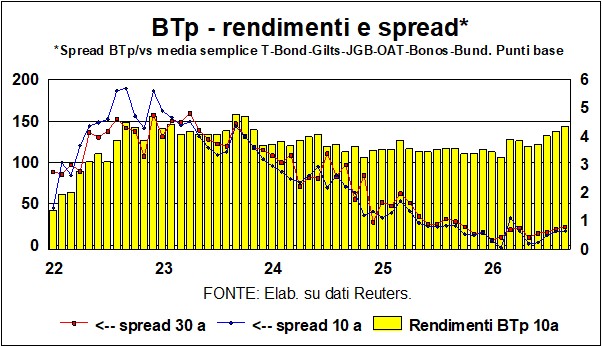
We said that the returns of the btp have increased more than elsewhere. But spreads remain at non-worrying levelsFor both 10-year and 30-year bonds, the gaps, compared to the average of six major countries (see chart), and despite the increase in BTP rates, remain close to the lows reached before the Gulf 'incident'. Certainly, the fact remains that BTP yields have increased, and thus, looking ahead, interest expenses (even if the impact on the average cost of debt is slow to manifest itself). The only consolation is that the threat of an increase in those expenses is useful for defend oneself from the usual stagecoach robbery, now that the 2027 Budget Law is approaching.
The decisions of the Fed and the ECB
Next week the Fed will decide whether to raise rates or keep them unchanged. Of course, there is a third option, to lower them: as suggested (with all the capital letters), by Trump in a post that is worth it reproduce in full: “High interest rates put the US at an unfair disadvantage, and I will not allow that to happen… We should have the LOWEST RATES of any country in the world. LOWER RATES OR I WILL SUSPEND TRADE WITH ALL COUNTRIES WITH WHICH WE HAVE A DEFICIT.” We plead incapable of unpacking the logic of this threat, but let us at least mention the fact that theinscrutable warning from to Kevin Warsh a golden opportunity to ignore it and thus assert the Fed's independence.
Barring any last minute surprises, the Fed should sync to what the one just did ECB: increase by a quarter of a pointSpeaking of synchronisms, let's mention, and passant, a curiosity: as a young girl, Christine Lagarde was, «in the great sea of being», in the French national synchronized swimming team.
In fact, all three reasons that explain the increase in market rates – demand for funds from the government and businesses, threats of inflation from energy prices, a healthy economy (GDP estimates for the current quarter indicate an annualized +4,4% for the US) – advise US policy rates to follow suitAnd the same reasons apply to the Eurozone and Japan.
Before closing the chapter on rates, it is necessary to dwell on the 'operation twist' of the Secretary of the Treasury Besent: curb the rise in long-term rates with a buyback of securities with maturities between 10 and 20 years (and how does it finance the buyback? By issuing short securities…). Operation failed[LP1] (10 to 30 year rates have further increased), both because of the small amounts involved (a few billion dollars in a 32 trillion dollar T-Bond market – someone said: it's like bringing a slingshot to a tank battle), and because It is futile to fight the fundamentals. And the fundamentals are scary: a structural deficit of more than 7% of GDP (don't tell that to the accountants of Maastricht), a debt-to-GDP ratio that the IMF [LP2] sees the share of the economy rise from 125,8% this year to 142,1% in 2031, a growing share of interest expenses (now higher than defense spending), not to mention the net position towards foreign countries which exceeded -70% of GDP. Some would say that Bessent is simply rearranging the deck chairs on the Titanic...
Currency: Dollar weak, yen and won appreciate
Il dollar, despite the winds of war that normally should have strengthened the greenback, he remains weak, and pour cause, as the French say: Trump's statements, Bessent's tilting at windmills and the fundamentals just described are not such as to inspire confidence in the American currency.
But there were surprises in the currency markets. In July, the unusual weapon ofintervention to strengthen the yen, conducted by Japan and the US Treasury with unusual caution so as not to damage either the dollar or the T-Bonds: on the one hand, the yen were bought by Japan with dollars that came from a Fed program (Foreign and International Monetary Authorities – END – repurchase facility) which allowed the Japanese central bank to take cash dollars by using its T-Bonds (held by Tokyo in industrial quantities) as collateral, without having to sell American securities. On the other hand, the The US Treasury bought yen with its holdings of euros., but without notifying the ECB, as is common practice among monetary authorities (the Trump administration is not known for its respect for etiquette).
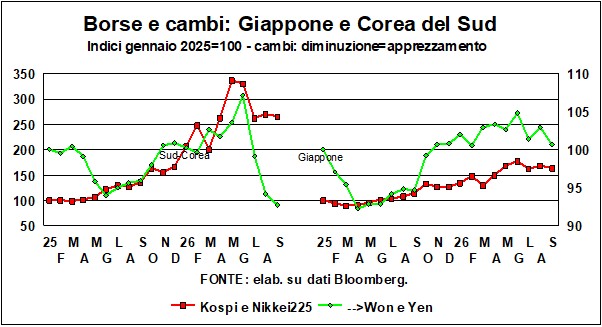
The graph shows how the exchange rate has evolved since the beginning of 2025. yen (against the dollar) and the Japanese Stock Exchange (Nikkei225). The depreciation of the yen seems to have helped stock prices, and the success of the pro-yen operation has been symmetrically accompanied by some weakness on the stock market. Japanese stocks, however, have also been helped by other factors, first and foremost by the Japan's good positioning in the booming AI products market. As for the discrepancy (already noted in recent days) between the yield gap between T-Bonds and JGBs on the one hand, and the Yen/US$ exchange rate on the other (a positive gap should damage the yen, a narrowing gap should strengthen it, which has not happened for two years), the latest trends do nothing to resolve it.
The first panel of the graph shows the performance of the South Korean stock market (Kospi) and the change of the won against the dollar. Here too, the stock market-exchange combination suggests the same considerations made for the Land of the Rising Sun, even if the collapse of the won was much stronger. A strange country, South Korea: the incredible profits The dividends made by companies supplying the booming demand for AI development, in addition to benefiting employees with massive bonuses, also led to one-time distributions to shareholders: these extraordinary dividends (approximately 150 trillion won) must be paid in won, and since Samsung and SK Hynix are roughly half-owned by foreigners, the companies in question had to buy won—or convert the dollars earned from sales into won. The government also benefited from these immense profits: taxes on profits of the companies have allowed to increase public spending expected to grow by nearly 13% next year, a record percentage…
The stock markets, resilient but doubtful
The storm on bond markets it should have, as happened in the past, also hit those equityAnd in fact the stock markets did not fare well, even if the impact on the economy was less strong than had been feared.
On both sides of the Atlantic the retreat was modest: compared to historical highs Stock prices in the US, Germany and Italy are lower by only 2-4%. Different from what happened in Asia, where in the last few months the stock market surges have been exaggerated, especially in Japan (today -12% on the highs) and maximum in South Korea (-26%).
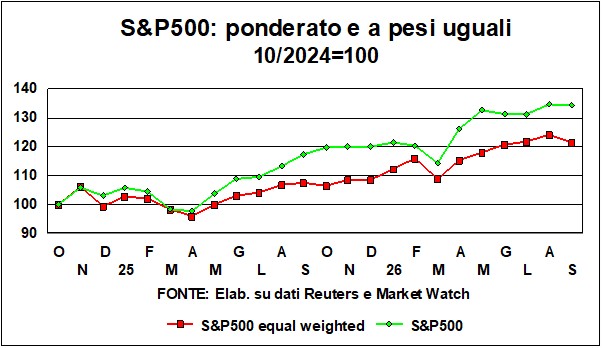
- Usa boast the greatest resilience. Perhaps because the S&P500 index is influenced by the plump profits of the Magnificent Seven? In fact, an alternative measure of the S&P 500, which gives each of the 500 companies equal weight (see the chart, which starts with Trump's election), has grown less than the regular index. But it has grown nonetheless. Vitamins American stock exchange They are more widespread than you might think…