we receive e we publish the following Press release spread by Hera.
Trieste, a national center of energy excellence
Following the completion of the SmartGrid project, funded by the National Plan for Regional Development (PNRR), which saw the strengthening and development of Trieste's electricity grid, AcegasApsAmga is now enabling a flexible upgrade in the city's energy management. This result was achieved using technologies developed in 2020 by Areti and now operational on Rome's electricity grid, thanks to the RomeFlex project.
To this end, LiveGrid, the pilot project for local flexibility services on the electricity grid, was officially presented to the Trieste area this morning. This project places the regional capital among the top Italian cities for this type of innovation.
By means of this live network This will enhance the ability to modulate energy consumption and production based on the needs of the electricity grid. AcegasApsAmga is among the first distributors in Italy to implement this type of experiment, making Trieste an increasingly advanced city in the energy transition.
The LiveGrid project is currently the subject of a public consultation with the aim of collecting and soliciting comments, contributions, and proposals from stakeholders, including on the AcegasApsAmga website at the link: Communications pursuant to ARERA AcegasApsAmga resolutions
What is meant by Flexibility Services?
The pilot project tests new local flexibility services that allow the electricity grid operator to ask businesses, plants, or storage systems to temporarily modify their energy exchanges with the grid through market mechanisms. When necessary, users can increase the energy they feed into the grid or reduce their consumption ("upward service"), or do the opposite, decreasing their energy feed or increasing their consumption ("downward service"). These actions help maintain the stability and efficiency of the electricity grid in the affected areas.
Users will no longer produce energy in a unidirectional manner, but will coordinate quantities and schedules, optimizing the balance between production and consumption. This will maximize production and consumption needs, ensuring efficiency, stability, and continuity of service in a context of growing, distributed generation.
A technical workshop to launch electrical flexibility in Trieste
This morning AcegasApsAmga together with the Polytechnic University of Milan, the Energy Market Manager GME and Areti
They involved all the local industrial entities in a workshop to present LiveGrid, the innovative project for the flexibility of the electricity grid.
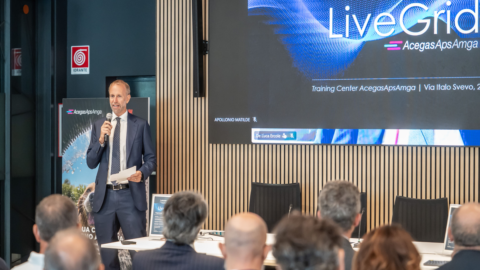
In the new Training Center of the operational headquarters in Via Svevo in Trieste, the CEO of AcegasApsAmga, Carlo Andriolo, opened the workshop by exploring the technical aspects and operating methods in a discussion with stakeholders as part of the ongoing consultation. "With LiveGrid, AcegasApsAmga SpA is taking another step in the evolution of the electricity infrastructure, experimenting with a model that aims to make the grid increasingly flexible and efficient, encouraging the integration of distributed generation and new loads associated with the growing electrification of the city."
Andriolo's speech highlighted how LiveGrid rightfully ranks among the national cases of excellence for innovation and sustainability, and is the result of a broader project smartgrid on the city's electrical infrastructure, financed by the PNRR with an investment of over 26 million of euros, which also includes some interventions in Gorizia.
Creating a new energy culture in the region: involving BSPs
With the intervention of Paolo Manià of AcegasApsAmga The development opportunities for the area thanks to LiveGrid and its innovations were explained, as well as the possibilities for participation of BSPs.
The workshop involved the Balance Service Provider, market operators who aggregate customers with the ability to modulate their consumption or energy production who, thanks to storage systems, generation plants, electric vehicles or the coordinated management of their loads, will be able to make this flexibility available and take on the role of balancing service providers.
Future scenarios for the energy transition
The future scenarios of the energy transition have been explored by the Polytechnic University of Milan, which has offered an independent perspective on the development of renewable energy, of the new actors in the system and of the concept of flexibility, through the interventions of the Professors Maurizio Delfanti and Davide Falabretti of the Department of Energy.
The example of Rome: RomeFlex case history leader
LiveGrid represents an innovative initiative developed in continuity with similar experiences already implemented by three other Italian distributors: Areti in Rome, Unareti in Milan, and e-distribuzione with the EDGE project. LiveGrid is being adapted for the municipality of Trieste by 2026, and is currently being studied for the municipality of Gorizia as well, starting in 2027.
The best practices of the Capital, the first city to implement the optimal exercise of flexibility markets with the RomeFlex technological platform in 2023, have been examined in depth by Ercole de Luca, Head of Electrical System Development at AretiDespite the characteristics and complexities of a territory different from Trieste in terms of morphology and population density, Rome has led the way in the sector, offering a virtuous example and constructive dialogue, and showcasing its skills and experience, even exporting them abroad.
The Local Flexibility Market
To provide a framework for the national context, it was Stefano Alaimo of GME, Energy Markets Manager, which developed the Local Flexibility Market (MLF), the trading venue through which distribution network operators can procure local ancillary flexibility services. This platform helps select the most cost-effective resources through market mechanisms, which are instrumental in resolving congestion on local networks, complying with the Network Code on Demand Response that the European Commission will adopt by the end of the year to define harmonized European regulation for flexibility services. In the first two pilot projects (RomeFlex, MindFlex), 61 forward auctions have been organized to date with the participation of the various Balance Service Providers registered on the GME platform.
The foundations towards the network of the future
He closed the workshop John Piccoli, Network Director of AcegasApsAmga Confirming the importance of this project for the future of the city's electricity grid: "This year, with the Smart Grid project, also implemented thanks to contributions from the PNRR, we have laid the foundation for energy development today and in the coming decades. LiveGrid is an innovative flexibility initiative that we are proud to share with all local stakeholders for the benefit of the city and the citizens of Trieste."